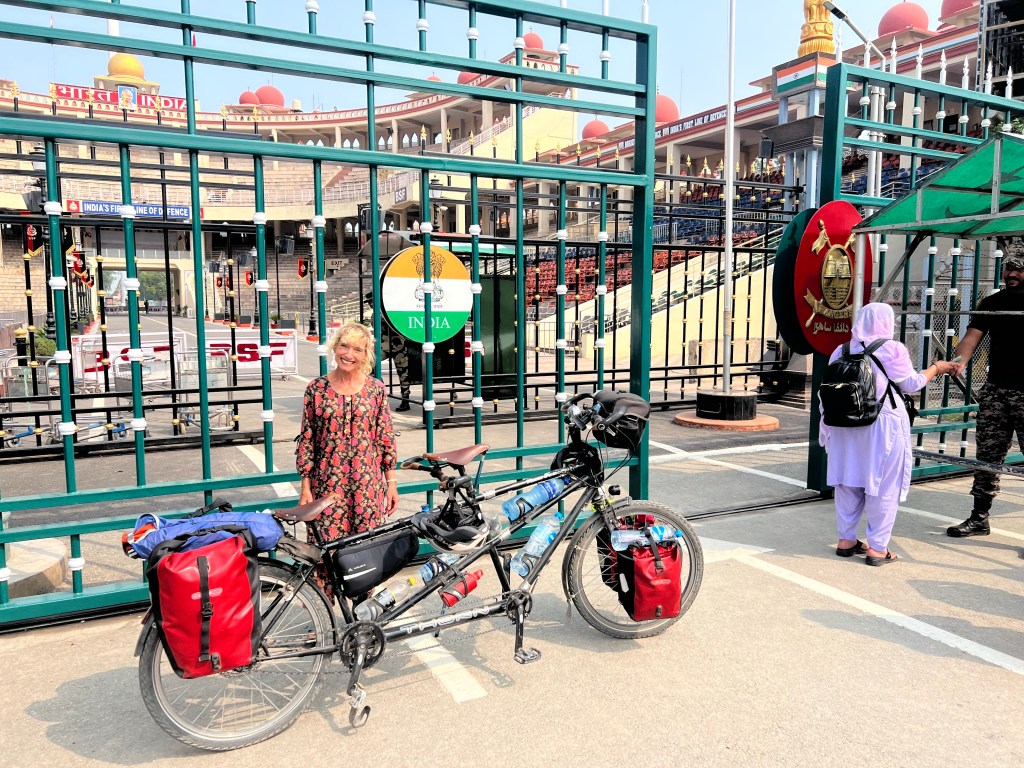
We left behind the painted trucks and mild mannered folk of Pakistan as we passed through the symbolic gate that the night before had been the stage for the elaborate comical patriotic border display, and crossed into India. Bureaucracy teased us as entries were recorded in books as well as on computers, just in case of what, we thought! Scrutiny of our visits to India from four years ago showed missing information about our exit when we crossed into Myanmar. “Why haven’t we got our old passports with us to show the exit stamp”? they asked. Smiling and time resolved the situation and we were eventually let into the country, feeling slightly irritated that India remains unchanged when it comes to this sort of thing.
It was refreshing to see brightly dressed women and girls confidently going about their days. Such a contrast to Pakistan.
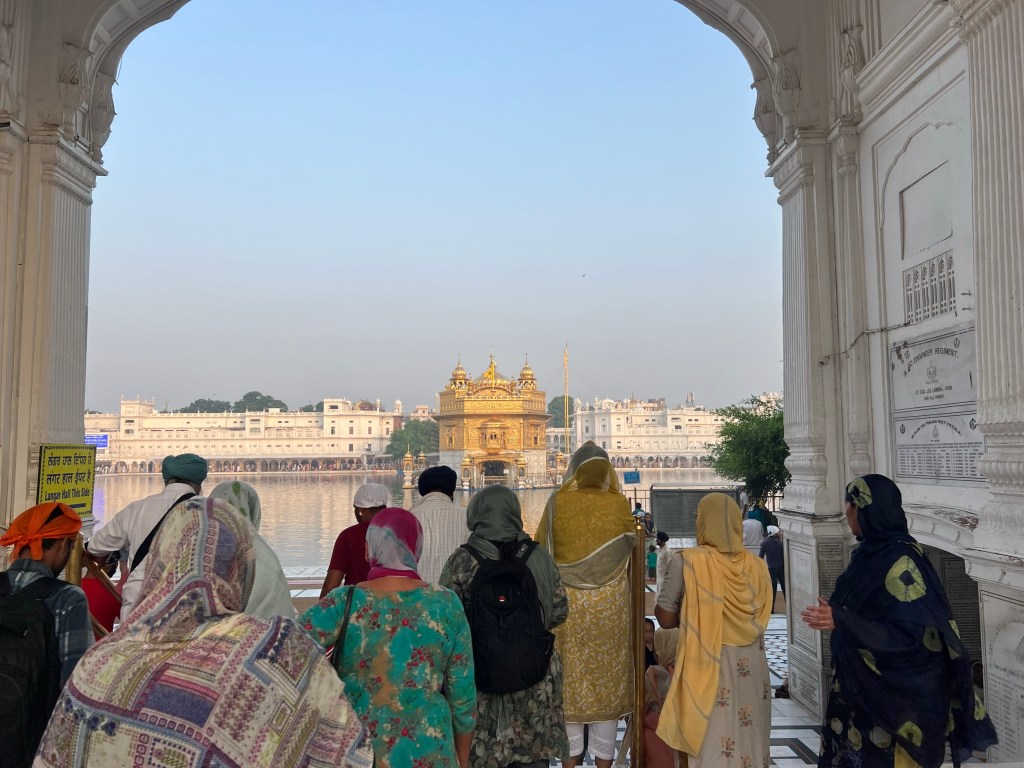
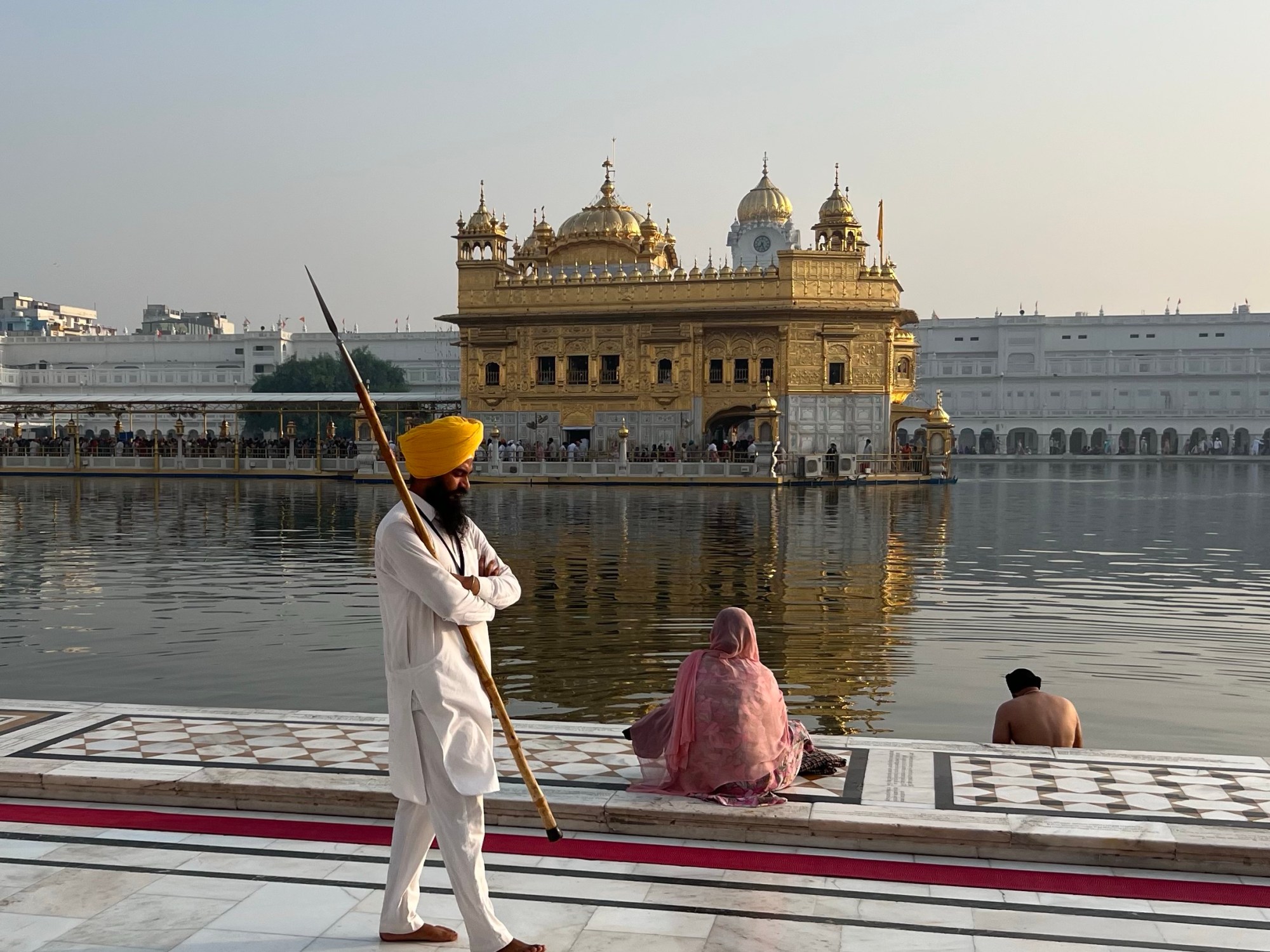
Our gateway to India was Amritsar, the spiritual centre of the Sikh religion and home to the Golden Temple.
What a great start to this amazing country that we have visited so many times before. Apart from France we have visited India more times than any where else in the world spread over nearly forty years. My first time in India was actually in 1975 when my mum bravely brought us five kids to India by cargo ship to Bombay. Around 1990 we travelled for a few months in this fascinating addictive country and this is when we first discovered travelling by bike was so good with a cycle tour on Indian bikes from Kerala to Tamil Nadu. A trip with our daughters trekking in the India Himalaya and bike tours in more recent times, we have seen the country change a little but there is something magical that remains constant, the street scene of so much going on, brightly coloured markets, the hustle and bustle of individual commerce going on everywhere, the devotion to Hinduism, the old holy man dressed simply, his gnarled face framed by orange head cloth, people bathing at ghats in the morning light, black and yellow auto rickshaws menacingly buzzing about, this is what makes India a great place to visit.
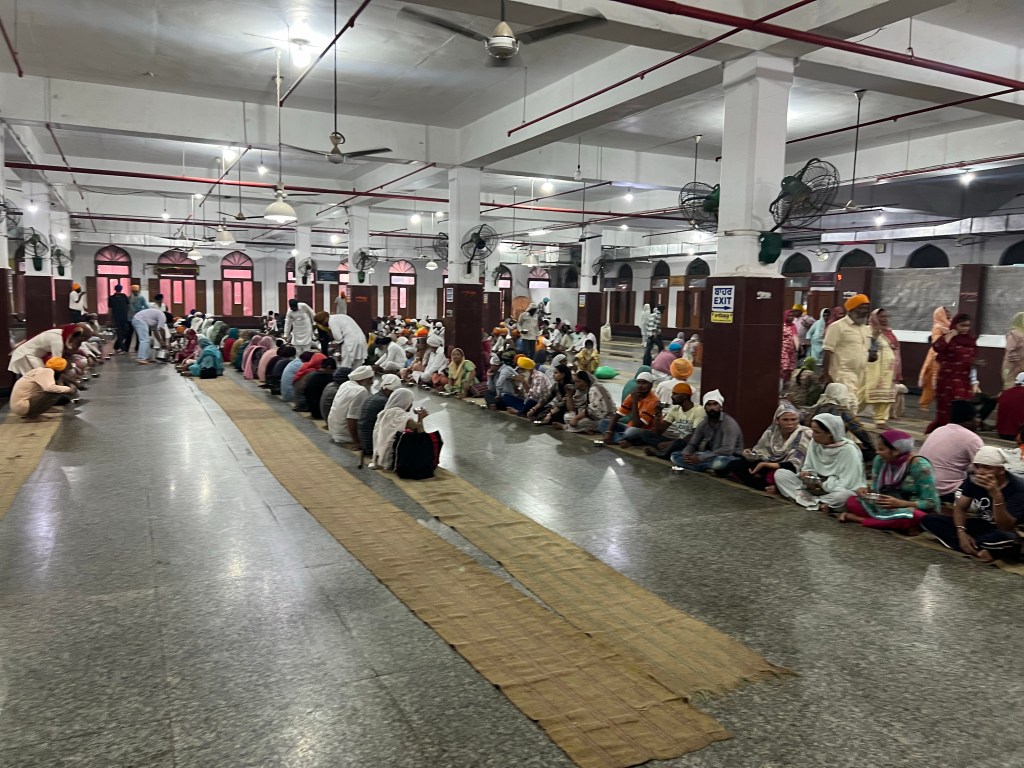
A morning visit to the golden temple was a powerful experience as we joined pilgrims and walked clockwise round the huge water tank that surrounds the temple itself, shimmering and shining gold catching the orange sun and perfectly reflected in the still water. As with all Sikh temples (Gurdwara) free food is always on offer to all visitors. At the Golden Temple this was on a vast scale, some 20,000 meals a day are given out, all served on stainless steel trays, catering on a huge scale and even the washing up was a spectacle.
We set off across the Punjab countryside, verdant green with rice growing everywhere on an industrial scale, huge level fields skilfully irrigated and flooded to the correct depth using a series of canals and channels bringing water hundreds of miles across the north of India. White domed Gurdwara dotted the lush green land.

Quite built up villages with modern buildings, a sign of the areas farming wealth, came and went as we picked our way south through the Punjab. Striking looking elegant elderly Sikh men sat in groups under the shade of a banyan tree at each village. A smile and wave as these two strange people passed their world for a short intrusion.
A disruption “We slept terribly last night so today has been tough. The odd resort I mentioned yesterday was somewhere we saw on Google maps. You often get places called resorts! that are wedding venues and they have rooms so can be quite good. Well this one seemed like this but it became more and more peculiar! The hotel was in the form of a concrete cruise ship and there were all sorts of other weird concrete buildings in the shape of the Eiffel Tower and the taj mahal, plus other strange themes. A guy who spoke English explained more to us. We were on a 1000 acre site that included hospitals, posh schools, a sports complex and fancy housing and farms. It was all part of a religious cult, this gave us the creeps. It got worse when we googled the current Gurus name, he had been convicted for rape, murder and been accused of ordering of 400 castrations. We slept very badly after reading this and it was quite a relief when we cycled free of the place at first light! The guru was sentenced to life in prison in 2017, but seems to be able to get stretches of 50 days parole quite easily! We cycled fast that morning and it was a relief that we had no trouble leaving.
We realised we were nearing Rajasthan when we saw hefty camel carts. Absurdly wide Punjab grass trucks carrying animal feed were a regular sighting. Colourful Hindu temples began to replace the Sikh Gurdwara and soon old crumbling Havelis, merchants houses for the traders of the silk routes across the Thar desert to Pakistan and Iran appeared in the towns.
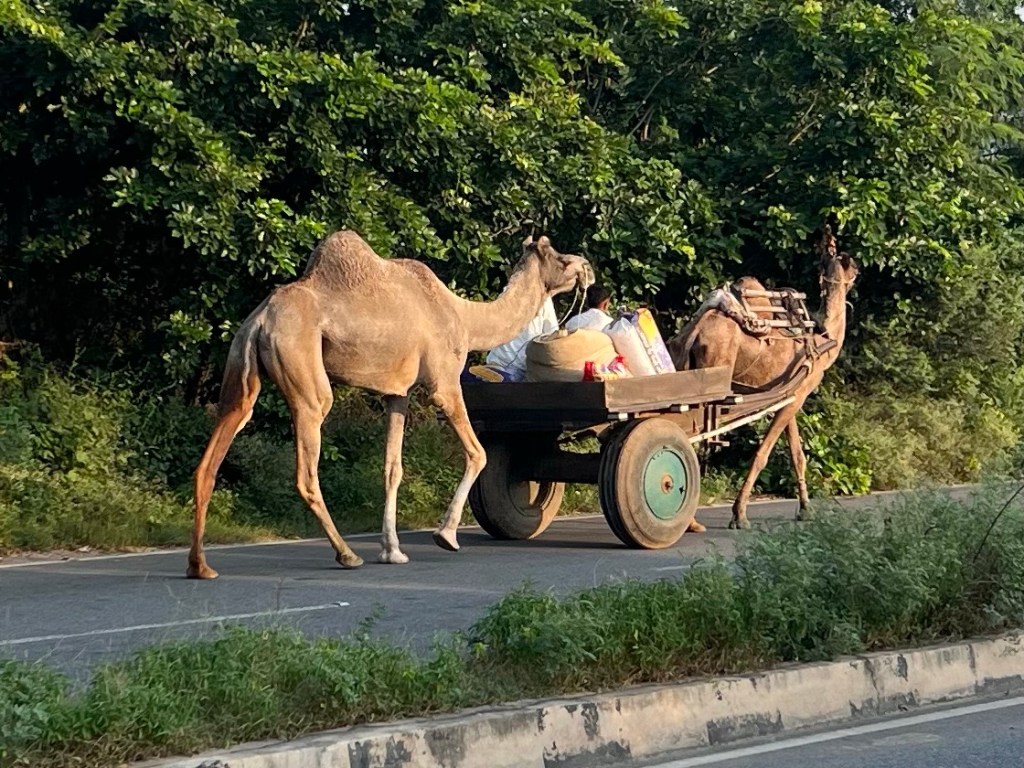
The farming and countryside had changed to grazing of goats and cows and mixed cultivation of things like soy beans. It was dryer and we were near to the Thar desert but arable farming was well organised and productive. The land was a lot greener than we expected mainly due to the best rains for more than a quarter of a century.
The wrinkled weather beaten farmers with a few goats normally walking with their brightly dressed wives were quite a sight. They always had a beaming smile even in the hottest part of the day when they stopped under the shade of a thorny acacia tree. The thin gaunt men dressed in white cloth with bright coloured head wrap looked like Gandhi.
Settling into a routine, cycling the length of India, generally on very quiet roads and tracks. Another day starts, the orange hazy circle of the sun sits low to our side softly illuminating the cultivated landscape. Smoke and steam bellows from a chai stall, the piercing repetitive high pitched bell from a temple sounds, someone sweeps the sand outside there house, school children crammed into a tiny mini bus on their way to school, a thin gaunt farmer and his colourfully dressed wife pass by with their goats, we like witnessing the beginning of another day. This year has seen the best monsoon for more than 25 years and Rajasthans water tanks and lakes are full to the brim. Everywhere is green and fertile.

We are enjoying the lunch stops, samosas or Dahl and chapattis, and sometimes we cook ourselves if there is nothing about, noodles, vegetables and eggs.
We are finding the heat overpowering, 1100 to 1500 our strength is sapped in the sweltering high humid temperatures.
We stay the night with a king and queen in their historic mansion that they run as a guest house. A ruined castle stands high up on a rocky mountain nearby, the families ancestral home in days gone by. These peoples family dates back to the maharaja days and it was interesting chatting to them about their role and challenges they have experienced over time. Clearly a feudal set up with lots of people working their land and being taxed heavily on what they produced but there were some community benefits to the people with pretty much all the local governance being carried out by the local royals who were greatly respected. Independence saw them stripped of power and the system fell apart although they seem to have been assimilated into local government. I guess their challenges were the loss of their high income generated by the workers!
Rajasthan was fascinating, forts dotted the rocky hills perched on perfectly strategic summits, towns with crumbling merchants houses, atmospheric active colourful temples and elaborate fortifications surrounded the ancient settlements of places like Bhundi and Mandu. Both places made for pleasant rest days to soak up the Rajasthan atmosphere.
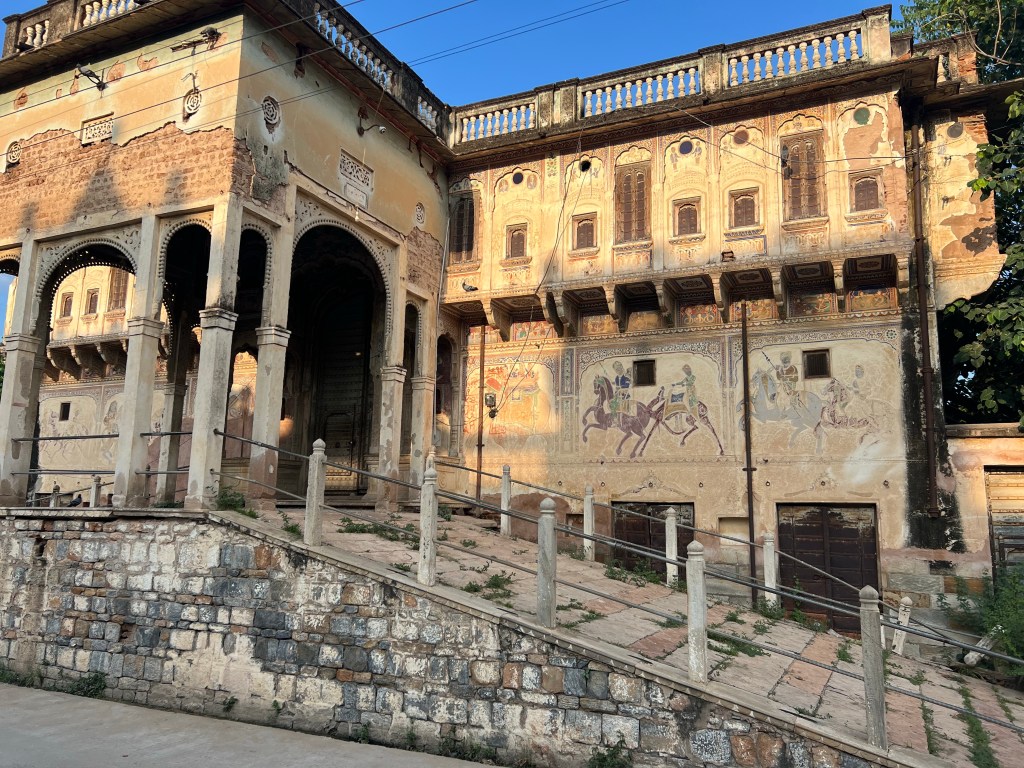
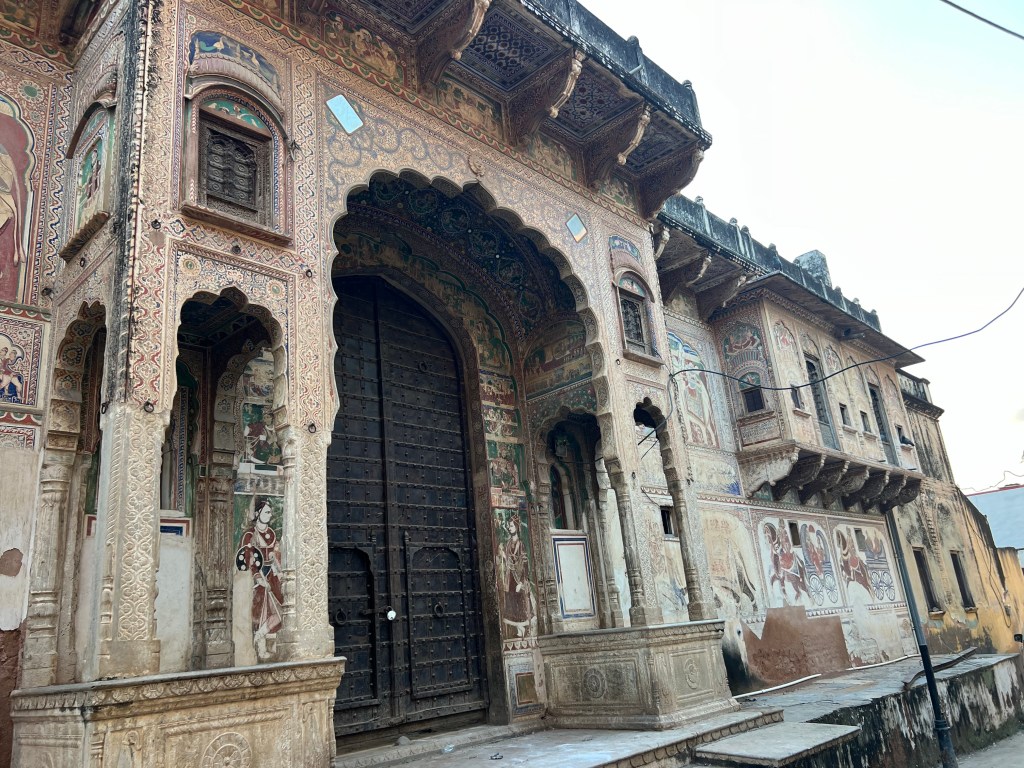


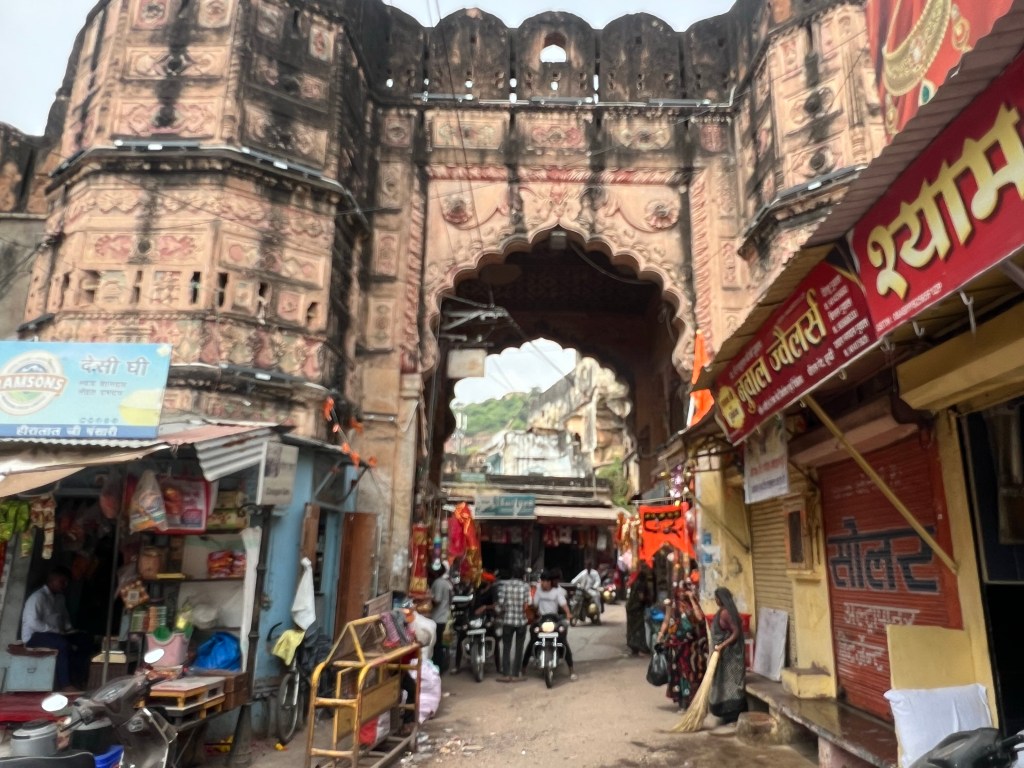
We loved our stay at Bhundi, a real taste of India with the narrow streets, old buildings and atmospheric temples. We left in the dark at 5.30am and cycled through the quiet empty streets, swerving round the sleeping cows. The odd chai stall was brightly illuminated and pans of milk were being heated to make tea. A guy was making samosas and dropping them into a large blackened round pot of bubbling oil. Temples were starting up with a shrill of bell ringing, wafts of burning incense were illuminated in the bright lights, and evocative loud chanting broke the early morning silence. We had the streets to ourselves as we passed ancient buildings and exited through the old town gate to the deserted market area. It was a special departure and a chance to absorb the India we love. India has modernised significantly and is changing. On previous trips we noticed certain changes with more cars and mobile phones which you expect, but there was always something that made the place quintessentially Indian and this didn’t really change over the years. But now no-one walks, preferring to go everywhere by motorbike. This means that the narrow streets of old towns have menacing motor bikes, continually beeping loud horns, wizzing around and you have to dodge them all the time. Hardly anyone uses a bicycle and there aren’t as many auto rickshaws and buses as people have their own transport. It’s progress but it does take away the charm of the chaotic interesting street scene of the past! Somehow it just feels less Indian.
On rough muddy broken roads again crossing tranquil countryside, we stopped in a village, this young lad starred like so many do, but this time his face soon melted into kindly expression and he said, “nice bike, you will not experience the pain of loneliness” ( when talking about the tandem), the words were magical and we set off feeling humbled.
We dropped down the escarpment from Mundu leaving the mighty hilltop walls behind us. We were now in the Narmada valley, a significant river and like nearly all water in India seem to be sacred. Our journey over the days ahead will involve crossing small mountain ranges and several more big rivers. The landscape had changed, farms were small and small villages were much more prevalent, some traditionally built and generally poorer than Punjab and Rajasthan. Ox carts and ploughs started making an appearance too, often working alongside tractors.

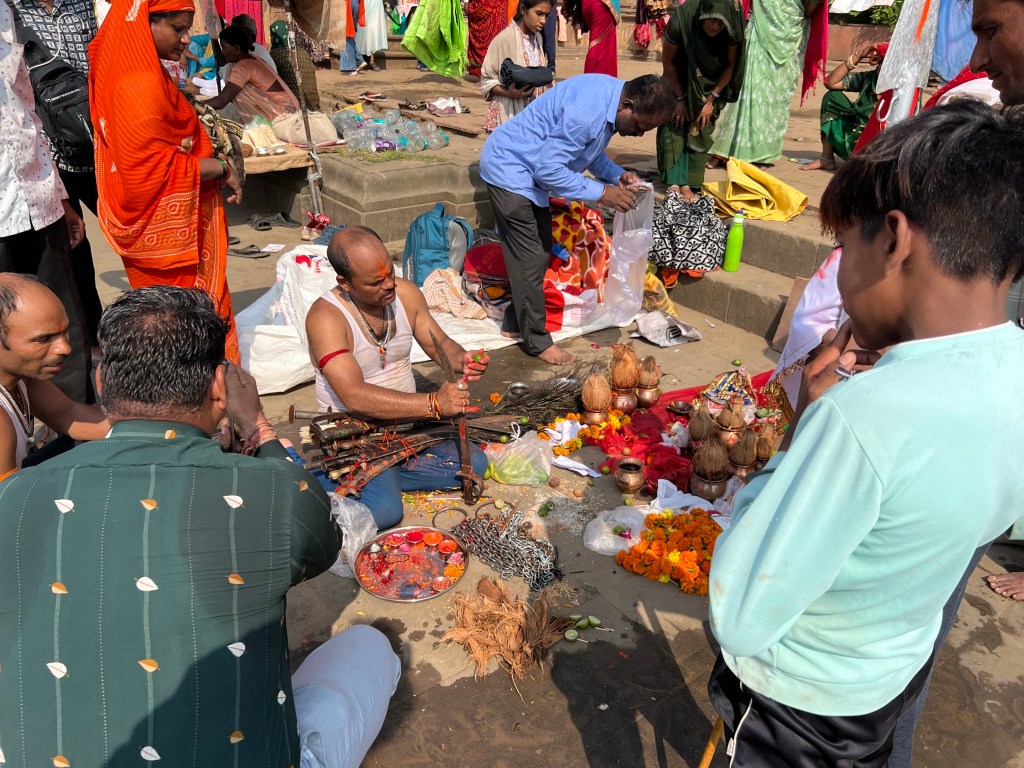
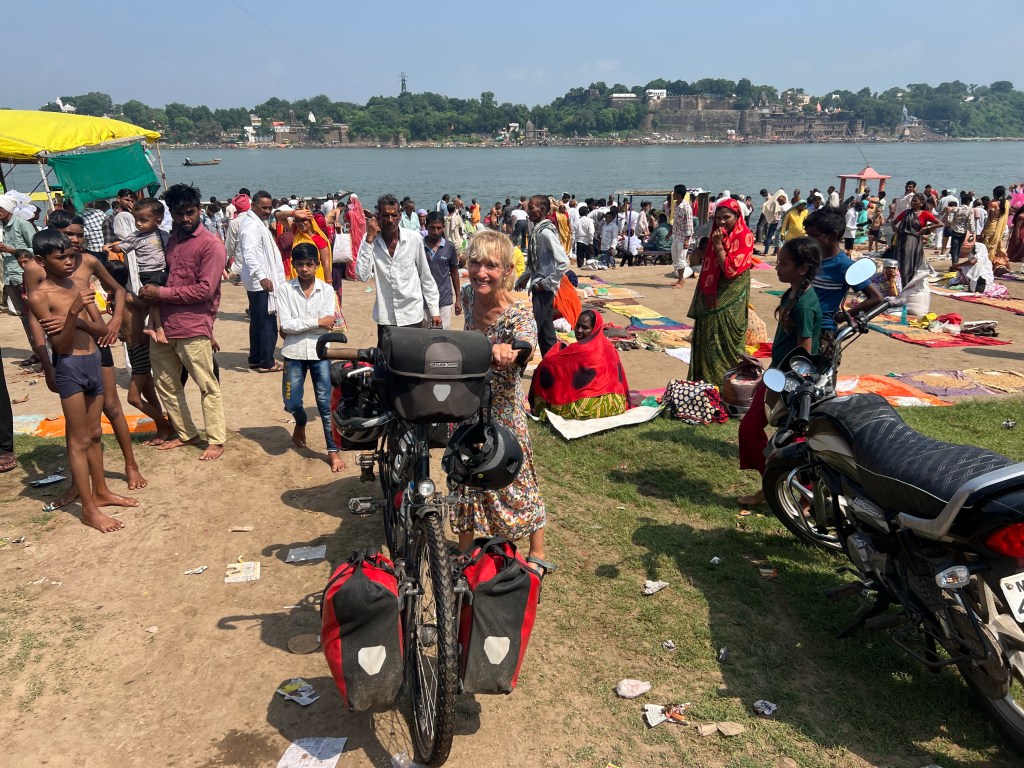


The great thing about travelling by bike is that you stumble across stuff going on like the hoards of pilgrims bathing in the Narmada and carrying out all sorts of rituals and offerings by the river side. Old elaborate stone temple complexes clung to the river bank peacefully looking down on the devotional activity. We find a boat to take us across the Narmada, a flat bottomed, rickety, slender planked slightly leaky craft with a long tail engine slid across the glassy sacred water to the other bank. We left the spiritual ambiance of the smooth stone ghats and looked back at the devotees immersing themselves in the water and casting off many small clay pots with burning incense.
We are traversing the undulating Deccan Plateau, the central part of India which is flanked by the coastal ghats on each side. We have chosen this inland route to cycle the length of India in the hope of quieter roads.
We are lucky that the majority of the time we manage to ride on tiny quiet roads, but India is highly populated, you are rarely alone and we regularly pass through villages and towns which are mostly surprisingly big and busy.
Lunchtime we hide down a track in the cotton fields for a cook up of vegetables from the market, topped with parsley and cashews and a brew of coffee. The song of birds fills the air. We are alone and it is pleasurably peaceful. India is so great for food but when all you can find are cold samosas that don’t look all that good it is nice to escape the persistent stares from crowds of men that soon gather, and find some seclusion. Not always easy but we cycle along and when the ‘coast is clear’ we dart down a track and find the shade of a tree where we are hidden. We muse on the days lovely encounters at a chai stall we have stopped at on the edge of a farm and all the brightly dressed people that wave from the fields where so much is going on. But sadly there is a menace in India! Thats the ‘Selfie Hunter’, It’s always been a tough country to travel in compared with other places we have visited. Typically you have a love hate relationship with the experience. It’s a fascinating lovely country that has drawn us in many times but there is nowhere else where boundaries of personal space, persistence and annoyance are pushed to such a limit. The Selfie Hunters are young to middle aged males usually on a motorbike and they aggressively need to get selfies to post online. They swerve in front of us and try and get us to stop shouting abruptly, “stop, stop, give me pic, just one selfie” They swarm round us like some irritating insects continuing with their demands which they repeat over and over again never tiring it would appear as they coast alongside us nearly pushing us off the road. They are worse in late afternoon when we are quite exhausted and when coming into a town for the night. Sometimes complete chaos breaks out on the busy road as more vehicles, rickshaws and cars too, sometimes the odd lorry and bus, all start videoing us, driving like maniacs and not looking where they are going. We struggle to find a way through, getting squeezed onto the last strip of rough tarmac before we fall off the edge dodging the people that are driving on the wrong side of the road which is completely normal of course. All this to get us to stop for a selfie! If we do stop which is a strategy we have tried, you get prodded, pushed around and shouted at to stand next to different people and it goes on and on as more selfie vultures come out of the woodwork. Even when I have been fixing a puncture in the heat of the day pouring with sweat, you get some selfie wannabe snuggling up with you, smart phone in hand!
At the end of a long day this becomes tiresome and this really is the biggest challenge to our strength for completing “Cycling the Length of India”
Progress is good, we push on cycling over 100km a day, sometimes upto 150km. We are partly fuelled by the desire to complete the journey and maintain our sanity above the annoyance factor.

A morning bike ride got us to the amazing spectacular Ajanta caves. Large Buddhist monasteries cut into the cliff side over 2000 years ago on a meander of a beautiful river with surrounding jungle. I visited this place in 1975 when my mum brought us five kids to India on a cargo ship from Dubai to Bombay, quite a brave adventure back then. It was a rough crossing of several days going through the monsoon swell. We traveled unreserved hard seat on a train to Aurangabad, a journey of some ten hours that involved a change of trains in the middle of the night. Aurangabad was our base to visit the caves of Ajanta and Ellora back then. Picture in your mind a lady in her 30’s with five children aged between 6 and 12 arriving at Bombay seaport and travelling on Indian trains unreserved hard seat! Oh and we didn’t have rucksacks, but had globetrotter suitcases!

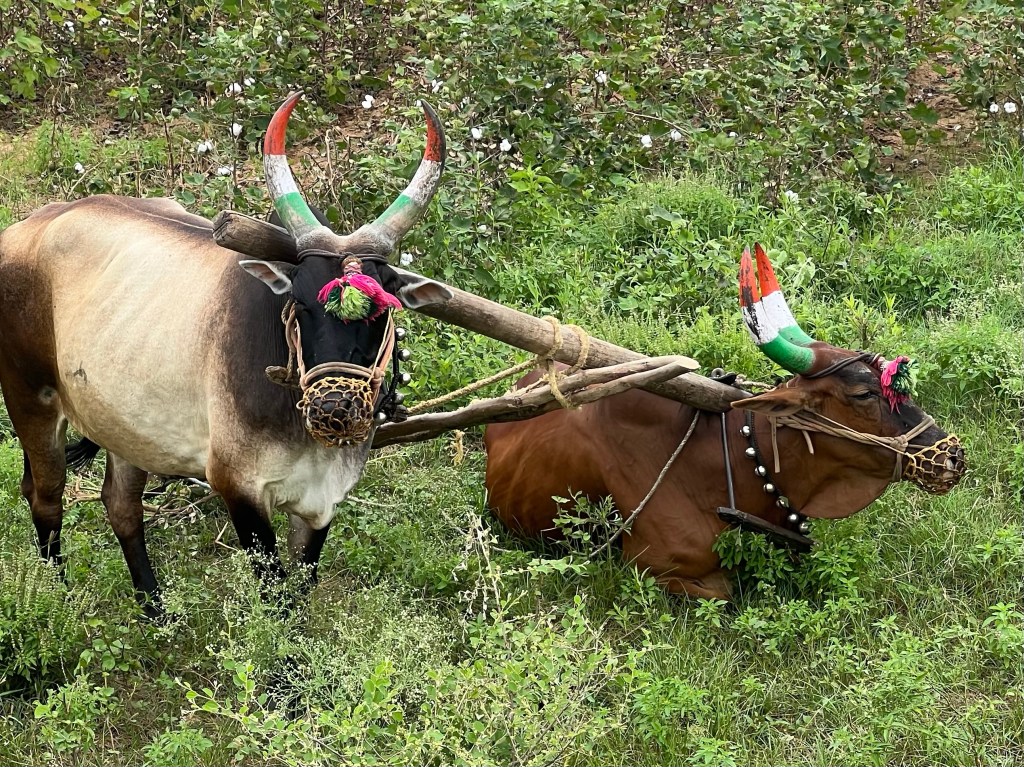
The truly rural Indian scene came and went. Sometimes rolling green hills, but mainly well organised neat cultivated land growing cotton, corn, pulses and chilli. Ox carts were more common and the occasional plough alongside more mechanised farming. The ox ploughs are often used for scarifying the earth to ease weeding. The ox fit between the mature plants while the plough is pulled amongst the crop cleverly without causing damage. We love watching the cultivation and the determination of people to farm everywhere. As the day comes to an end people are still frantically threshing pulses in the last of daylight, desperately trying to get the most done before dark.
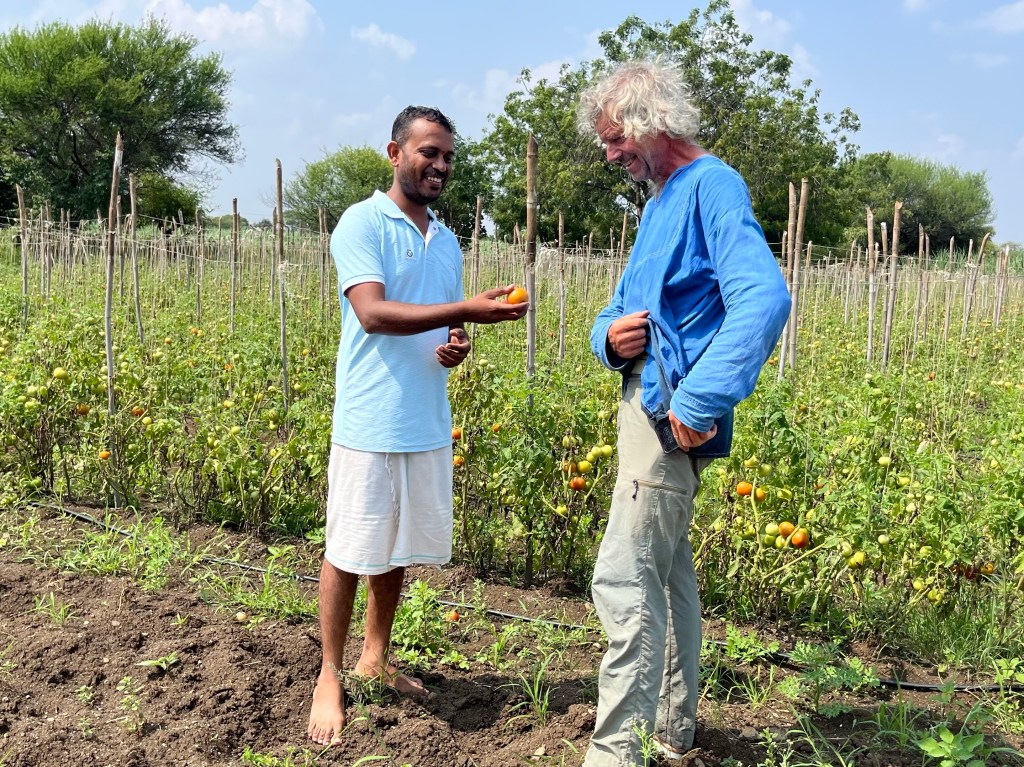
Remote at times today….Fixed a puncture today rather cheekily in the shade of some trees in someone’s garden. The lovely owners came out, Ganesh and Shilpar, a software engineer and a master in chemistry, they had left the city life and run this little organic farm! They brought us tea and lovely tomatoes from their plot.
Later in the day a lovely stall holder wouldn’t let us pay for some bottles of water and insisted on giving us tea too. We sheltered from torrential rain in a shop in a small village, a small crowd of women and children gathered along with the shop keeper, all intrigued by these two strangers. The shop keeper insisted on giving giving us some Cadbury dairy milk chocolate! Lovely kind people.

A day through rolling very green farming landscape on quiet well surfaced roads. So often the minor roads have been good tarmac, sometimes they deteriorate but there clearly has been lots of investment and big changes have been brought about by government rural policy. As controversial as Modie is lots of things have changed for the better with infrastructure, development of agriculture and a much less poverty.
We stop for omelette and sweet milky coffee at a village stall run by two brothers sporting their football style tea shirts that commemorate their recent pilgrimage to an ashram. Again there was no way they would take any money for our food, coffee and water. So kind and a genuinely lovely act from two young jolly lads. We had a rest day in the interesting city of Kalaburagi, it’s predominately Muslim and a pilgrimage centre. A real bonus there was no selfie brigade as we approached the town in the late afternoon.

Busier roads return, lots going on, a street festival, lovely school kids, and we stopped to cook up lunch hidden away behind a haystack on the edge of a chilli field. We cooked aubergine and pepper omelette with salad and mayonnaise and made chapattis with Ganesh and Shilpas organic flour. They were great. Just as we were finishing our lunch the farmer wearing a chequered longi and his wife in a brightly coloured saris arrived to do some weeding of their plot. They were quite surprised to see us and a tandem parked on their little farm. Then a few moments later two youngsters turned up on an ox cart. Decoupled the oxen from the painted wooden cart and led them to a cotton field carrying a plough over his shoulder. They were soon set up and ploughing with the oxon between the cotton plants to prevent the weeds taking over. It was a magical agricultural scene. We enjoyed our chapattis and thought of our visit to Ganesh and Shilpas farm a few days ago. We had half the bag of chapatti flour left over so gave it to the farmer and his wife as a very small gesture for the intrusion into their lives.

A big change is the aggressive selfie hunters have gone! Don’t know if it’s because it’s more Muslim or just getting further south it’s different. The south when we visited in 1990 was always more chilled than the north so let’s hope this continues. Loads of people still film us but that’s not the problem we appreciate we are strange, it’s just the aggressive rudeness of it all was so weird and we are more than double their age but manners and respect just didn’t count for anything. Today we snapped both chains which while fixing a crowd of at least 20 plus four auto rickshaws and numerous motor bikes gathered for a long stare, but no one pushed in trying to get selfies. We have been to India many times and the relentless stares and attention, unique to India is what you expect and you get used to it. But that unpleasant selfie nonsense was impacting on the trip. It felt so much more positive today and yesterday, just having lovely warm interactions as we normally do.



Bangalore looms ahead, 12 million people and dubbed the IT capital of India! Still feels pretty Indian though, but nice to have an Indian Pale Ale in a trendy microbrewery and spend a night in a fancy Airbnb in the verdant hills to the south of the city.
Came down through the Nilgiri hills on small roads through lush green cultivated land and large areas of coconut palm plantations. Up and over forested hills before dropping down into more populated areas as we approach the sacred Kaveri River. The sheer number of temples, large and small, and sometimes just a few painted effigies, is astonishing. Every village has multiple places of worship. By the end of the day every house or small business seemed to have the clatter of looms working away frantically, weaving saris. More and more the menace of the selfie hunter has disappeared as we move south. It’s been quite a while now that things have been chilled. We are now again able to smile and wave at everyone as we always do all over the world. It had got to the point that we were avoiding eye contact with people because you dreaded it leading to them being a pain! Tamil Nadu was always our favourite state back in 1990 and it’s so pleasing that it’s still really great. The Tamil people are so nice and easy going. It’s such a relief as we near the end of our journey through India.
We reached the Kaveri river, drums beating and various offerings being chucked about over a pile of colourful flowers, as some ceremony was being carried out near to the waters edge in front of the temple complex. We stopped for curry and rice at a meals place run by a lovely bunch of ladies. An eat all you like meal for 20 pence really was quite a bargain. Employment of women is so much greater than 1990 and we see no children working. Before eating places always had children clearing the tables and pouring out water, now they are all in school. A fascinating encounter we had today with Ravi, who was back helping his parents on the family farm. He was a first generation graduate and worked for Indian oil. He spoke great English which is really quite rare, and it was interesting talking to him about farming and land ownership. The average size of a farm in India is 2.5 acres and there is such a strong desire to keep the land and hand it onto your children and never sell up! Apparently even in the Punjab where we thought the farms were massive, they are actually multiple small holdings that are being farmed on a greater scale like a cooperative. Most of India however they are just very small holdings farmed by single families, sharing or hiring in equipment when needed. ( A tractor costs £7.00 a day) This is how food production for the 1.5 billion population is carried out. There is no shortage, they don’t rely on imports like in Africa, actually they are exporting rice, spices and pulses, there seems to be an abundance of food wherever you look. It’s remarkable and only in India could this work.
We cross our route of our first bike tour across South India https://tandemtravel.co.uk/2020/04/22/our-first-cycle-tour-jan-1990/ and have a think of how India has changed from back then. We brought our children to the Indian Himalayas in 2006 and although there were more cars and mobile phones not that much had changed. But now India really has taken a leap forward. The controversial Modi has achieved an incredible amount over the last ten years or so. From our view( cycling mainly through rural India) we have noticed: far less poverty, much more mechanised agriculture, and huge advances in the road network. There are expressways, but it’s the rural secondary roads and very minor roads that have surprised us on how good they have been. Infrastructure generally has had real investment and many town centres are a lot more sealed in without ditches to get across like it used to be. Everywhere has electricity even in remote rural places. The very destitute people in towns, that has always been a troubling sight, is a lot less, but sadly now seems to be predominately women and girls. Rubbish is still really bad, with rivers blackened and full of plastic bags, but plastic bottles are generally all recycled by very poor people. There is a network of dealers to sell plastic bottles to. There are alot more really fancy cars and masses of motorbikes, household must have many motorbikes. Wealth does seem to have trickled down through lots of the population which is surprising. Modi has brought in lots of financial help for farmers, young people, poor people, and unemployment and maternity payments. The cast system is still massively restrictive. You have to declare your cast for school applications and probably everything else in life too. Higher education has large quotas for places for low cast people, but they are so often discriminated against making it hard for Dalits to realise their qualifications and careers if they were ever able to get started in the first place.
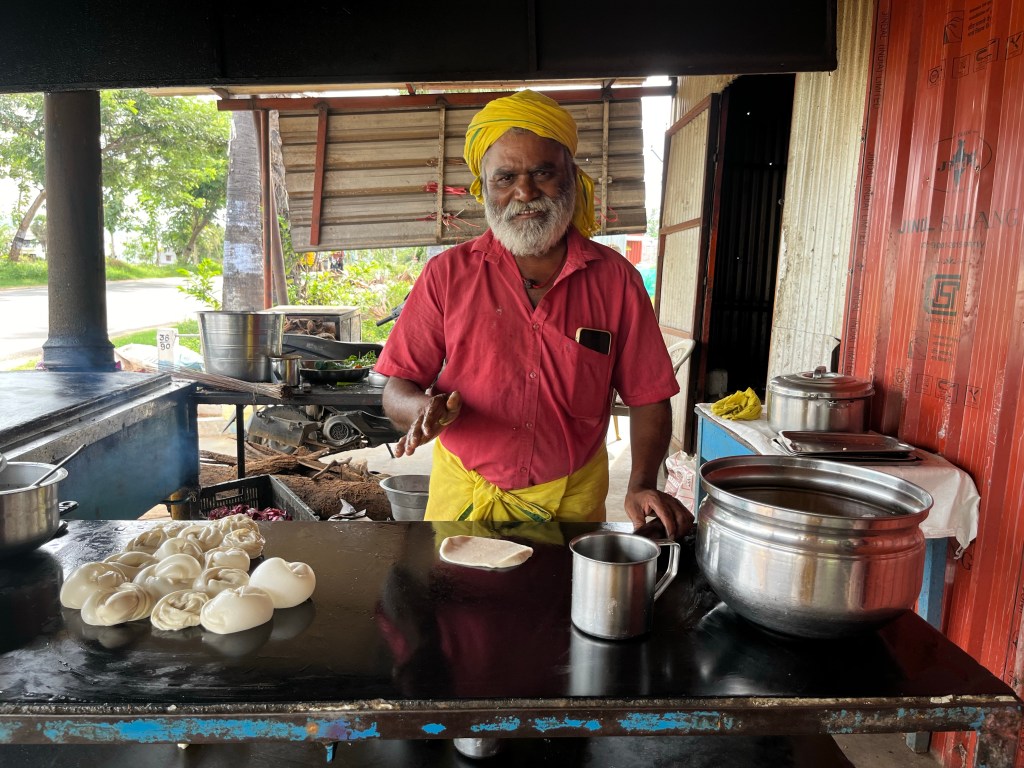
Another great meeting at a coffee stop today. Fascinating talking to Rajah about all things from farming to finance and marriage. Their family stall was outside the local school and again it was interesting to hear about the problems of getting people to work on your farm. Their farm is 4 acres and they have decided to farm cereals now as they can rely on bringing in machines for ploughing, seeding, and harvesting and not rely on labour. A lot of the problem with labour is there are lots of government jobs for poor people doing things like planting trees and clearing up but they have to do very little work and the projects are extremely over staffed. We passed one today and thought it was some sort of protest as everyone one was sitting around! The wage is the same as the agriculture day rate making it tricky to entice workers to a full day in the fields.
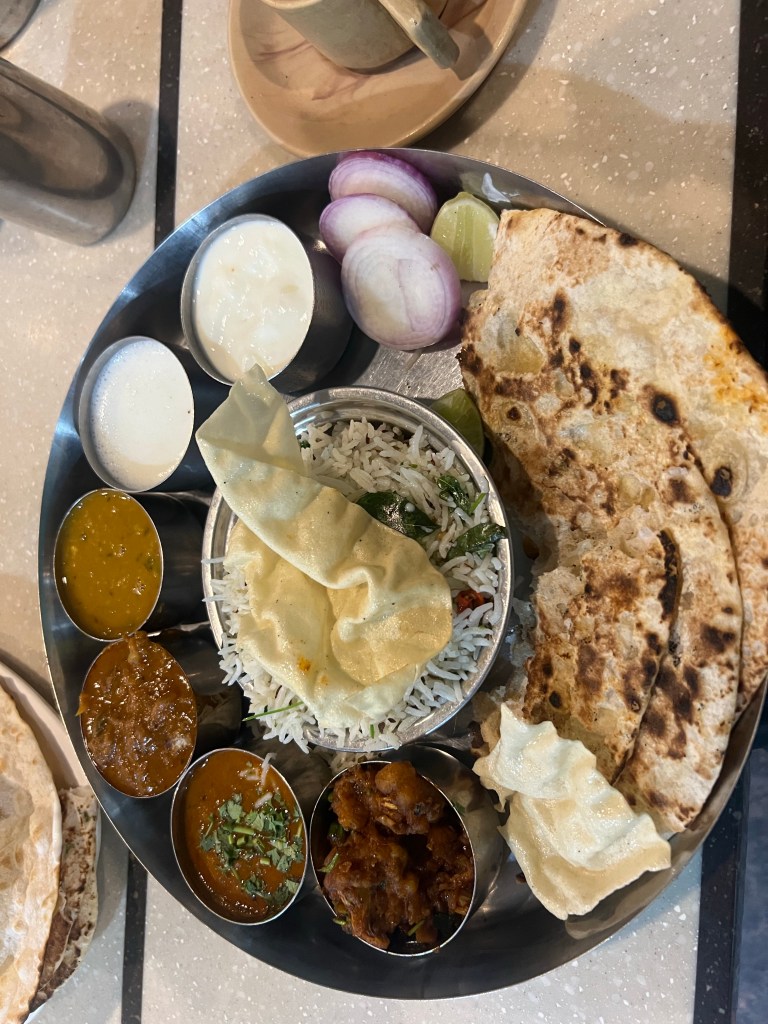
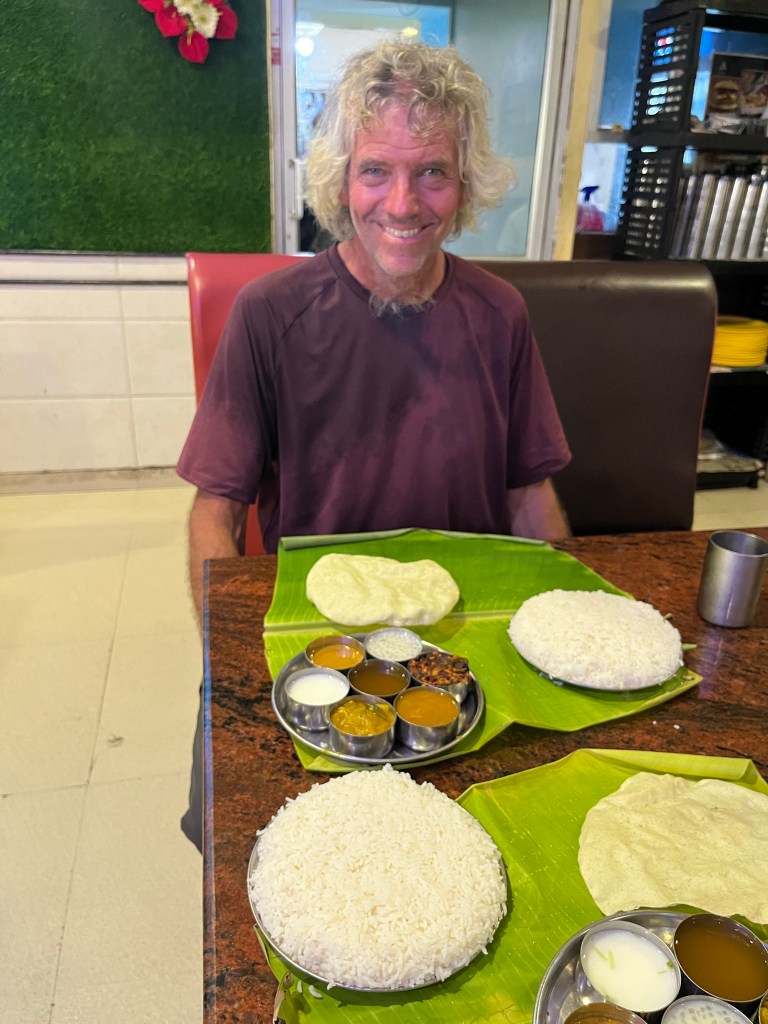
We are truly in South India and loving it. The Tamil people are great and the abundance of eating places is a real pleasure. The lunchtime meal places, a large scoop of rice with various vegetable curries and chutney and curd, all served on a banana leaf, and the classic masala dosas served at other times are a delight.

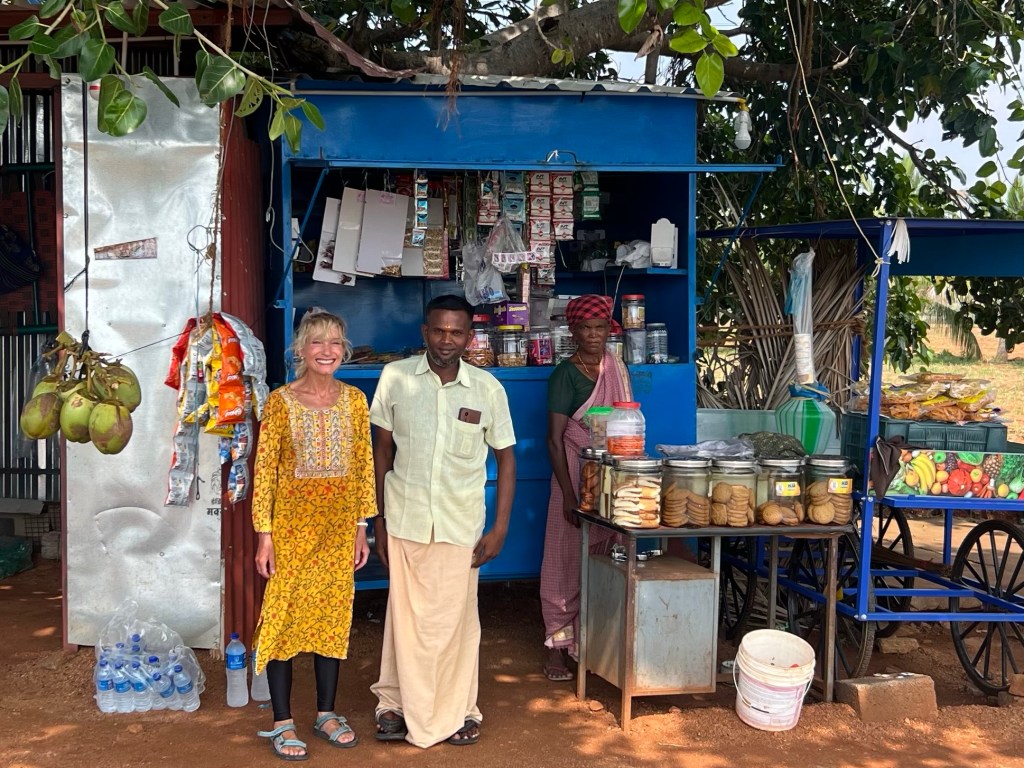
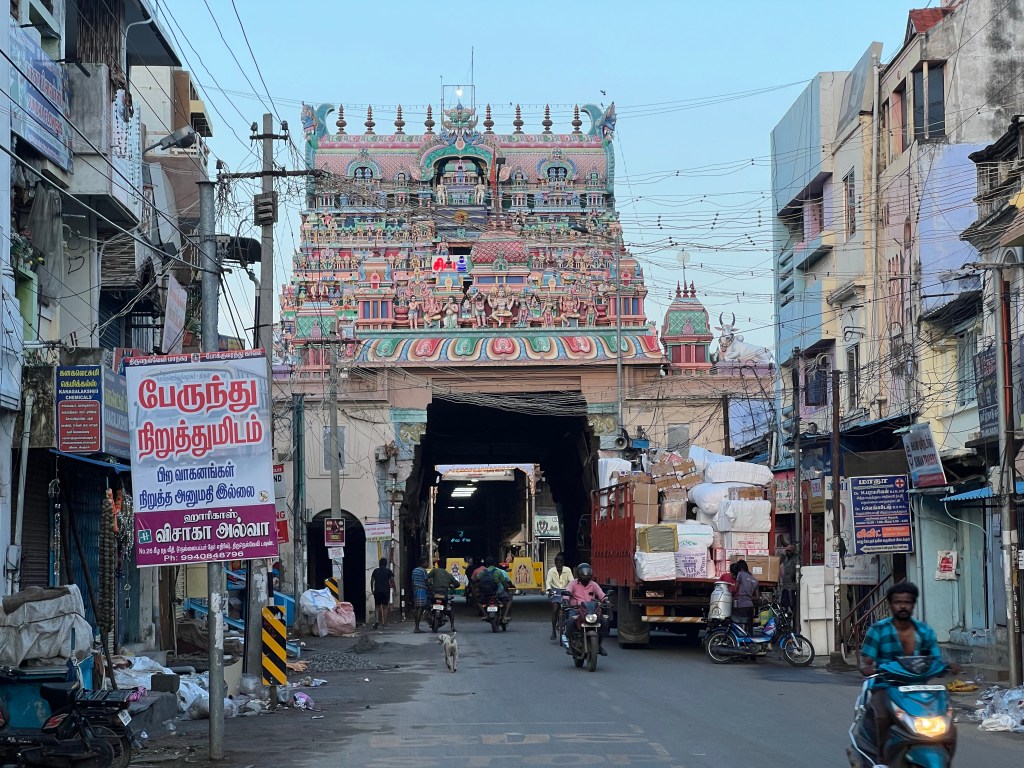
Our last day to Kanaykumari was a wonderful day riding: came across a huge temple complex, nice exchanges with road sweepers and ladies doing some digging, remote muddy tracks at times surrounded by craggy mountains to our right, the last of the Western Ghats, and decaying temples in the countryside. This is what’s great about cycle touring, you just come across so much stuff going on and you are travelling at a speed that you don’t miss out and have time to interact.

We have arrived at the meeting point of the Arabian Sea, the Bay of Bengal and the Indian Ocean, the southern tip of India.

 tandemtravelcouk
Congratulations on the completion of another mammoth trip! India looks like it’s changing but the difference in intensity between the north and south seems to be much the same as I remember it (my first trip there was when we met up in Agra in 1988!). I’m certainly glad there were no smartphones when I rode around the north on a motorbike back then, the hassle was quite enough without them (I think I only found myself truly alone once and that was in the desert!) – you did well getting through them all! The south was definitely much more relaxed (except for possibly the railway stations!). Will look forward to seeing what you do next, perhaps something less exerting?! Lloydy
LikeLiked by 1 person
A fascinating read, and huge congratulations to you both.
LikeLike
Well done you two, and thank you for your fascinating accounts as you travelled.
Love Mum.
LikeLiked by 1 person