

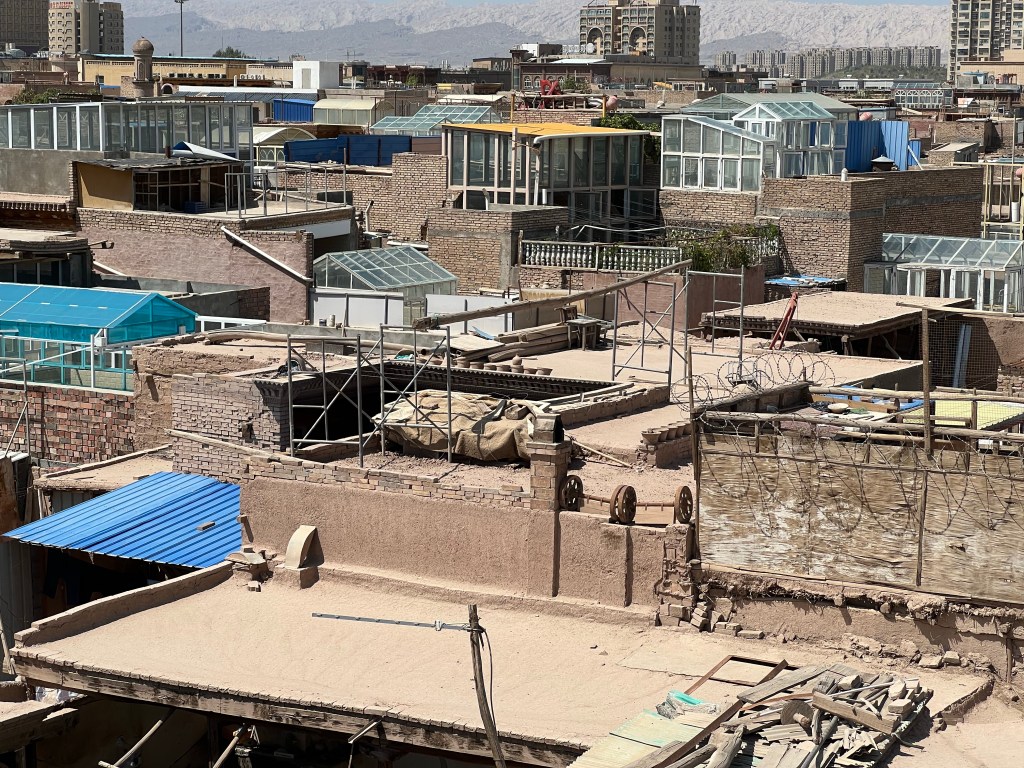
A new day starts in a very different country. We look out of our window from our luxury suite on the tenth floor. The birds eye view gives a fascinating overview. In the distance tall modern buildings dominate the skyline. The large Id Kah mosque surrounded with tall poplar trees sits in the middle distance and low mud and concrete Uygur houses make up the rest of the outlook. An untouched neighbourhood of traditional living, pinned in by modern development, a network of narrow streets and alleyways, and the beige coloured mud houses typically have large glass sections high up, like a large lantern with a tin roof, and sometimes this extends down a high up wall, illuminating a central atrium to the property. An old man is tending to his doves on his rooftop, the birds flutter around the waney pole perches. From the outside the houses dont look much but behind the intricate antique doors a tranquil haven of natural light opens up. The tiled hall with plants and galleried stairs and landings encircle the space leading to the other floors and onto the roof. Ornate carved timber columns support the landings and raised carpeted areas, with fine local rugs, provide for seating, rooms behind grand timber doors lead off the landings. Some spaces are open to the sky and others are enclosed with glass or a matrix of timber slats providing a cool comfortable haven.


Kashgar is a melting pot of so many cultures, a crossroads of people, there are faces from Mongolia Afghanistan, Persia, Pakistan, Kyrgyzstan, Tajikistan, the local Uygur people, and other local ethnicities, and even faces from Europe.
Of course there are the Han Chinese too, but these are mainly tourists in Kashgar, there are hoards of tourists from other parts of China.
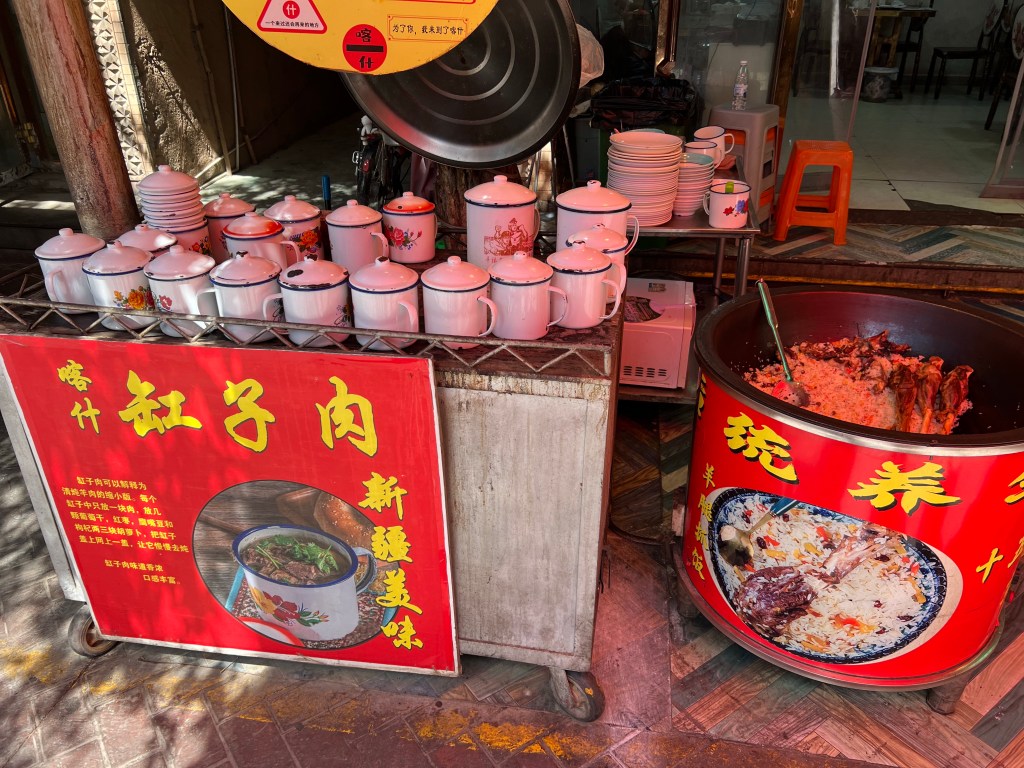
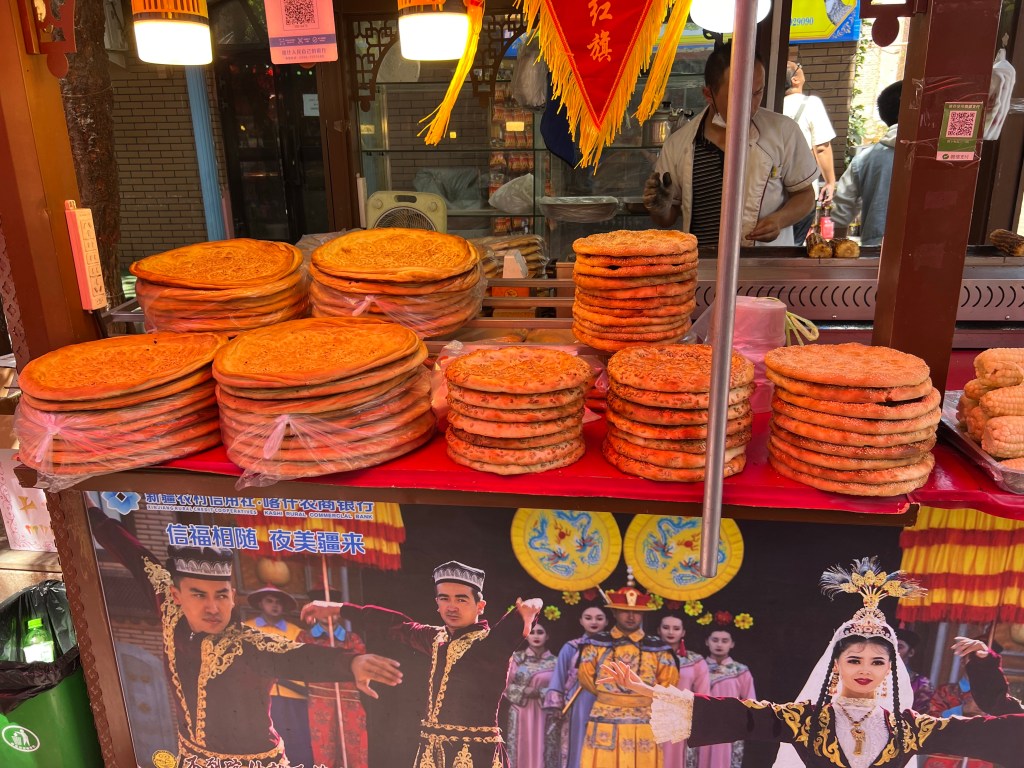
The mood is vibrant, fun and colourful, street food everywhere and vast arrays of nuts, spice, dried fruit, honey, flower petals, and tea on sale from shops and street stalls. Old ladies, hair in long plaits are out wearing their sparkling, embroidered traditional clothes. Back from the main streets in the old town alleyways lead to swathes of Uygur communities that have been spared from the development of the city. Children returning from a day at school play in the streets and then disappear through the old painted doors of their homes.


With some imagination when in the old town surrounded by mud houses in the narrow passages, you can feel the history of the place, this oasis on the Silk Road, the Tacklamakan desert to the east, and Central Asia to the west.
Lots and lots of tourists come from all over China drawn to the diversity of the people of Kashgar. Tour groups, a few friends travelling together on holiday, all ages, and families, in huge numbers. There are no international tourists, they stopped coming after the uprisings in 2009. The main streets lined with shops and cafes seem to be entirely geared up to this mass tourism. We pass two men in a blacksmiths shop forging horse shoes and making nails. Was this for real? Or perhaps a set up! There used to be whole areas of the town where blacksmiths and silversmiths worked but we could find none apart from this one on the main street sandwiched between restaurants and tourist shops.
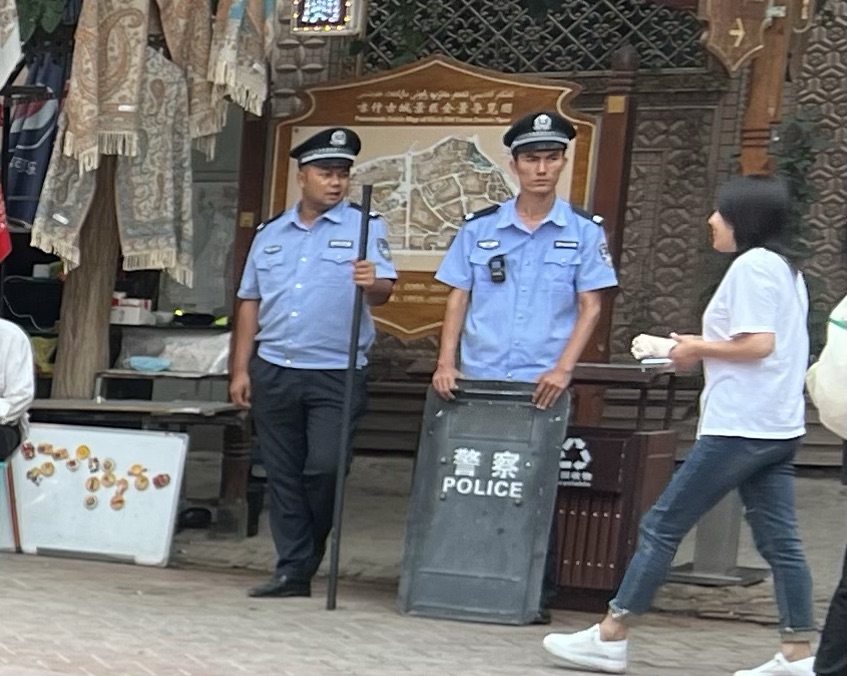
There are cameras everywhere, you rarely pass 50 metres before the next bank of cameras with lights in anywhere that maybe shady. Police with long batons and sinister riot shields stand at each street corner.

There is dancing and music at the east gate every morning and evening. Brightly traditionally dressed Uyghur girls present a rehearsed routine that involves speeches almost like in an opera. We visited the performance along with a large crowd of Chinese tourists that filled the neighbouring streets, and were lucky enough to bump into a guy who spoke English. A very rare find and only the second person we met in four days. He was very frank and open. We imagined the dance and talking was some kind of story telling of the Uyghur culture, but our friend explained it was, a kind of propaganda and the dancers were welcoming the tourists to the peaceful and safe town of Kashgar, that has welcomed people for centuries. The presentation was in Mandarin too. Our friend explained that Uyghur wasn’t taught in school now in the hope that the language and culture would be forgotten, he mutters “this is kind of political” and backs off smiling. We lighten the conversation saying we understand and warmly reciprocate with smiles. His family had relocated to Urumqi, the capital of Xinjiang, many years ago due to his father’s work with the army. He was visiting Kashgar with his lovely uncle and aunt and we all had a lovely time together while watching the dancing from the distance as the crowd of tourists was too great to see anything. Actually the highlight of the show were the open exchanges we had with these lovely warm hearted people.
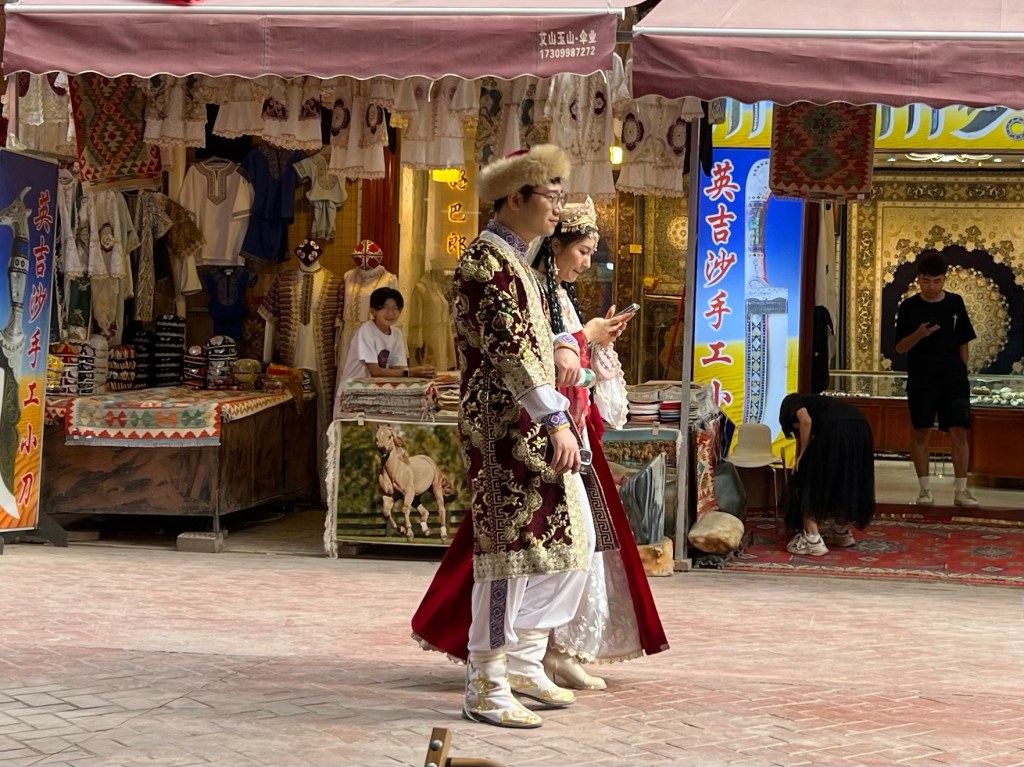
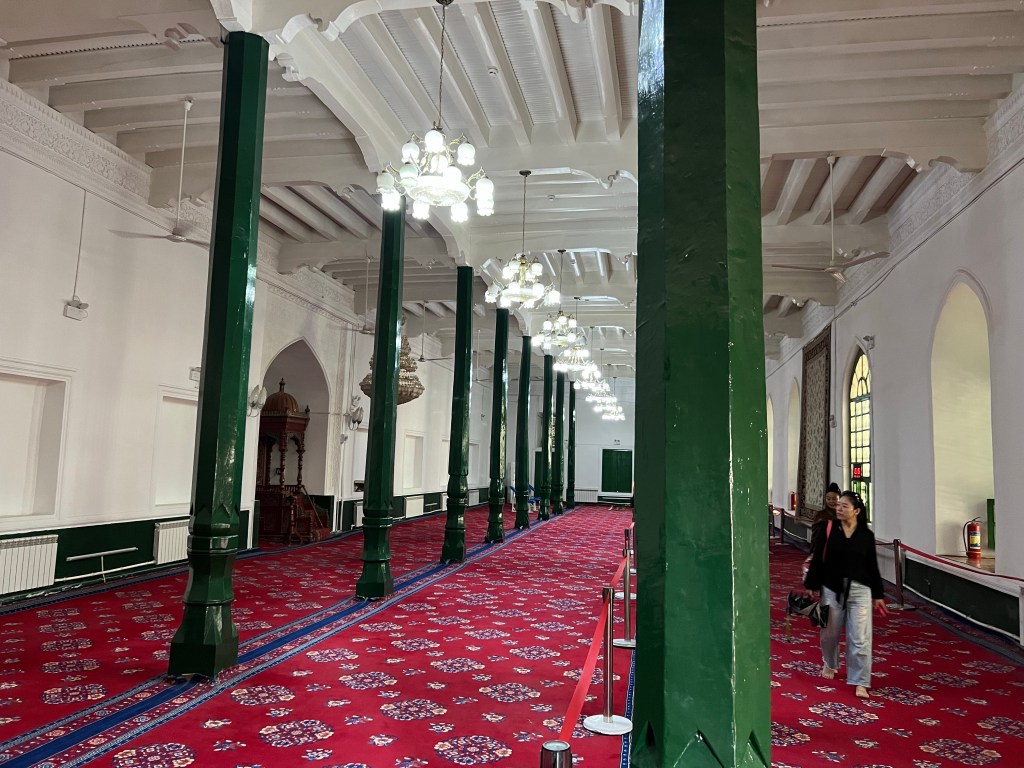
The tourism was uncomfortably tacky. A popular activity was to buy Uyghur clothes from shops that were geared upto this tourist demand, and then go to a beauty parlour and be heavily made up. Then the rest of the day is spent posing all around town taking photos, sometimes employing a professional photographer. The few tourist sites like the main mosque and a museum of a Uyghur house were derogatory and mainly served as places to obtaining more posing pictures and selfies. There was no respect for the mosque and we wondered how much use it was getting. Once the centre of the Uyghur community and could hold 20,000 people, but it seems people have moved away from this traditional way and worship in recent years.
The Uyghur and the multitude of other ethnicities seem to make up nearly all the population of this far west part of Xinjiang. They are really friendly and engaging. We have many magical interactions with no language or our three words of Uyghur brings much laughter and smiles. People aren’t poor, there are lots of smart cars, you never see an old car, and everyone seems to be part of the economic boom. All the police and officials look like they are from this area. Lots of Han Chinese have also moved to other nearby cities and new towns but here we are seeing that it is the multiethnic indigenous people that are running the show.


It seems that the culture and traditional ways are generally eradicated. But then traditions are reinstated in an appropriate format that draws in the tourists. There are numerous must see sites to visit and they all have amazing photography and videos of traditional living and customs like herders on horseback galloping across wild lands, taking part in customary games and hunting with their eagles. Women are portrayed in pristine bright costumes dancing and carrying out domestic duties in harmony.
It appears a racket that buys into the huge tourist demand. But in this clever Chinese mind game it is the Uyghur that are benefiting financially. These tourists are spending lots of money and the Uyghur businesses are thriving. The mood is uplifting and there is no feeling of suppression.

We stop for a coffee and two girls sit at our table. They are from another part of China and have a few days holiday in Kashgar and the surrounding area. One of the girls spoke pretty good English and she is a politics teacher in school. A compulsory subject in secondary school, which includes Chinese law and economics with globalisation she tells us. There is one semester on international politics and law. A petite pretty girl dressed in black, 30 years of age, she teaches to a class size of 55 kids aged 15 to 17 years old. There are no issues with students talking or looking at phones as this is forbidden she adds.
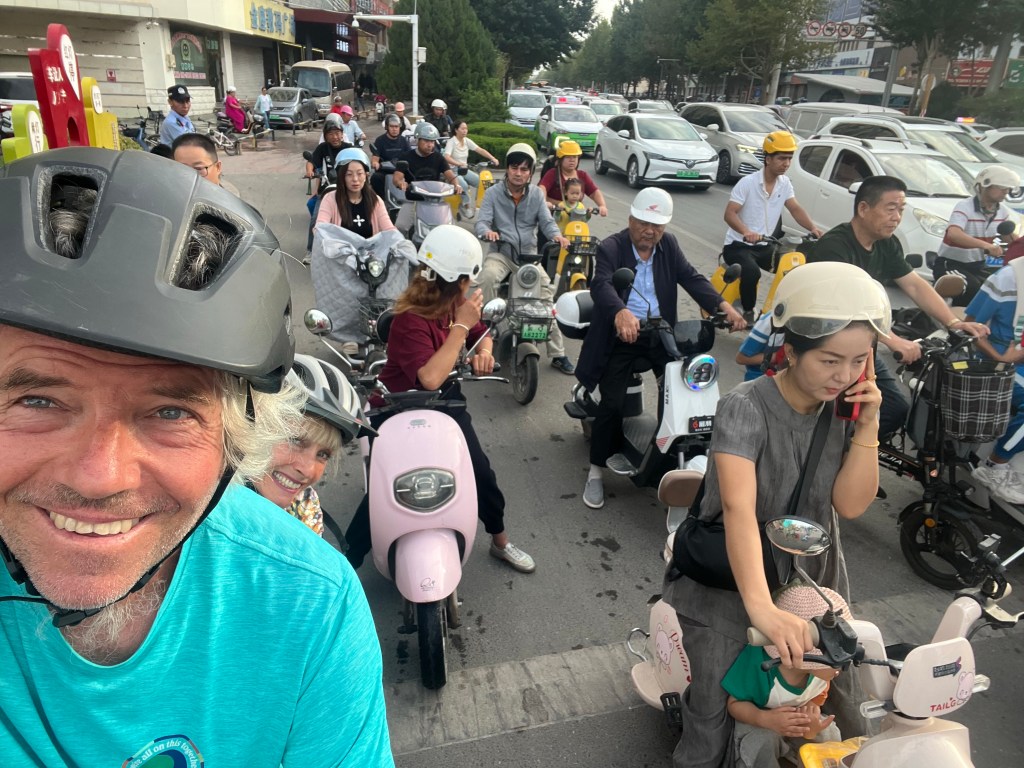
We are cycling through some suburb areas of the city. There are plush restaurants and fancy shops aimed at the local population that have done well. They park their fancy gleaming SUVs in the allotted spaces. We are continually surprised by the wealth and it is local people rather than people that have relocated from other parts of China.
But then for kilometres and kilometres we see piles of rubble from old mud and brick houses that have been flattened. The ornate doors and carved poplar columns so typical of the Uyghur houses were pulled out of the destruction and stacked by the roadside presumably they were being sold off. A glimpse of decorative flamboyant plaster mouldings hanging onto a fragment of standing wall that must have been part of a central hall of someone’s proud home protruded boldly above the debris. Whole communities now a pile of rubble. We didn’t stop as we weren’t sure whether we should be seeing this and there were cameras every fifty meters over head. We felt sad and sickened, peoples homes, places they loved and made special now flattened. We don’t understand what’s going on here at all and never will.
The next day on our way to the Karakoram Highway we pass through many suburbs and new towns. There are rows and rows of new high quality houses. Large walled plots set often in farmland growing peaches. First we thought perhaps these housed the influx of Han Chinese people, but no, everywhere the inhabitants are local indigenous people. Although the substantial single storey dwellings were all the same, they had traditional Uyghur doors that led to a central courtyard with trees. Perhaps the city people have been rehoused and there are better work opportunities. People seem very happy and the Chinese need everyone to have employment and be productive. We will never know but everywhere you feel all people are part of the machine to building wealth.
We will never understand this system. It’s not a Stalinist or Maoist type of suppression, it’s a lot cleverer as everyone does rather well out of it in terms of standard of living. Of course the rules are you must agree with the system and there is absolutely no room for personal opinion or beliefs, and there is only one winner when confrontation presents. This ideology tinkers at our minds as we are soon to travel through Pakistan and India, democracies with huge levels of poverty.
The Pamir mountains loom ahead. We need to cross the Pamir range and the Karakoram to get to Pakistan. We are now on the Karakoram Highway which is a good tarmac road. It is pretty busy a few lorries but mainly lots of Chinese tourists in smart SUVs and coaches.
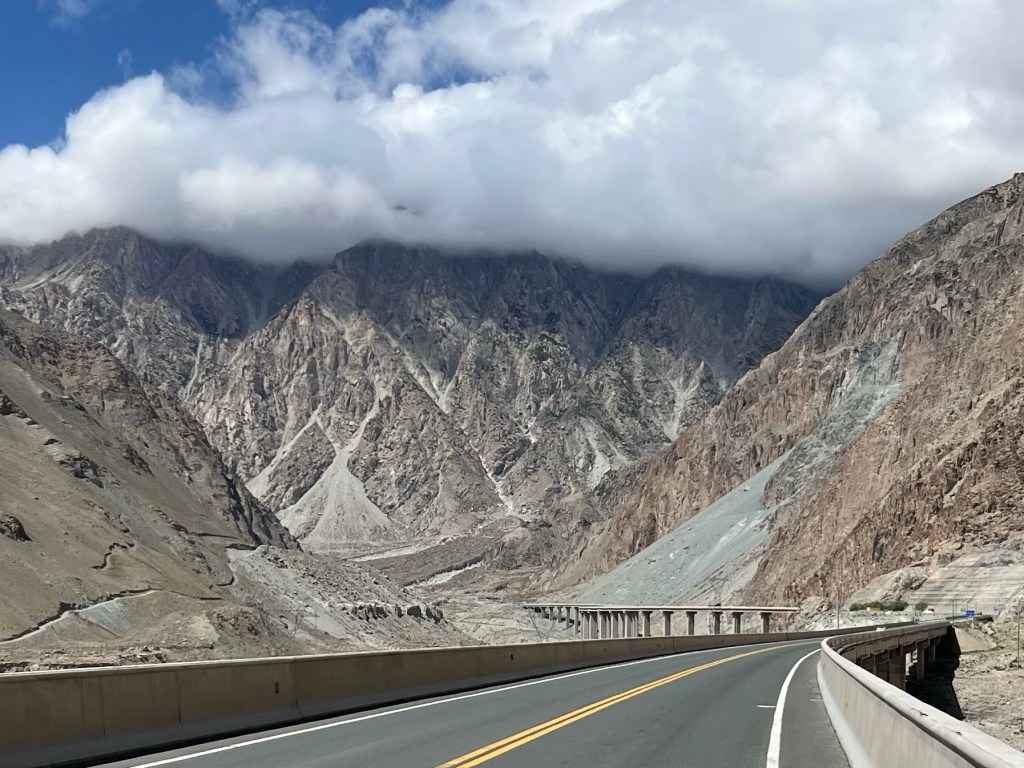


When I have looked at this area on maps over the years I pictured a remote road traversing these mountains. The development of China is unbelievable. You wonder what will happen when everything is built. What will this vast population do? It’s almost a necessity to build roads, factories and buildings to keep everyone busy and content and in money.
We climb steadily on the well engineered road. The Pass we need to cross is 4100m The mountains are far harsher than the Tian Shan of Kyrgyzstan. Slabs of craggy rock rise abruptly to a great height forming an inhospitable wall, and behind this severe relief stand very steep rocky bleak snow covered peaks projecting to extreme heights obscured by broken cloud in places. It is dramatic and immense.
The tourists wiz by, but are all very friendly, many slow down, the tinted windows are lowered and lots of encouraging gestures and shout outs help us pedal up the hills.
We cross some landslides that are inevitable in this geology. Very new looking big machines are already on scene pushing back what nature has chucked at them.
We meet Chinese tourists that speak English which is so refreshing to have a chat. Interesting finding out about things with their lives. People are affluent, there is more poverty in Europe. Lots of touring motorcyclist pass us, as do smart camper vans, and 4x4s with all the adaptations, on big road trips. All the kind of summer tourism for the better off in Europe goes on here. It’s interesting wages aren’t that far behind Europe and with things being very cheap it makes for a high standard of living.
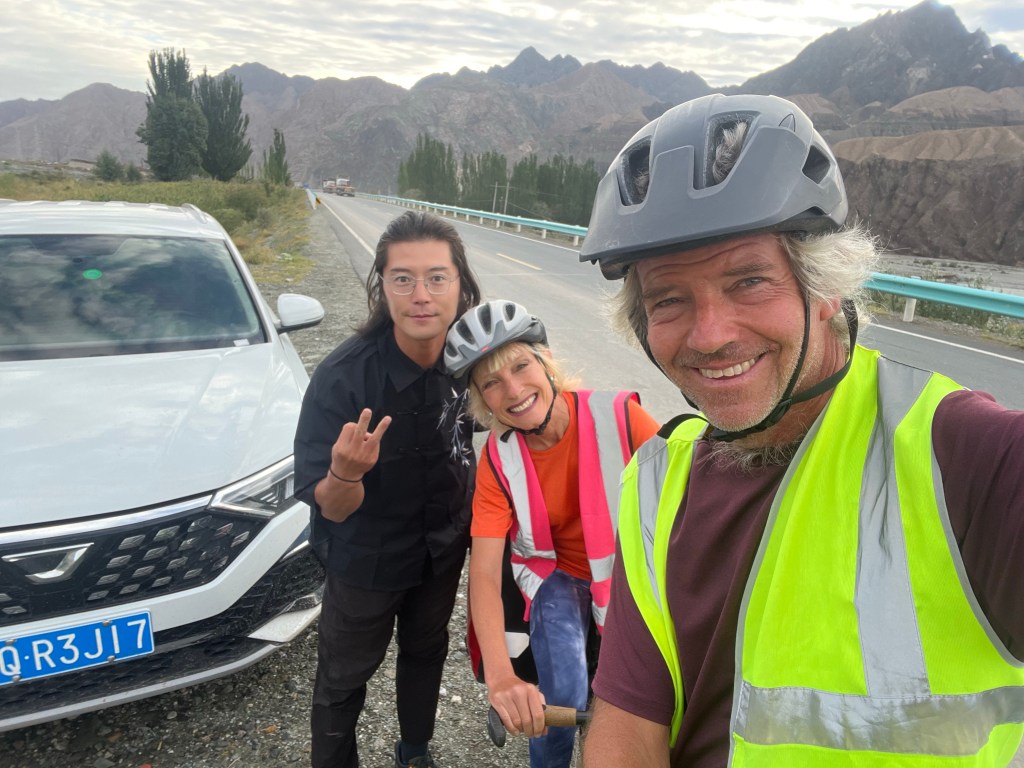
We climb and climb through majestic landscapes past turquoise blue lakes and towering snowy mountains and eventually reach the Pass at 4100 metres. This is the longest uphill we have ever done, starting at 1100metres, it’s been a climb of 3000metres. Lucky it’s been tarmac but we have had a ferocious wind against us in parts near the top when we were struggling with the altitude.
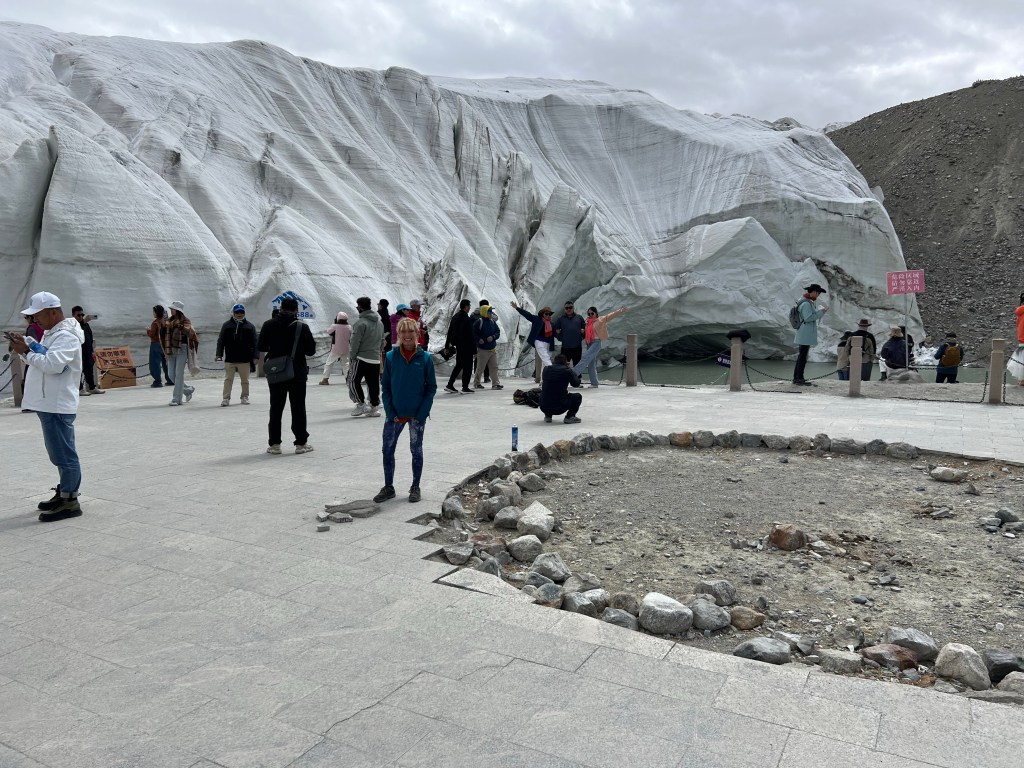
At the pass in very Chinese fashion there is a visitors centre with vast car park for tourists. From the centre you can take a smart bus upto a glacier at 4700 metres. The huge round visitor centre was encircled with beautiful pictures of local indigenous people riding horses and dancing. Videos with incredible photography ironically portrayed how the local people lived. There were scenes of rugged tribal men in horse back competing in traditional games and hunting with their eagles.
The buses running to the glacier transported numerous unfit tourists up the mountainside. Oxygen was on sale at the centre. From where the bus dropped us off it was still quite a walk to the official viewing platform and it was hard going. We were very impressed with the mainstream tourists determination in getting to the top and some chose to smoke too. We were gasping and we hadn’t arrived by car.
We pushed on to Tashkurgan, the last town before the border with Pakistan. We were exhausted it had been a long day of 130km and alot of climbing to over 4000m altitude. The town was bustling and felt like a frontier, but still had the Chinese grandiose layout of newly built wide multi lane streets lined with bulky modern buildings with bold bright Chinese signage everywhere. We thought about how different a place we will be when we have crossed the 4700m Kunjerab Pass. At the central transport hub it was exciting to see groups of friendly Pakistanis and vehicles with Hunza and Gilgit number plates. Their humble smiles and perfect spoken English was very refreshing. From here Chinese border zone restrictions require us to take our bike on a bus over the Kunjerab pass to Pakistan.

An early start and the bike was loaded onto the bus for Pakistan. The hours went by and we were still in Tashkurgan. Lengthy searches, passport checks, more searches and numerous head counts for our bus passengers, rechecks that we all have the exit stamp on our passports and eventually we were off to the pass some 120 km away. Our fellow passengers were mainly Pakistani and a few Chinese. We reached the pass on the wide smooth Chinese road, that we shared with tourist traffic keen to get the best selfies at the symbolic ostentatious Chinese border gate. More checks of passports, head counts and searching around the bus for stowaways by the smartly dressed masked Chinese police, and then we were let go through the gate into Pakistan.

The sleepy somber mood on the bus soon changed. The driver pulled over a little way down from the border gate, leaving the crowd of Chinese tourists getting the best photos. It now felt remote and quiet,just down from the Kunjerab there was a light dusting of snow that lay over the rugged scape. People shouted “we are free, we can do what we want, welcome to Pakistan” We all got off the bus and breathed in the cold air and the sense of freedom.


Wonderful travels you’re having once again! Enjoy Pakistan, I very much enjoyed my time there almost 37 years ago (October 1987)! I imagine the mountain areas may not have changed too much, the scenery and the friendliness of the people were certainly the standout. Where you are now in Hunza was very spectacular and to see it once again in your photos is great and brings back fond memories! I will be most interested to see your route from Gilgit. I’m not sure if either Skardu or Chitral will be on it, but Skardu and its surrounds were very spectacular too (as was the road from there to Gilgit), and the trip I took along the road from Gilgit to Chitral over the Shandur Pass (on the back of a jeep), was quite something! Have a great time!
LikeLiked by 1 person
Hi Lloydy, yes this part of Pakistan is still amazing and people are so friendly. Along with Kyrgyzstan it is one of the easiest and most relaxed places to travel.
LikeLike
I think I read all of this with difficulty and found it marvellous, the whole Chinese experience was so interesting.
LikeLike
That’s great Mum, I am glad you read this one because I think we had quite an insight
LikeLike
Well, it gave me an interesting insight,
LikeLike