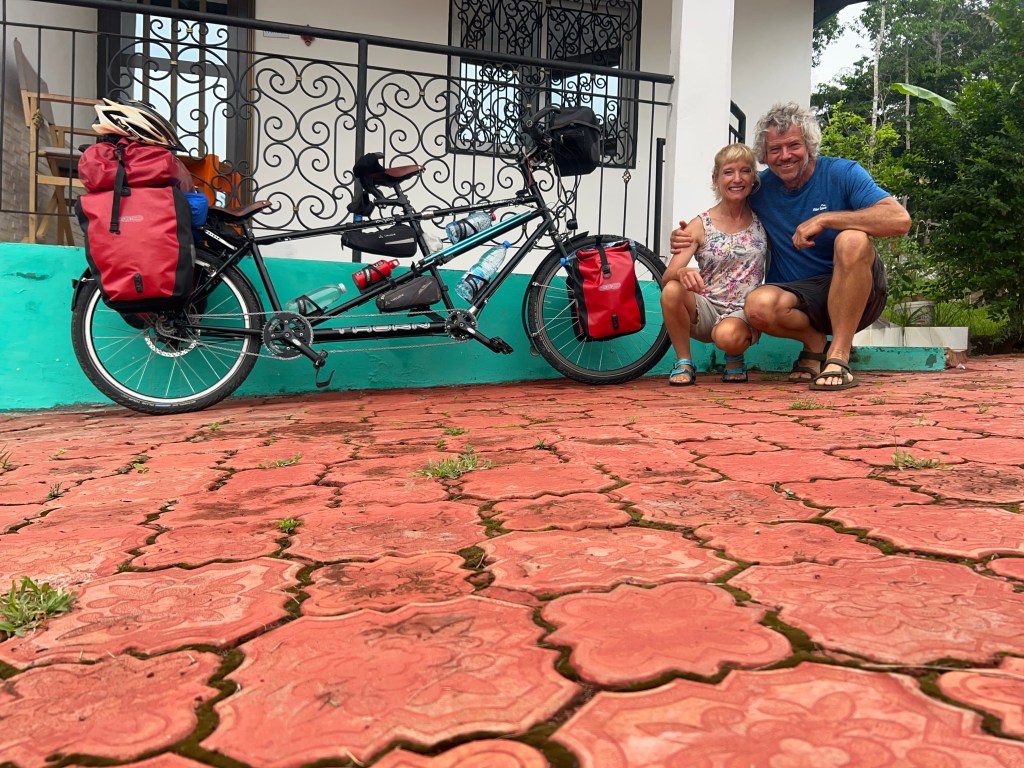
We had arrived once again in West Africa to continue on the next stage ‘To the Cape before we are 60’
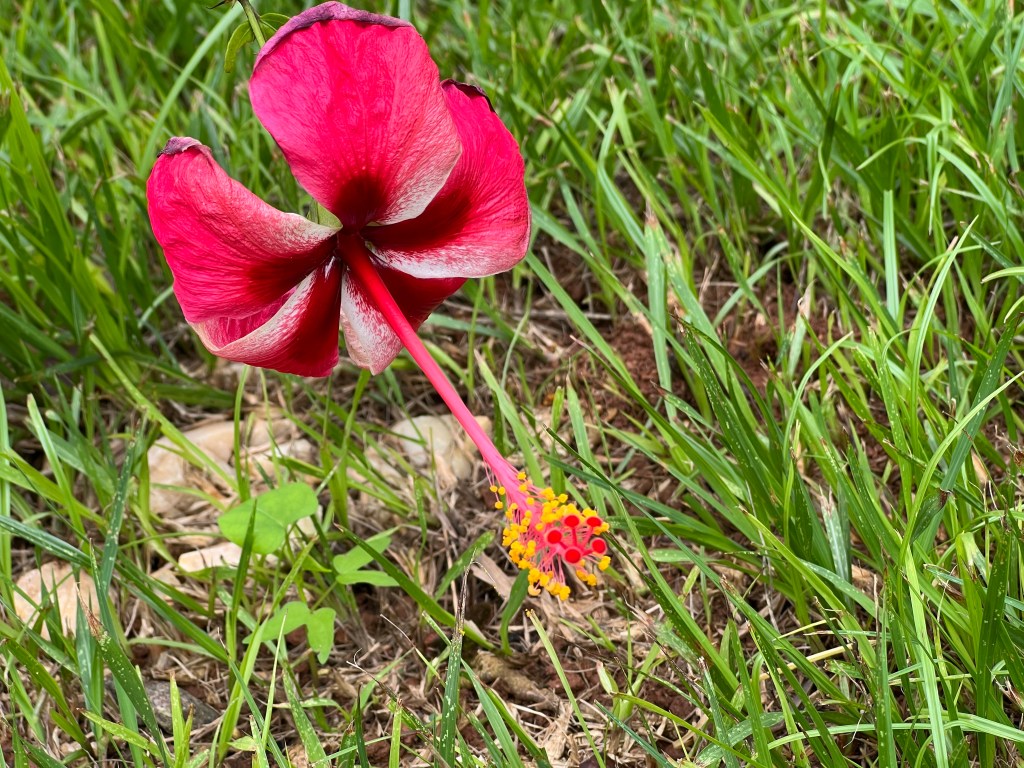
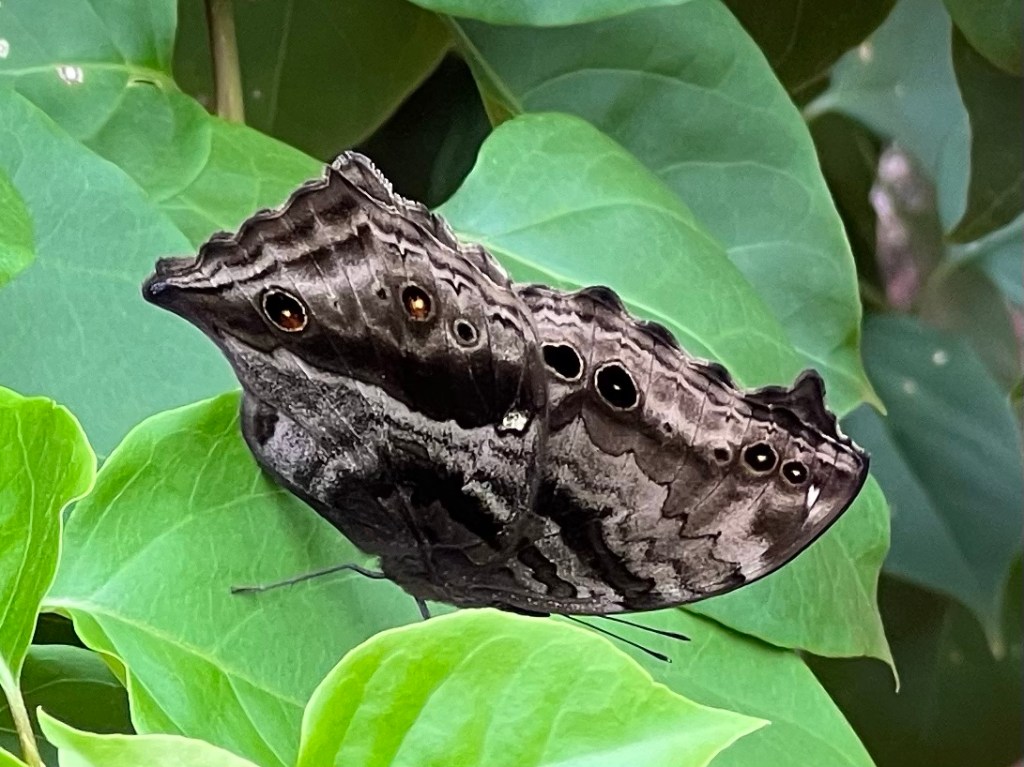
The air was warm and thick the vegetation luxuriant with every hue of deep green. Bright flowers randomly punctuated the tropical foliage. Swarms of brightly coloured butterflies darted around the stunningly beautifully flowers. We had been transported to a tropical paradise, leaving behind us, the routines of work, familiarity of our home and friends and accustomed way of life. The transformation into this world of travel through sometimes remote and harsh environments always takes a little getting used to, but it is not long before we settle into this new life where there are different priorities from back home.
Bike loaded with supplies, local Simcards in our phone, and with a bundle of local cash we are ready to cross the jungles of Cameroon heading towards Gabon.

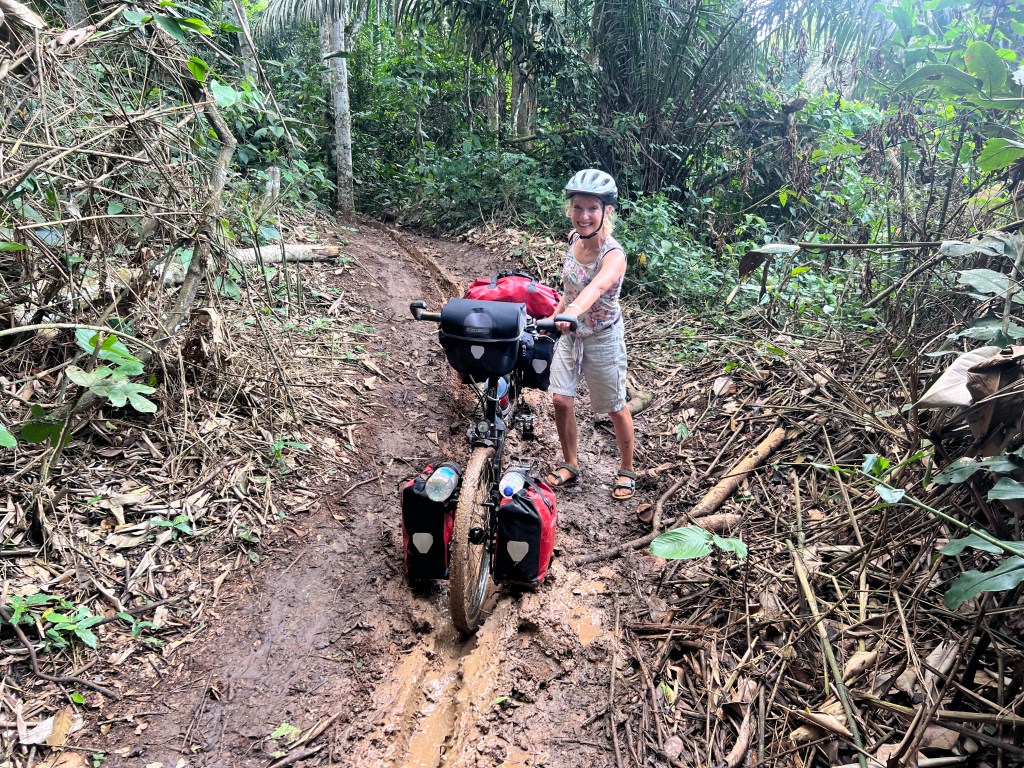
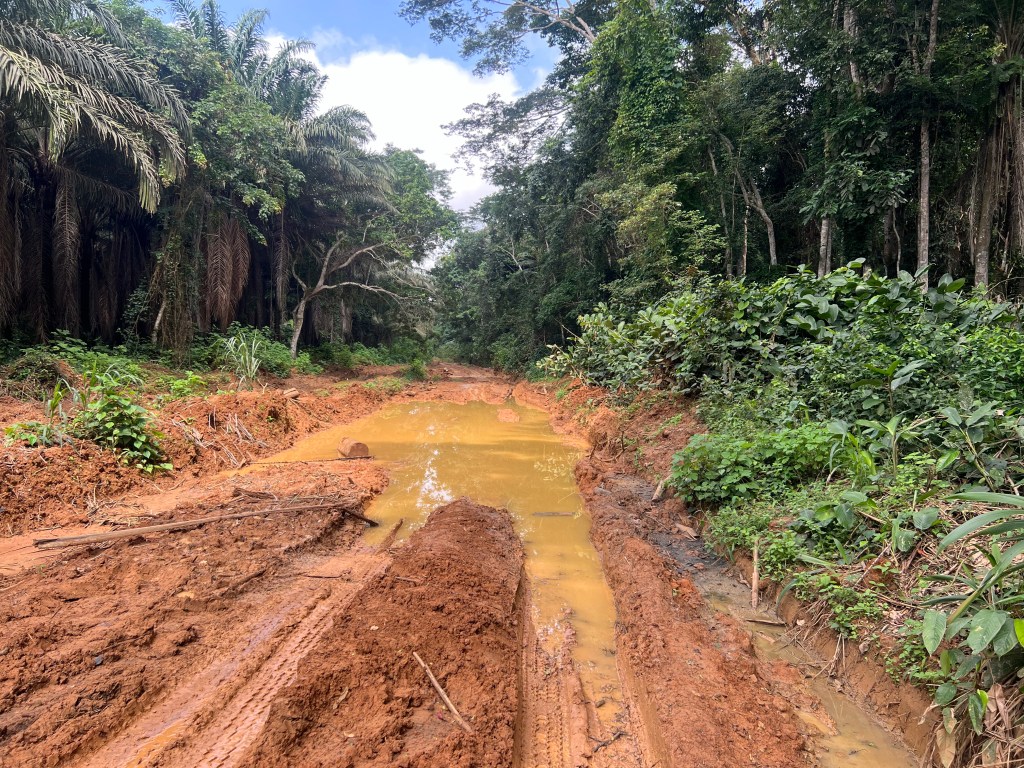
We soon left the tarmac road and the familiar red coloured laterite track lay before us contrasting powerfully with the hues of deep green foliage of the rain forest.
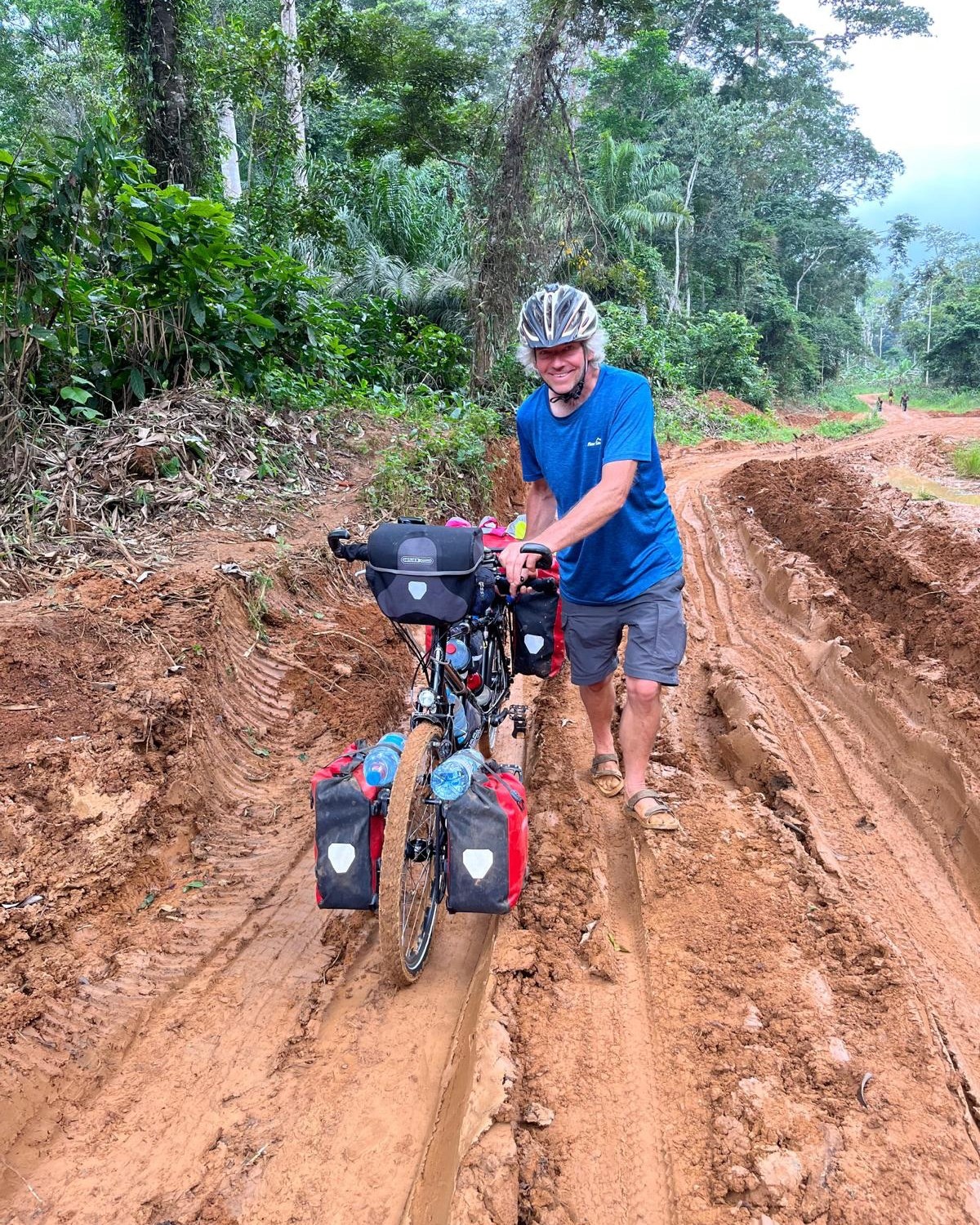
In at the deep end! A measure of what is to come. Very hilly and deep rutted tracks with quite a bit of water about. One water filled rut, the water came over the top of the front panniers, nearly the whole front wheel was submerged! Another was impassable and some ladies showed us a path through the bush. Another we slipped and fell off. The mud stuck to one side of us so there was no disguising what had happened. We slid around, sometimes pushing, sometimes cycling through the water filled ruts, and at times the track narrowed to a path as the the jungle encroached. We really weren’t that far from the Capital Yaounde, probably less than 100km, but this felt remote. Villages were scarce and the intensely coloured birds and swarms of dazzling butterflies of all sizes were our companions, along with the shrill and resonating sounds from within the rain forest. The wide Nyong river lay before us. Tall vivid green grass slipped from the land to the water disguising the river edge, and forming a tall lurid dazzling green carpet. Tall trees sitting on a lattice of exposed roots forming like a meshed cage under the trunk, clung to the waters edge. Occasional tiny delicate pirogues slipped by with people fishing. On satellite research we had seen what looked like a cable winch ferry. Sure enough there was one, still looking very new but it had sunk and the proposed tracks to this useful piece of infrastructure had been retaken by the rampant rain forest. There were some rectangular pirogues used for sand collection and two guys agreed to get us over the river in one of these. Propelled with a long piece of thick bamboo as a punt we silently slipped across velvety serene water.
We continued to Sangmelima where we wanted to explore possibilities of visiting the Baka people, a minority group of pigmies. In particular a contact from Cameroon, Adam had kindly given us some coordinates of a Baka Sacred Forest and recommended a visit. Visiting the Baka in south east Cameroon and north east Gabon is what’s brought us this far east and has become a particular focus of this part of our journey. The Baka were originally hunter gatherers and some of the oldest inhabitants of this region. They have strong beliefs in the spirits of the forest and are known for their knowledge of traditional medicine using plants from the forest.
https://photos.app.goo.gl/uW3R6b8V57QedSuv6
Our bike is covered with mud from the difficult tracks and we have a very jovial stop at a car wash to get it cleaned.

We set off in search of the Sacred Forest, armed with the coordinates and information from Adam “the gate of the forest is a big splitted tree, where you have to leave all bad things in physical reality (which can injure others) and all bad things from your heart. According to the Bakaa beliefs the sacred forest is a forbidden place for bad ghosts/souls, and it cleans your heart…”
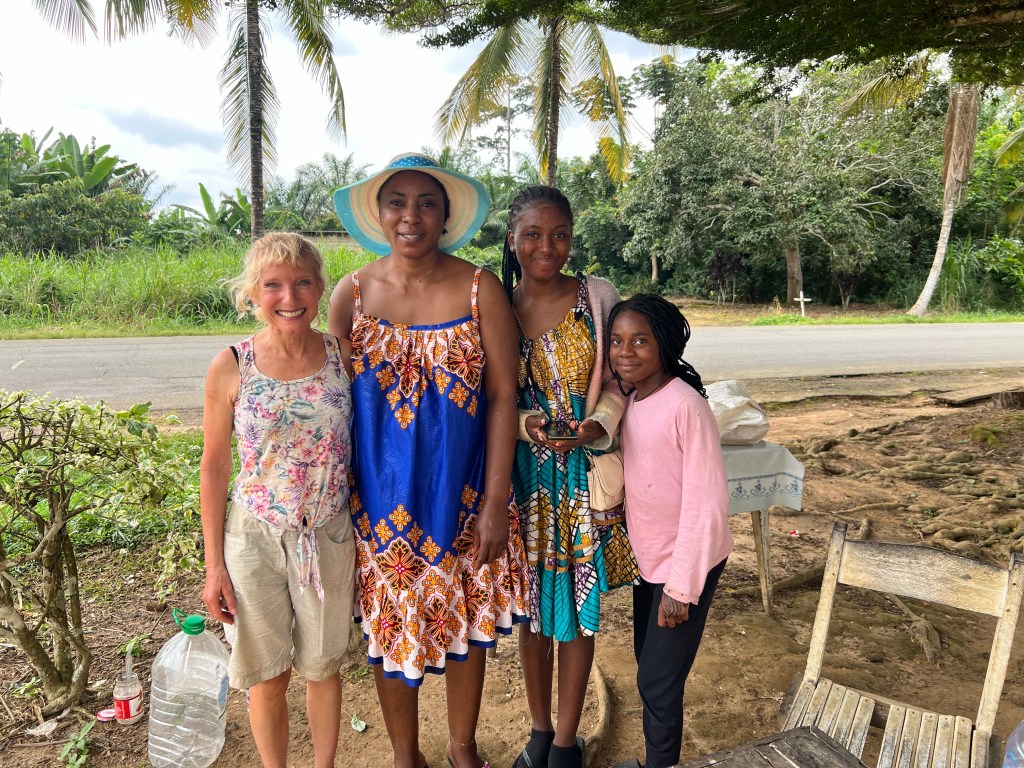
We are accompanied by Nelson, the taxi driver and Eric, a young policeman who speaks brilliant English. We weren’t too sure why he had got involved and were a little dubious of his intentions, but we were so wrong and he was a lovely guy who brought so much to the day.




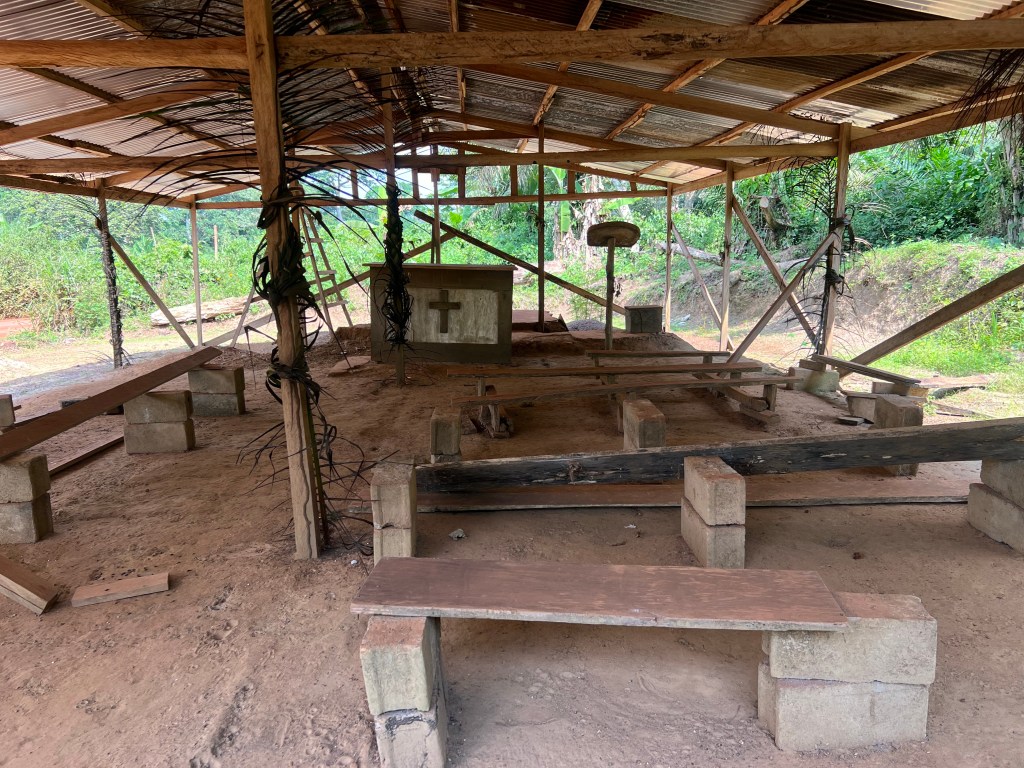
We negotiate with the chief of the village to allow access to the sacred forest. The spirits had told him about our arrival so he was expecting us! We presented gifts. We thought a head torch, a light and a sharpening file for his machete would be good, but luckily Eric our friendly young policeman accompanying us advised that actually chiefs really like whisky and cigarettes so on the way we stocked up! The chief held court in the village shelter sat behind a simple desk, with us along with other villagers, explaining “how he was the guardian of the forest and only he can give permission to enter. People that have done wrong cannot enter. The women of the village will dance and sing to warm up the spirits and explain our arrival, the songs will mention our names” all translated by Eric. With this information we head off along an overgrown path into the forest to find the split tree that marks the entrance and where the spirits need to be warmed up before we can enter…..
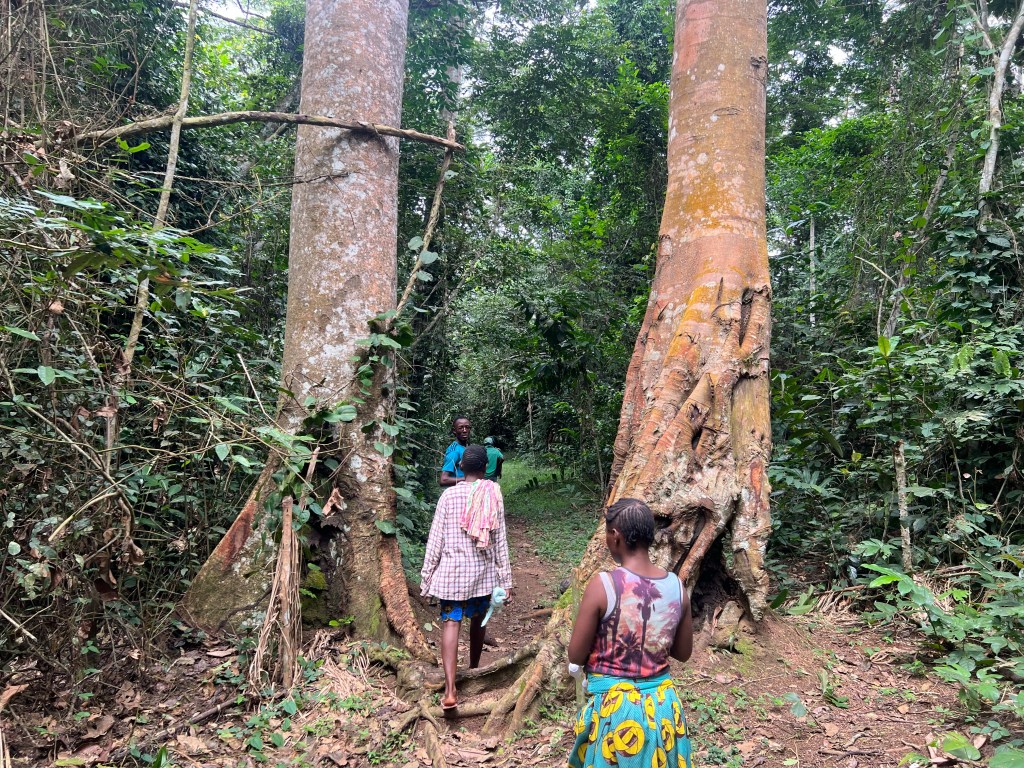


Off we head into the Forest with the Chief, who is also a traditional medicine healer, and another village elder. The women are ahead warming up the spirits for our arrival. We have no bad things on our minds. The singing resonates through the forest. We pass through the split tree when instructed and walk along paths leading to the old abandoned village. The chief leads the singing in a melodious call and response song with the women answering. The singing was emotive, heartwarming and soul-stirring. The spirits move to a place to one side of the village where no one is allowed to go apart from the chief and village elders. We wash bad luck off our faces in the Dja river. There is a large kind of effigy of a women, made from branches and leaves, with large arms and breasts to embrace many children. The dancing and singing continues, now with the chief on the drum. The last song is a crying song about the loggers destroying the forest.
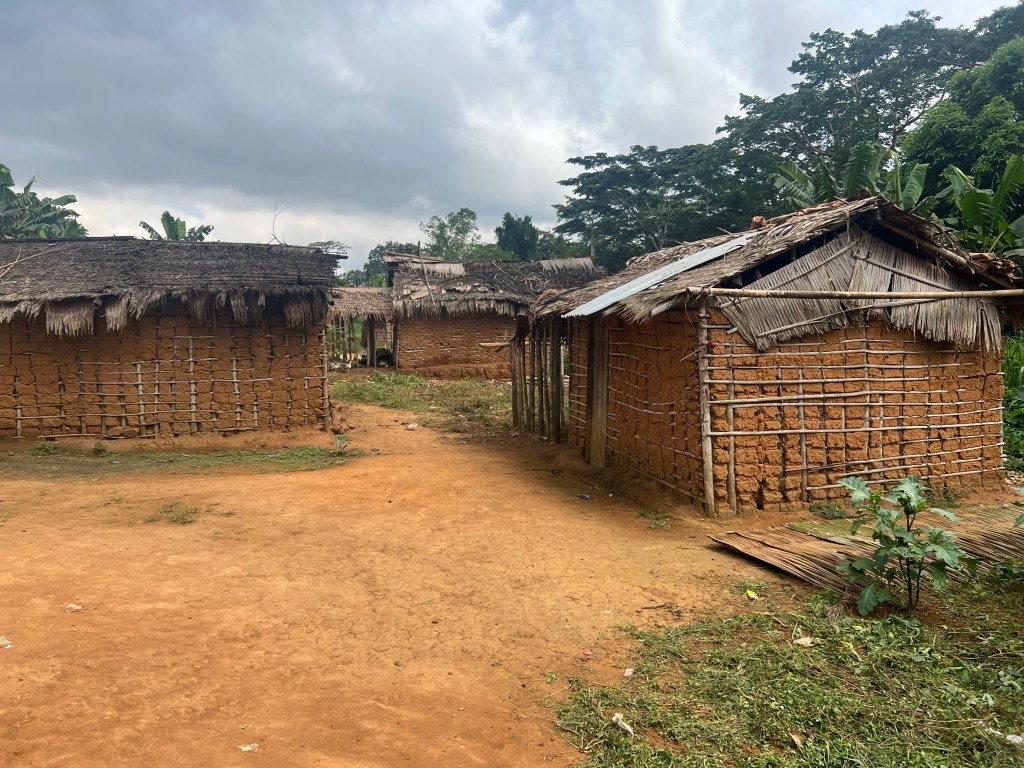
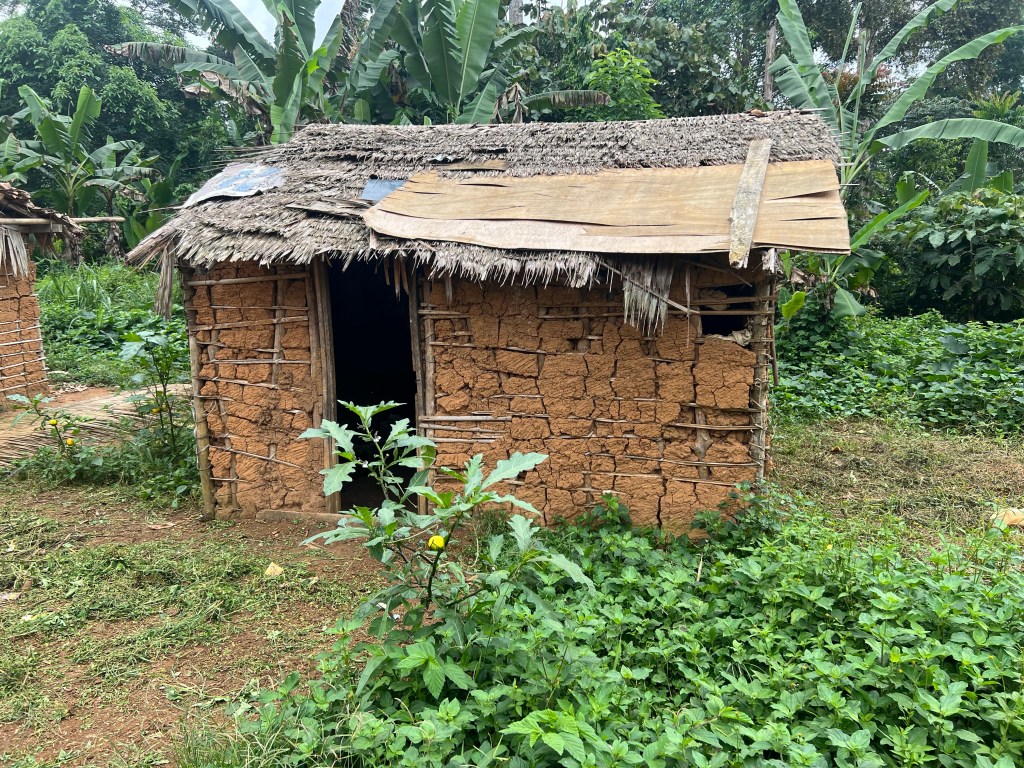
The Baka were hunter gatherers but have mainly settled in villages and this group had built a new village with mud houses near the road.
Back at the village the elder and chief gave us advice and good wishes on our travels and said we are good people. We think with their blessing we won’t run into any problems on our journey. Our hearts felt full with the memories of this moving experience.
We head off with some intrepidation for the 150km to the Gabonese border. A journey through thick very hilly jungle on a small track, deeply rutted and very muddy. We had the forest spirits with us! Progress was going to be slow. We hoped to get through in three days.
Lack of photos on this section as we entered survival mode! Video is before things deteriorated.
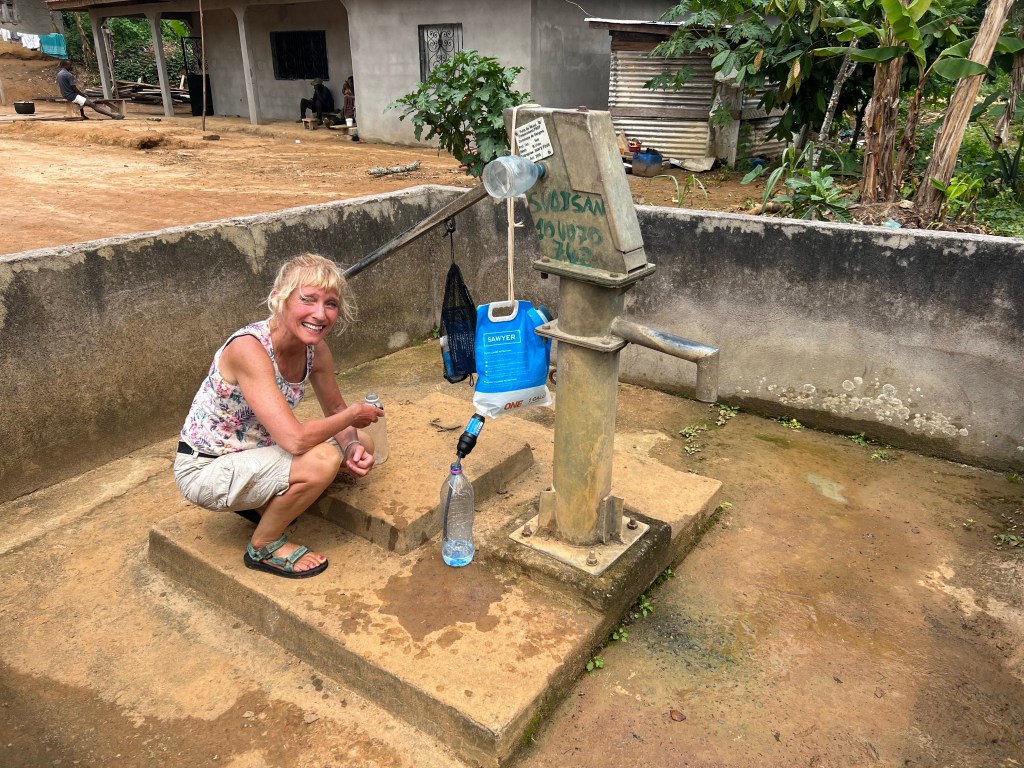
The jungle thickened, the profusion of butterflies came back, the squawking sound of jungle fauna and the resonant shrill of the forest filled the air. The track narrowed, luxuriant rain forest encroached, the ruts deepened to miniature ravines, the mud returned and the relief became steep. The bike disappeared once more into deep muddy water to above the wheels. This was going to be tough going. Villages were frequent, people smiled at us, we called out “ambulu” hello in Fang, the local language, they called back, their faces erupting into laughter and enamoured waving with both hands. Progress was very slow, we slid around the mud, pushed up rough steep hills, and waded through floods in the hot humid air. Villages started to become less tranquil with groups shouting out aggressively. The days drinking of palm wine was taking effect. This became more and more a menace to the day. People obstructed us demanding we drink with them, politely we declined, but they became more forceful as the alcoholic chaos increased. It felt threatening although not particularly dangerous, just a nuisance as we became physically drained by the extreme route. Every village was filled with extremely drunk people. This isn’t something we have experienced before. The behaviour was aggressive and confrontational. Muslim countries respect and honour the traveller, always checking you are ok and giving you water and fruit. Other Christian countries in Africa we have travelled in on Sundays the air is filled with beautiful church singing, but in this part of Cameroon alcoholism is preferred to church. We felt we could not stop in a village the night so pushed ourselves to the physical limit to try and get to a small town. In the last of daylight, exhausted, battered and scarred from the horrendous track conditions, we arrived at the checkpoint for Oveng, a small town. It had been 96km of hard going. The gendarmerie guarding the position could hardly stand up in his drunken state. We really didn’t need this! He took our passports and there was a very long stand off of nuisance challenges from him while he still clutched our passports in his hand. It was a delicate situation. He could hardly speak and needed to lean against me to prevent collapse. I managed to gently remove the passports from his and a kind child took the barrier away, like some miracle. We sped away on our bike into the town hoping there would be a sober soul about. We turned a corner, this beautiful elegant calm lady, Sammy, was standing outside her house. We asked if we could camp in her garden, without a question, her hand stretched out leading us to behind her house. We could have hugged her. We set up camp in her stoney garden. Sammy accompanied us to the nearest water pump where we could wash. We cooked a well earned supper as we had had no lunch. Sammy said I am just here if you need me, pointing to her room. We lay down in our tent shattered, and completely undisturbed in her garden.
Up at 4.30am we had the final push to the border 35km of similar terrain. It took nearly six hours through thick jungle and only seldom villages which were calm. We were continually on edge, scarred by the day before and also had the anxiety of not knowing if this border crossing would work for us and then having to return the way we had come. We encountered the commandant on the track out on his large smart motorcycle, he warmed pretty quickly and shared some cashews with us, clearly his hangover had subsided. The border post lay on the banks of the Kom river. With anticipation we visited one official after another. A bribe was paid, the official stating this was for motivation! The long awaited exit stamp happened and we wheeled our bike to the awaiting pirogues to take us across to Gabon. Jungle overhung the river, huge luxuriant leaves on arching stems lapped the water. We slipped out from the muddy river bank and paddled slowly across to Gabon, us in one pirogue and the bike in the other. It felt surreal as we glided over the glassy water surrounded by thick rainforest.
But would Gabon accept us? We had no visas. A recent change in the rules means you can travel visa free for 30 days, but will these alcohol fuelled officials in this far flung place know this. We arrived on the Gabonese side and cycled on a very superior gravel track, that’s a good start we thought. The gendarmerie was very straightforward, making a call through to immigration and we were soon on our way to Minvoul where we had to report to immigration. The country seemed totally different, a lot wealthier and we had jumped at least 25 years in development. Cameroon still seems to hang onto some aspects of stereotypical Africa like Nigeria. We could feel the weight of worry falling off us.
We arrived at the modern air conditioned immigration office to be met by a very helpful person who welcomed us to Gabon. But he didn’t have a stamp to formally enter us into Gabon, and told us no problem get the stamp at Oyem in a few days time. This felt slightly uncomfortable to be in the country but with nothing in our passports for a few days, but he assured us it was no problem and he would call Oyem.
It was so welcome to find a nice guesthouse, in Minvoul, owned by a lovely guy who couldn’t do more for us. SIM cards sorted, the use of his kitchen, a special room for the bike. Wash facilities for the bike too. It’s amazing how different things can be on two sides of a river. We had a rest day before going off on a visit to a Baka village which we will do on foot and by pirogue……..Gabon blog…….
 tandemtravelcouk
A marvelous account that transported me on a rainy English afternoon.
LikeLike
Excellent images and description of your “adventures” so far.
With best wishes from,
Steve B.
LikeLike
Wow guys, what an amazing account of your adventure thus far. Go well x
LikeLike