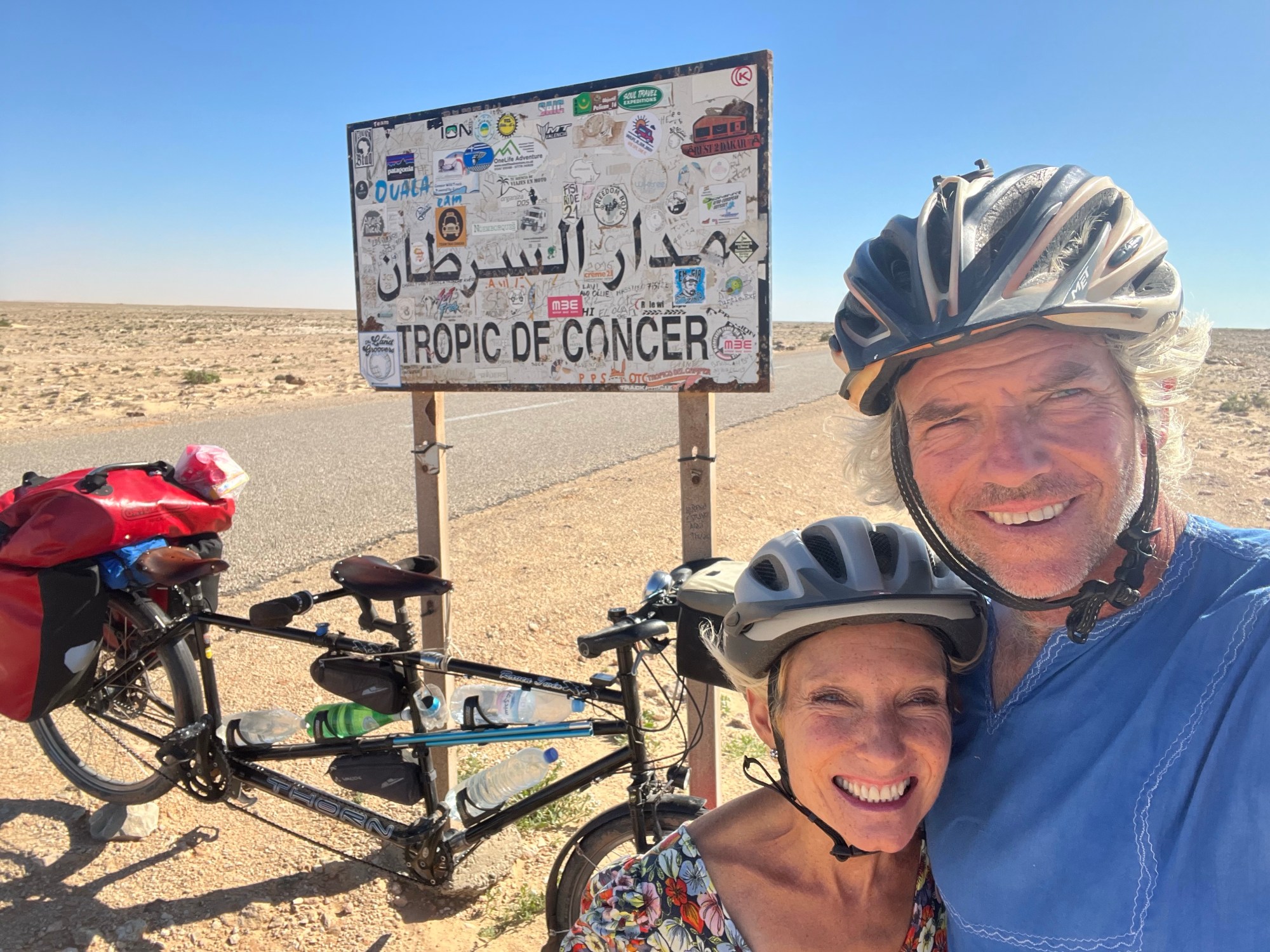
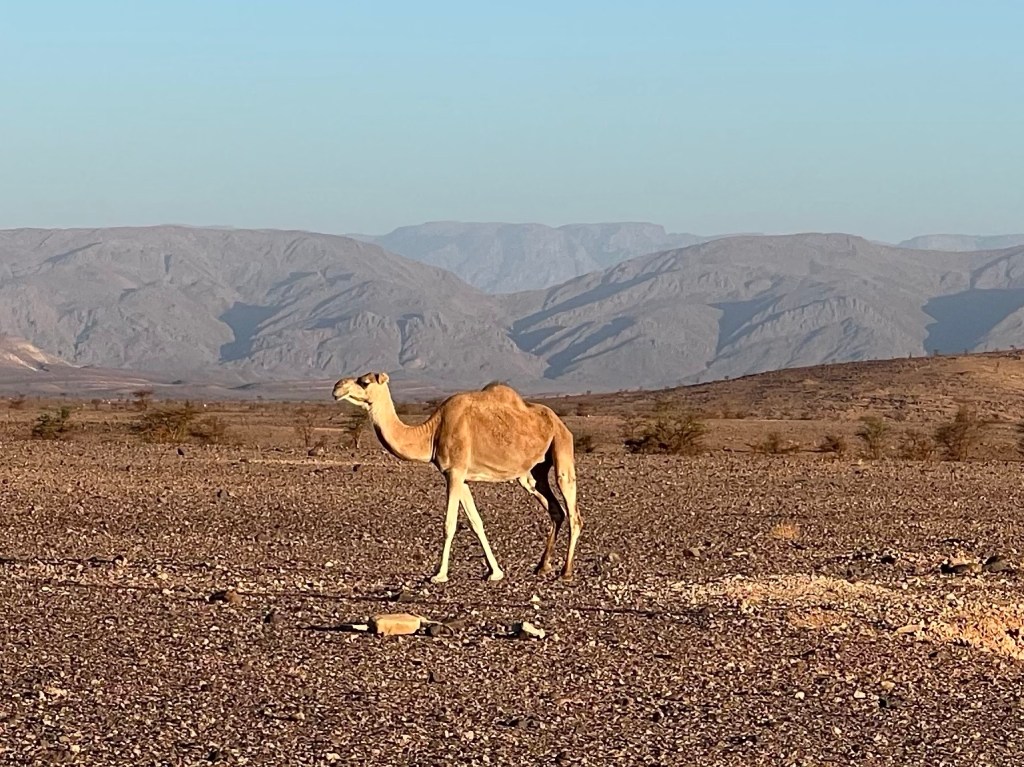
Zagora was hot, it felt like we had reached the Sahara. Ethnicity of peoples faces was varied, a cultural mix of people descendants from groups south of the Sahara and Saharan nomads alongside the Berber. As we were later to learn in Mauritania this merging of different peoples was the basis for the lucrative trans Saharan trade routes and the emergence of important centres of learning and civilisation like Timbuktu and Chinguetti.
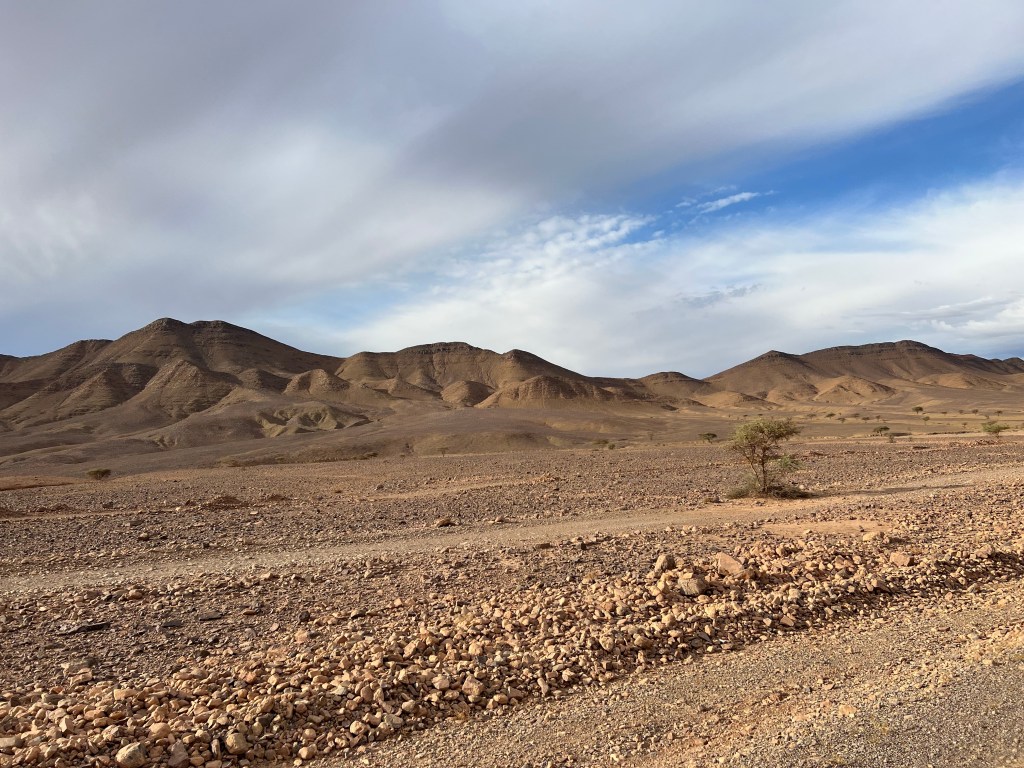
Our route across the Sahara to eventually reach the Senegal River on the other side, would follow the string of southern Moroccan oasis, cross the bottom of the Anti Atlas range heading towards the coast, which we would follow south into the disputed region of Western Sahara, eventually reaching Mauritania, and then onto Senegal.

Braced for the full force of the heat of the desert we set off two hours before day break loaded with 10 litres of water. We needed to be self sufficient for upto 100 mile sections without taking on supplies and water.
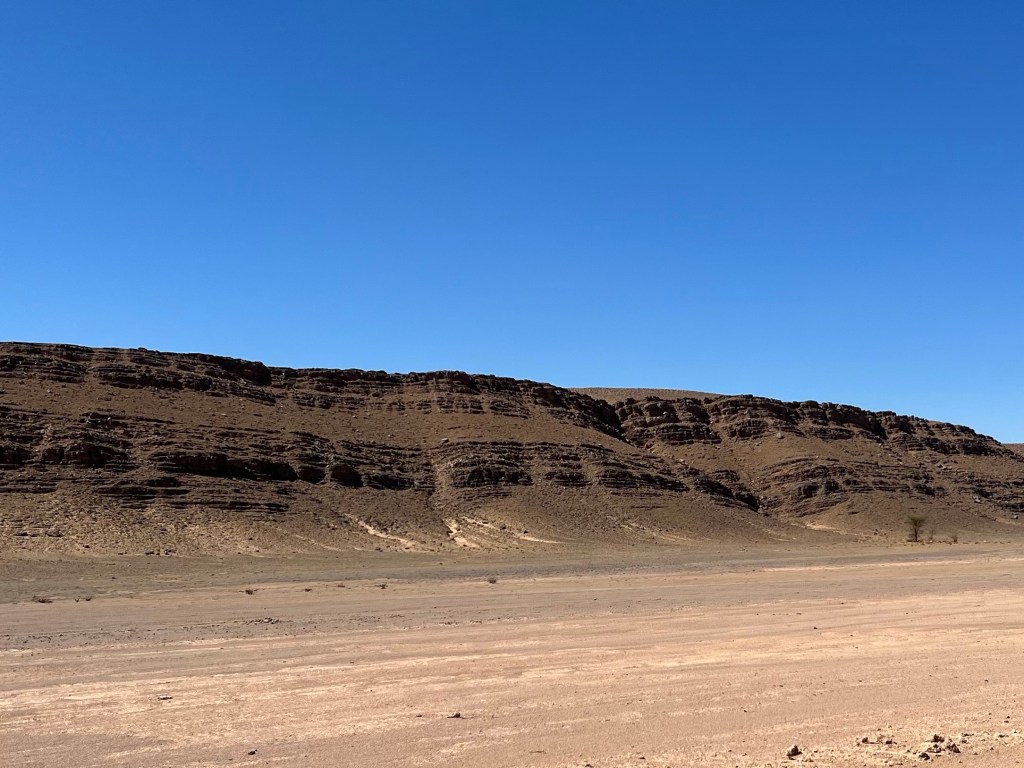
After the pockets of sand dunes near Zagora that attract the desert tourism the desert returned to large expanses of stoney ground backed by long rocky escarpment ridges that were sometimes in the distance as a backdrop and at times came close to the road which was more dramatic. The oasis were spread out here, not in a string along a dry river like the ones close to the Atlas, but isolated points where there was water.
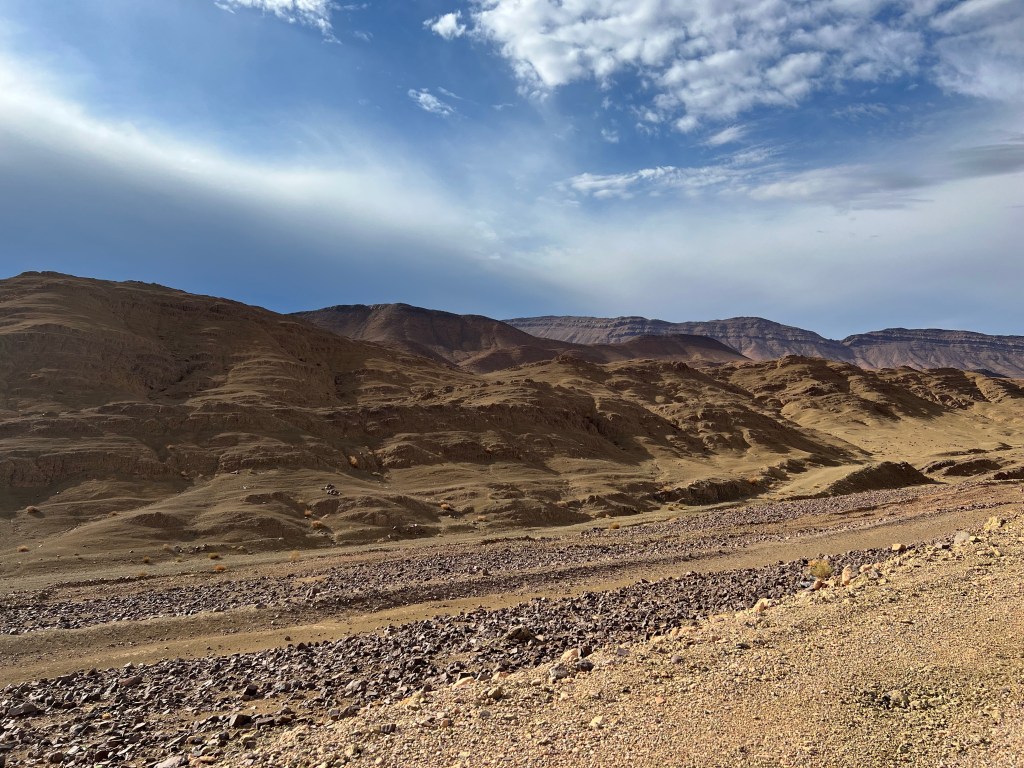
The panorama still had that ochre tinge of shades of red and mauve that gives the desert so much beauty. The oases appeared abruptly out of the arid land. Date palms heavily hanging with fruit, other cultivation between the palms, all added to the luxuriant green of the oasis haven, that contrasted vividly with the surrounding dry land.

The days went by as we pushed South West towards the coast. Travelling from one oasis to another, sometimes there would be one in the middle of the day and we could get an omelette or tagine for lunch.
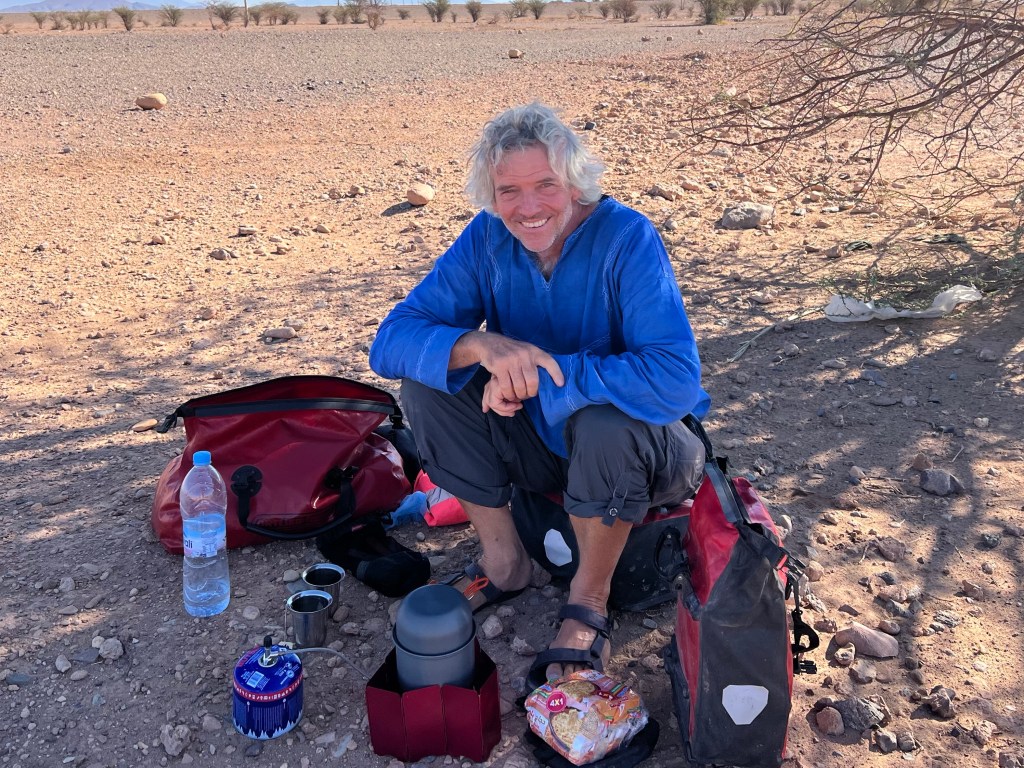
Often for lunch we would brew up coffee and noodles out in the huge expanse of the rocky desert. It felt like a really empty place. Camels appeared here and there with a lonely herds man and occasional nomads tents could be seen in the distance.


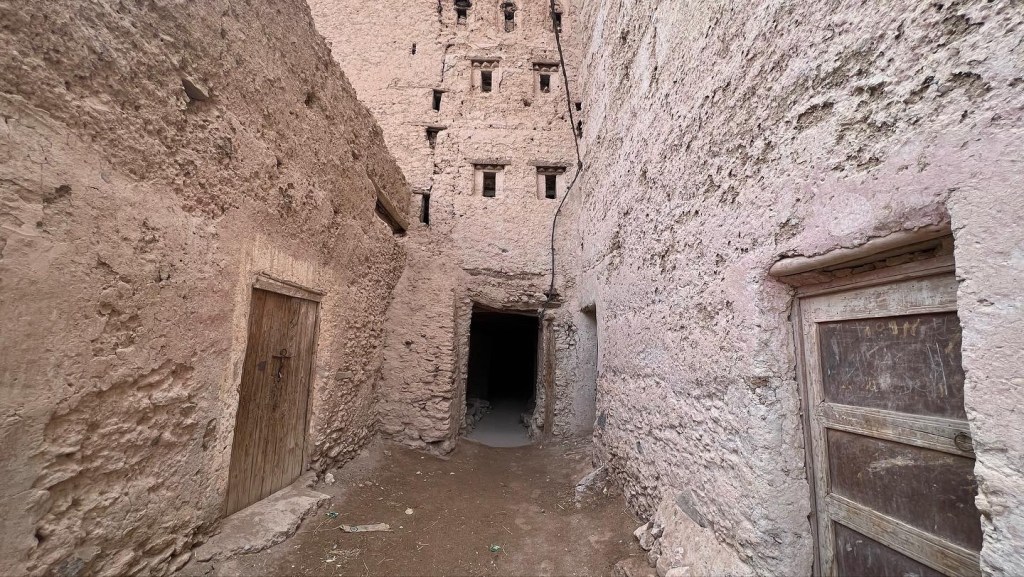
Some of the oasis had old Ksours and Kasbahs, sometimes partly underground to create a cool labyrinth of dwellings connected with passageways. The buildings blending so well with the surrounding vernacular rock and gravel.

As we neared the coast the last mountains of the Anti Atlas dropped down behind us. The desert became sandier with rocky outcrops and an array of sand blasted sculptural landscapes. There were no oasis or nomads with their camels and goats. It was vast and empty as we approached Western Sahara. Larger towns seventy or so miles apart at first then a lot further apart the more south we got were our staging posts and stops for the night. The towns originally fishing villages were artificially enlarged by enticing people to settle in the disputed region through tax breaks and incentives. They weren’t pretty places but did the job for us.

Our new ‘oasis’ were the lonely remote petrol stations and sometimes a cafe randomly a 100 miles from anywhere, servicing the trucks, they were useful places, having a shop, cafe serving tagines and omelettes, toilets and a mosque. We could camp at them too normally in a room to keep out of the Saharan wind. This was a long section for us to cross, about 800 miles of not a great deal out there.
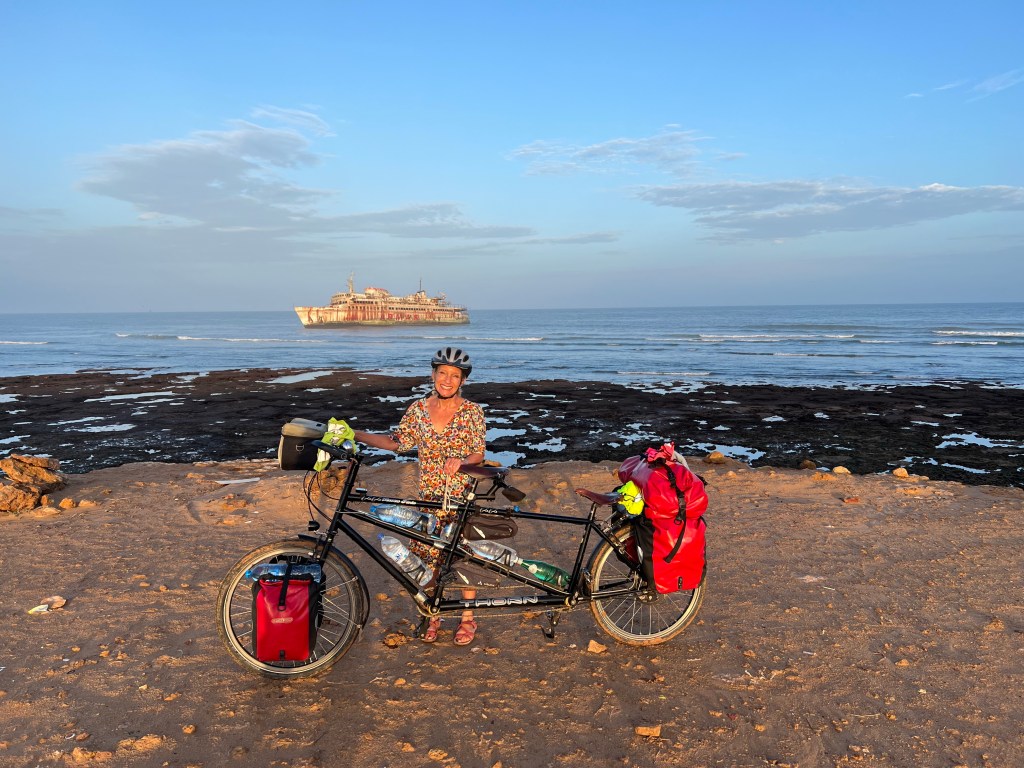
The desert still had beauty and we appreciated the little changes in the sand and rock that was such a harsh environment yet moulded and sculpted by the wind was softened in its appearance as the views disappeared into the vast distance. Very little plant life existed now, but there were still butterflies. The wind blew wildly mainly from the North and this pushed us on fast on the smooth road achieving some impressive distances, a record one day of just over 200miles!
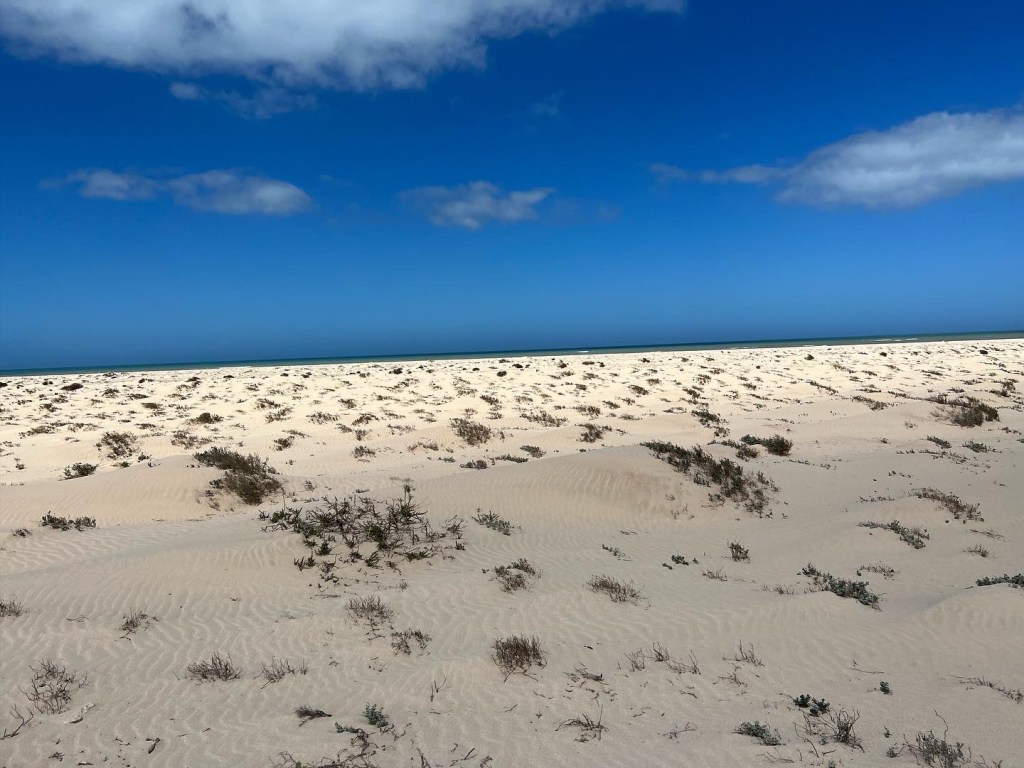
Dunes merged to flat desert, then back to dunes, huge depressions that looked like they had been carved out by wide rivers gave way to sand punctuated with sculpturally moulded wind blown rocky outcrops. The colours changed from dark orange to red and then white. The views disappeared into infinity and emptiness. There were no settlements and no life. We approached the Moroccan border post.

A short section of rough track took us through no man’s land to Mauritania. A lonely Moroccan flag mounted on a pile of rock marked the end of Morocco. Formalities on the Mauritanian side were chaotic and tedious. Fixers pushed themselves forward promising to help, “change money, visas, passport stamp”. We adopted our usual method of smiling, waiting and gentle persistence. A couple of hours later and no inappropriate exchanges of money, we had our visas and were on our way leaving the messy border post behind.

The desert had changed again. The sand was dazzling white and the wind blew harshly chucking up the snowy grains into a glaring haze that joined the sky with the desert seamlessly, a bright blazing intensity on the eyes like you might get in snow.
We were in Mauritania. We have crossed the arbitrary line on the map from Western Sahara and like so many land border crossings we are amazed how lives on each side of the line are so different.
The people looked a lot more African, men in blue loose fitting robes, called daraa and cloth veiled turbans, tagelmusts, roamed about. Their attire depicted the Saharan nomad and has been really adopted by the modern day Mauritanians. The clothing of the trans Saharan traveller was practical allowing enough air circulation to keep cool, conserve water, and give full protection in a sandstorm. The captivating shades of blue and indigo cloth flutter in the constant wind portraying a striking indigenous scene.

The sand blew around as we pushed on into the stark mostly flat countryside. Settlements appeared again in the desert. But they were mainly deserted, sad looking timber shed like buildings leaning over, dilapidated and half buried in the sand. The occasional remains of some planting retaken by the desert. Eerily grave yards surrounded by chunky timber posts forming a kind of fence in an attempt to keep the drifting sand out, stood as a reminder that these places had been homes and peoples lives. Debris was scattered and buried in the lifeless, desolate dust bowl. Life must be so hard, and it is amazing where humans live on our planet. Later some villages were partially inhabited but you could see why so many have opted to move to towns. These villages weren’t like oasis with a level of enclosure and some trees, they were plonked in the windswept, sand blasted barren wilds of the desert. I guess they had a well as a water source, but we did see later that many had large collapsible water containers and relied on tanker deliveries of water.

Kindness of strangers really was more common in Mauritania. So often people would pull over and check we were ok, or just drive alongside us, smile, chat and pass us water and fruit. Such a nice gesture from fellow travellers passing the bare arid desert.
One such encounter of a gift of cold water, we pulled over outside a little mosque to drink the refreshing water in the heat of the day. We still had that slightly unsure feeling you get in a new country before you get to know it, and soon a bond is created and things become familiar and reassuring. Shockingly at that moment a kid chucked a bottle of urine in our direction. We didn’t think anything of it, but then stones were flying in our direction and adults that were about didn’t intervene. Time to move on rather quickly we thought. It was an isolated incident but very surprising and not something we are used to on our travels. That evening we got to a small dusty run down bleak little town and went in search along rutted sandy tracks for a shop. Menacing kids approached and we kept things jovial and chatty but there was an underlying threatening air among the older ones. We were only in this simple open fronted shop for a few minutes but with our backs turned our mini speaker was removed from the bike. Just a cheap thing we picked up in Almeria so we could both listen to the radio or music in the long desert sections. It’s one of those little luxuries that really has been an enriching boost on this trip. Again this was a real shock as theft is something you just don’t experience once you leave Europe. We never lock the bike and we become totally relaxed. On all our travels it’s so different to the way we behave in Europe. This was a bit of a wake up call, and although no harm was done, it left a bad feeling.

We pushed on south through the featureless windy landscape, and the acts of kindness and generosity continued, always uplifting and lovely encounters. Habitation of settlements became more widespread as we moved south. Still extremely harsh places to live but the rural people became more friendly and engaging as we moved deeper into the country. Maybe that first part in the North was just so bad it made the people irritable. It would make me angry living there!
The conditions became wild. The wind started to blow very strongly side onto us. The air was completely filled with blasting white sand obscuring the sun. It was hard to keep a straight course on the road. We were being buffeted by the storm. Passing a village of a few flimsy timber buildings that appeared out of the murk, all shut up and only tiny signs of life as people shielded themselves from the blasting sand, we wondered whether we should take shelter too. But we continued, brightness reappeared momentarily, then heavy rain, and all the time we were being battered by the Saharan sand. Those first two days felt quite harsh.
There were very long stretches with nothing so we were carrying our maximum ten litres of water and usually had to cook in the desert. We did get some meals but the food had dropped in quality since Morocco. The fragrant spices were missing now and it had a more West African touch of cuisine. Camel meat and chips were the extent of what was on offer which was fine just simpler in taste.
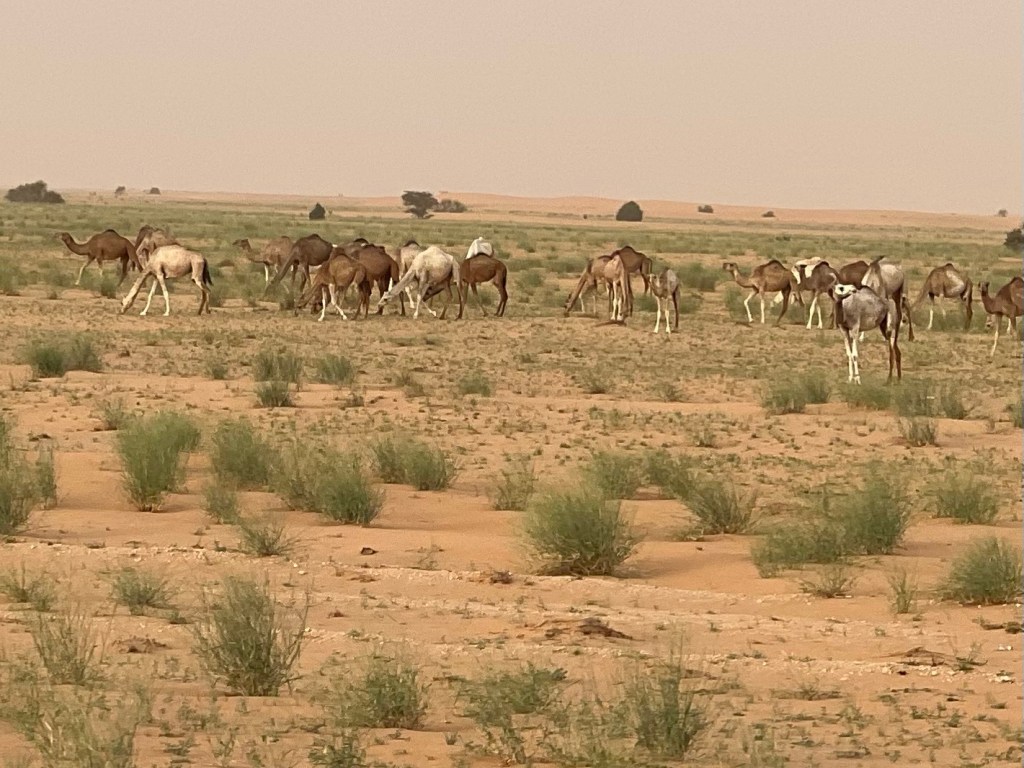
The third day, a really long one, over sixteen hours, 157 miles to Nouakchott the desert mellowed and became tamer. There had been rains turning many places green. The odd tree was appearing. Groups of tents made semi permanent settlements and there were large groups of camels grazing on the scrubby grass.


Nouakchott, city of the wind, buffeted for 200 days a year by sandstorms, is and endearing, shambolic higgledy-piggledy, miss mash of place. A village that was redesigned sixty years ago to be the capital with a population of 50k, has now swelled to 1 million population. An irregular layout of sandy bumpy roads round half built buildings and areas of wasteland harbouring stagnant water and rubbish. Yet it is a busy, but not overwhelming, bustling centre of vibrant life.
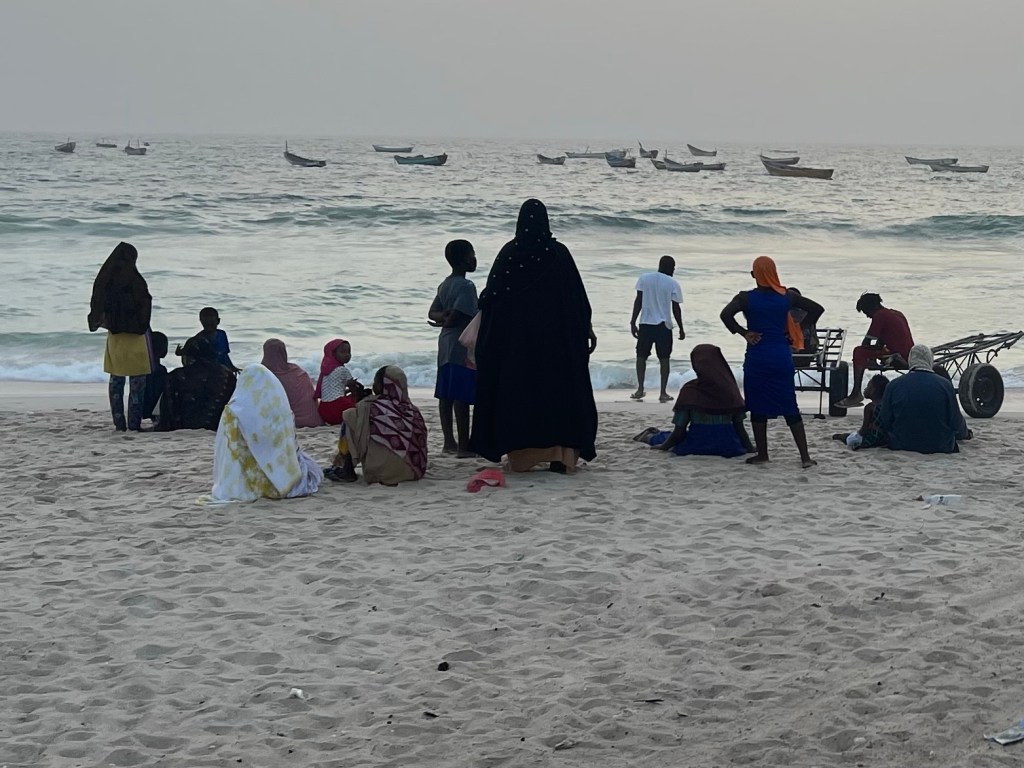
The high point of Nouakchott is the atmospheric fish market set on the beach. Frenetic activity as strikingly painted craft land their catch on the beach. High bowed slender fishing boats coming through the big swell and surf to awaiting labourers with trolleys on the beach. Quickly the crates of fish are transferred to the trolleys in the breaking waves chucking up gleaming white spray in the dark blue sea. Many hands struggling to turn the boating fighting the pounding of the sea, and then it’s off, crashing through the surf, the bow being chucked high as it manoeuvres back to the exposed anchorage out the back of the breaking waves. The big wheeled trolleys, loaded with the catch are dragged up the sandy beach to the fish market. Stalls with large concrete slabs display piles of huge fish. People are everywhere, shouting, hauling crates of fish, and rushing back to meet boats arriving in the surf. It’s a colourful scene and mesmerising to watch as the sun sinks down over the sea.

We felt like we had got through the Sahara, 3400 miles from home and 45 cycling days.

 tandemtravelcouk
Great descriptions of the desert and the changing landscapes and people. The fish market and the boats in Nouakchott are so typically West African. Like so many we saw in Senegal. Compare with the fish market in Niangal. It could be the same place.
https://unlikelystories.home.blog/portfolio/fish/
LikeLike
Hi Simey, great writing on your blog too. Yes the fishing scene is so similar across west Africa. We saw the same in kafoutine in cassamance. Look forward to seeing you at Christmas x
LikeLike
Absolutely wonderful photos and writing. I cannot say it loud enough of how completely amazing you guys are. Look forward to mor photos and then seeing you in person !!
LikeLiked by 1 person
Thanks Aftab, we are having a great adventure
LikeLike
I so enjoyed reading this blog and loved the descriptions. Parts of it looked so isolated and somewhat scary. It was so sad that your speaker got stolen.
LikeLiked by 1 person
I think thats the first anti social behaviour that I’ve read about in your travels.As usual good discriptions and pictures.
Joe and Alison
LikeLiked by 1 person
Yes I think it is, although it doesn’t represent Mauritania as a whole, generally very lovely people and very safe, just an isolated region!
LikeLike