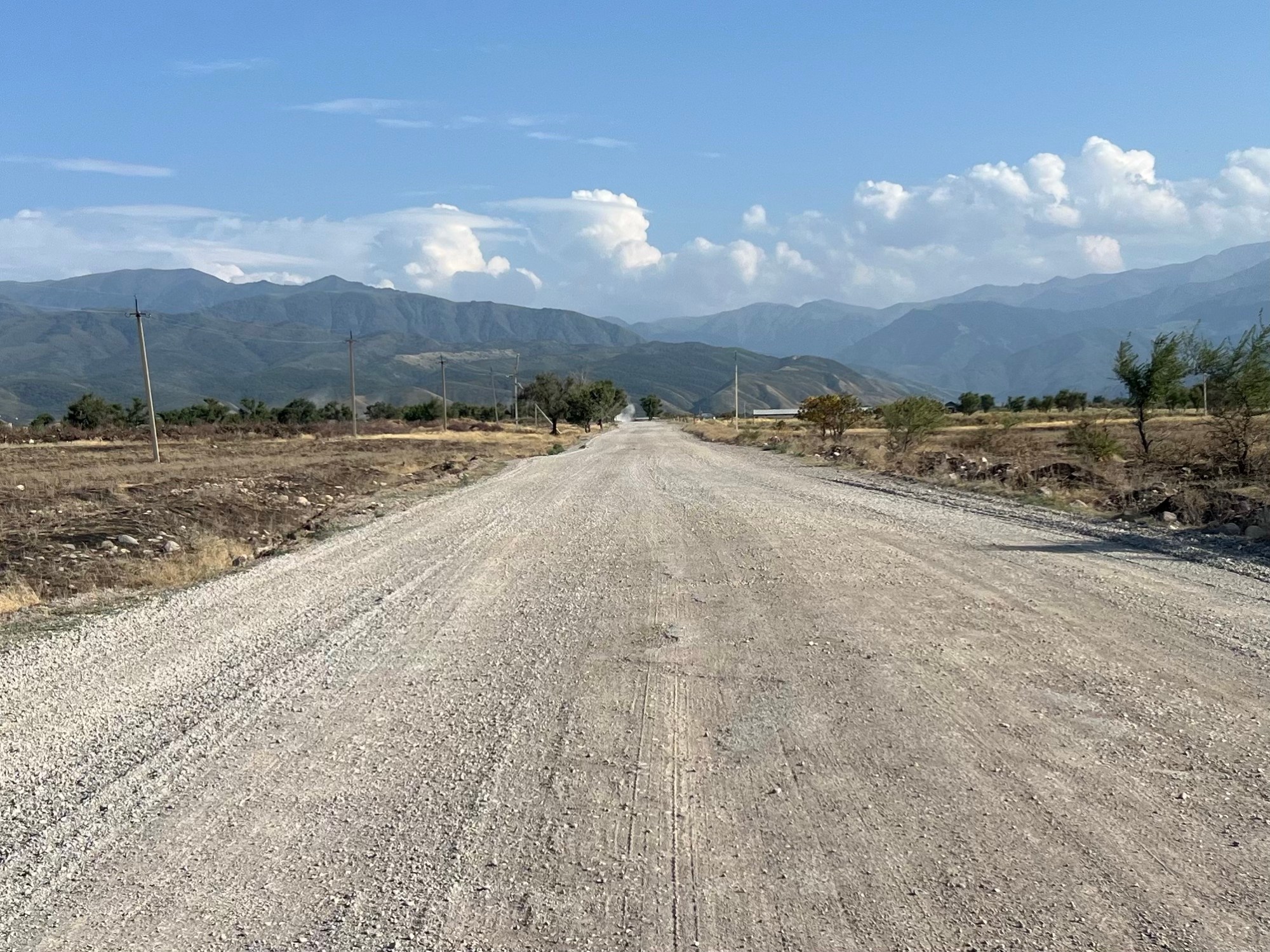
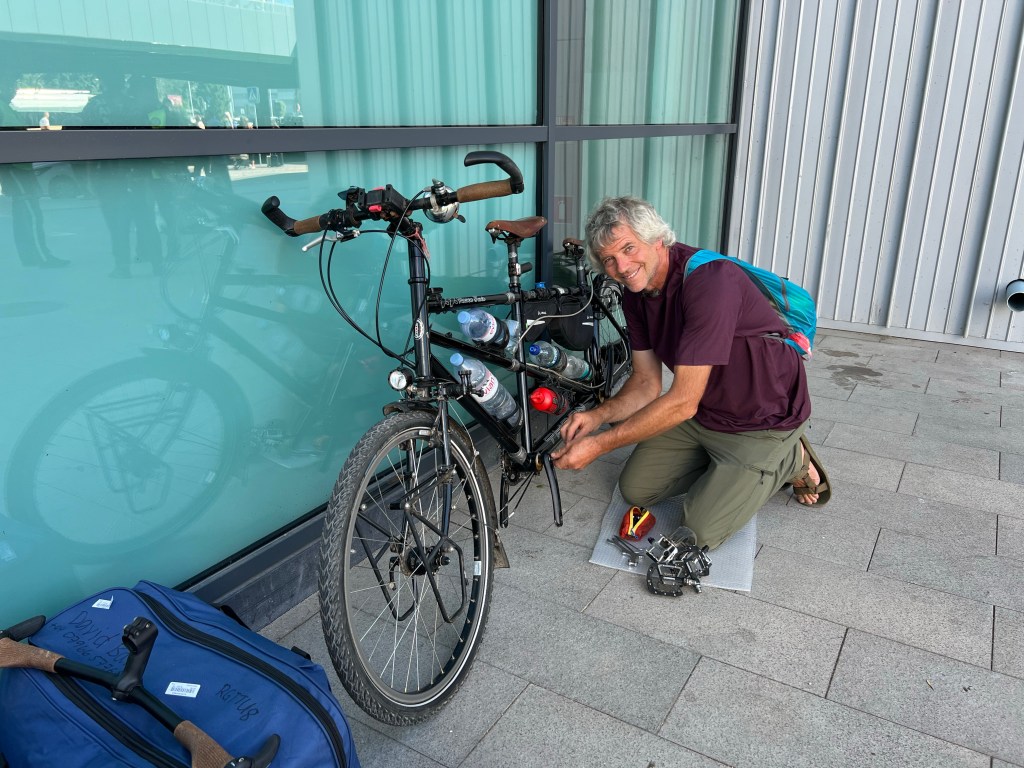
Touched down in Almaty, Kazakhstan,a very short night flight from Istanbul, left us rather jaded! We found a quiet, shaded spot outside the airport to rebuild the tandem. The sky was blue and the snow capped Tian Shan mountains, that make up Kyrgyzstan, towered to the south. The bike soon took shape and we were on our way navigating the suburbs of Almaty in the hot sun.
We picked up a route alongside a water irrigation canal, a relict from the Soviet days and the vast agricultural collectivisation schemes that cultivated colossal areas of wheat to varying degrees of success. The water is transported for hundreds of miles from the Tian Shan, irrigating the arid steppe. For us the proximity to the water was cooling and acacia trees had sprouted giving pleasant shade and protection from the menacing dry headwind. The lofty snow covered peaks set above immense walls of rock to our right side were a chilling reminder of the barrier between us and China that we will be picking our way through, finding a series of valleys connected by challenging, often freezing high passes, we will follow routes made by merchants on the Silk Routes to the orient for all of time.
It was about 40 km to Esik which felt long in the heat and our weary sleep deprived state.

Arriving at Slova and his young families plot growing vines and making cheese felt like a welcoming oasis. He kindly helped us get SIM cards, always a challenge in a new country with the language. Helen’s Russian that she has been working so hard on is helpful particularly with understanding the writing, but it is tricky to get by with sorting some things out.
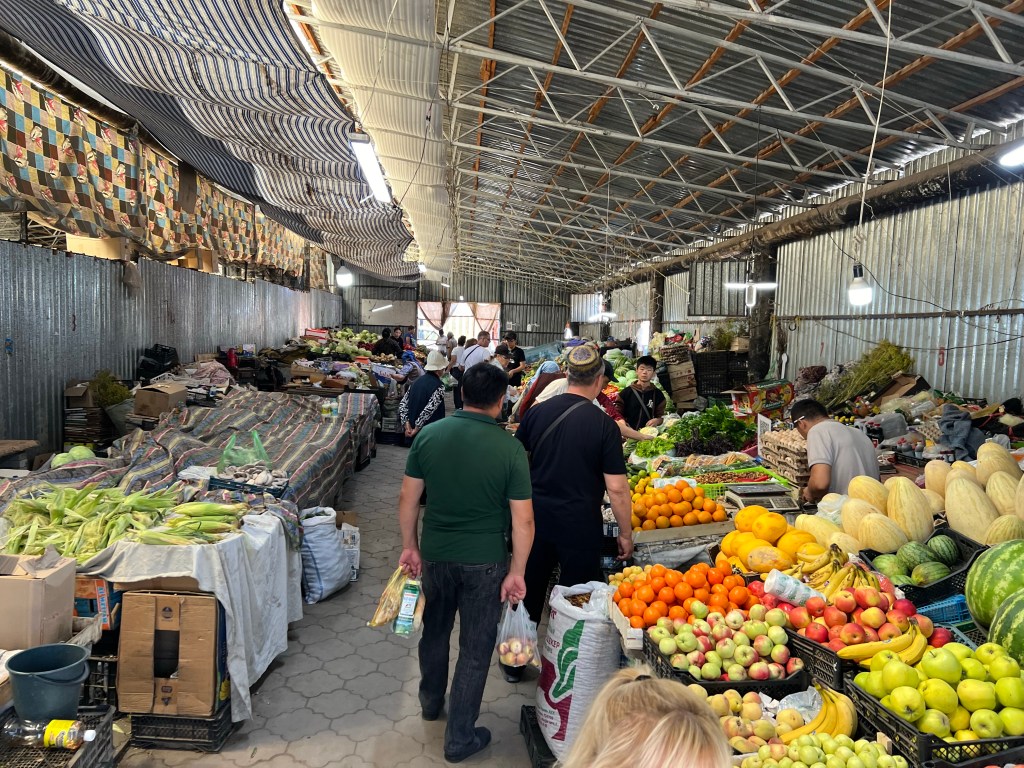
A lovely array of local produce stacked out the stalls in the market and made for a great selection for our supper supplemented with Slava’s homemade cheese and white wine. Colourful parasols shaded the warm hearted characterful ladies selling the wholesome produce.
Exhausted we slept well in the tiny house set in the small vineyard.

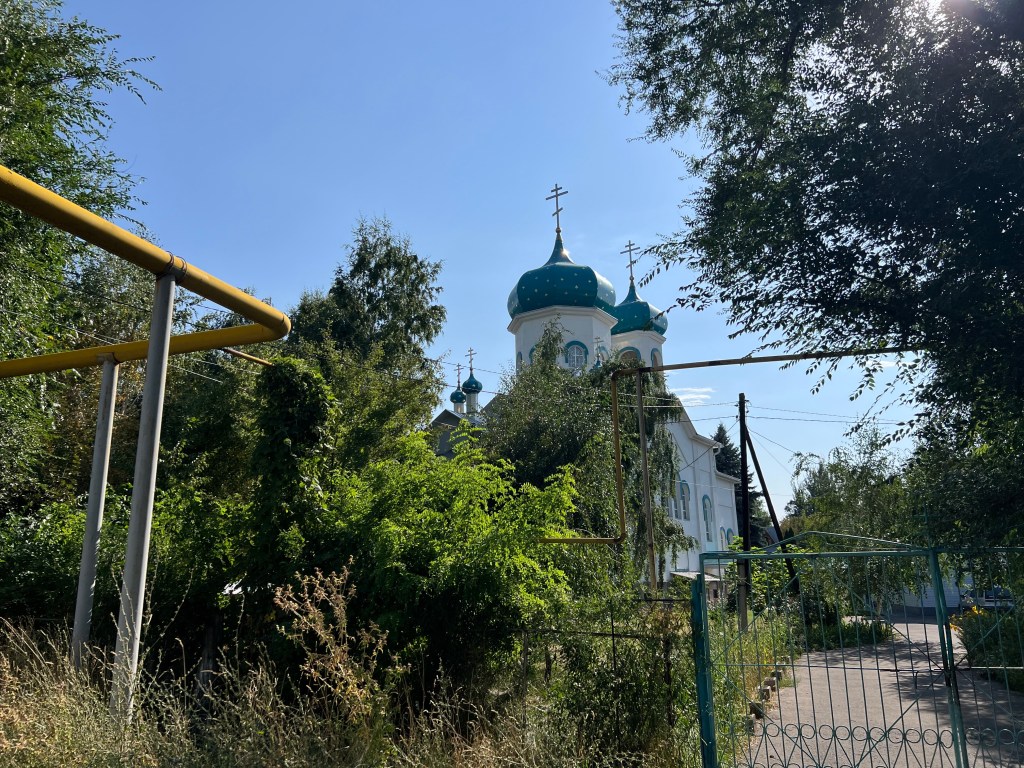
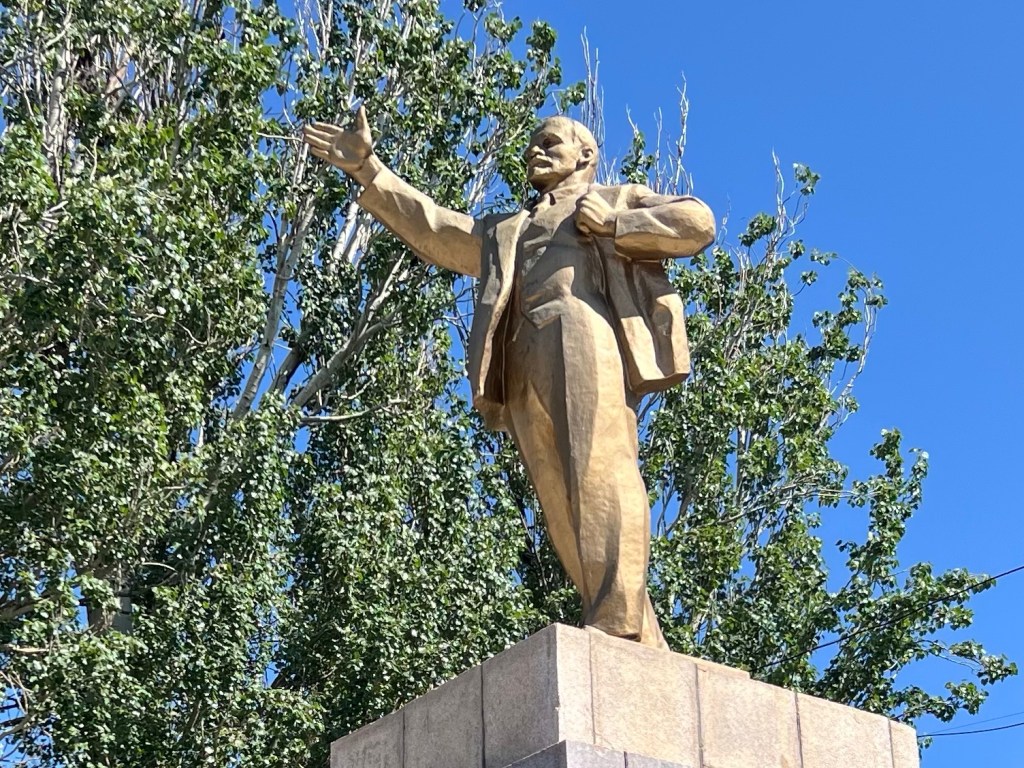
Today was all about finding our feet and we spent a second night in Slava’s garden. We ventured out to the next town stopping at the market, a place for lunch, and some shops to take on supplies. We covered sixty kilometres and enjoyed the lovely encounters and appreciated learning bits and pieces of Kazak life. The bread lady in the market shared slices of melon with us and chatted. A shop where we stopped for a drink brought us wild raspberries that are grown up in the mountains at 1500 metres and huge strawberries while we chatted with a young trainee teacher. We were given Kurt, a national food, made from sour curd. It sucks your mouth dry of any moisture, not an altogether nice experience. We drank tea served from large jugs with our lunch. The peoples faces are warm and kindly. A mixture of slightly oriental looking and harsher lighter skinned faces perhaps from Russia or the Caucuses. The ancestry is ethnically diverse. People have arrived from the east and west, plus there was a lot of forced movement of people to Kazakhstan during Stalins time. There are mosques and churches, both are ornate and domed. This contrasts to the harsh nondescript buildings around and the overhead yellow gas pipes that dominate the skyline.
We took a rough track back. The mountains were behind us. A herd of cows were being tended to by two men on horseback. Then there was another horseman with his goats following him along a crest of a small hill.
People keep buying us chocolate! The generosity of strangers.
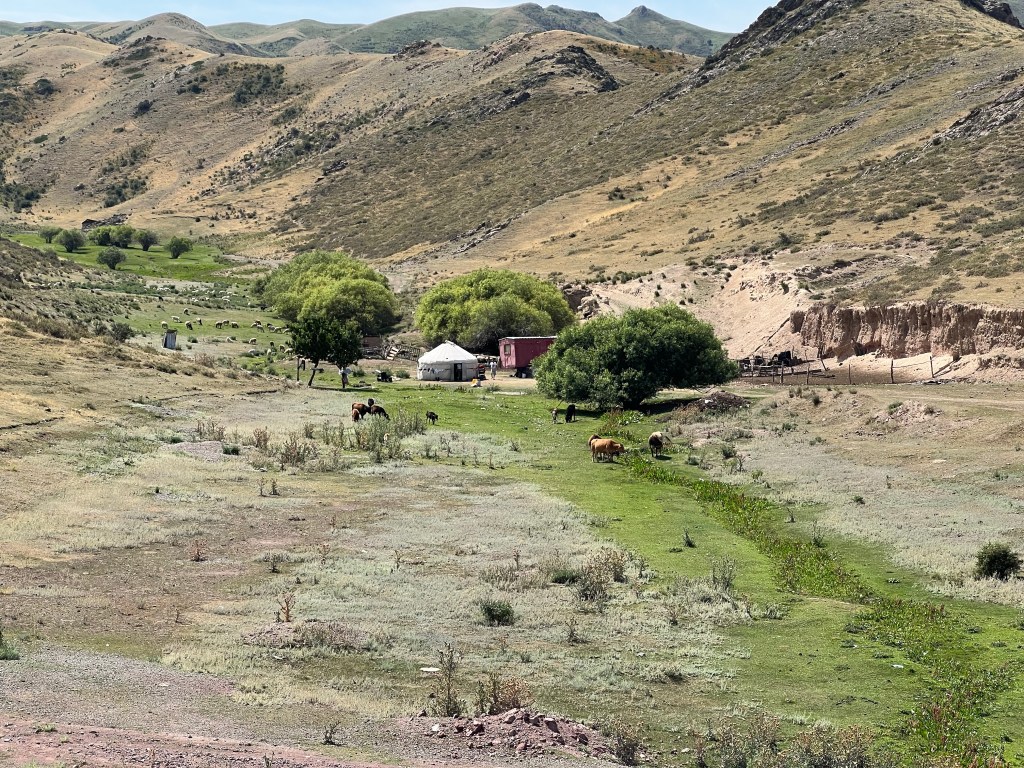
We have been climbing since leaving the canal and the scenery has changed. Arid impressive landforms are interspersed with greener valleys that support the odd farmstead. A yurt, some cows and a flock of sheep grazing on the parched grass of the steppe. Sometimes a few ramshackle corrugated iron buildings complete the little farms. Mountains separate the plains and the scene becomes more rugged and empty. Graveyards stand in quiet locations a little way from settlements. The view across this land reminds us of the start of the Sahara in southern Morocco and parts of Namibia, the colours of the parched grass set against the sandy coloured rocky soil and the rugged mountains in the distance, their purple hues silhouetted against the sky.


We have now climbed to nearly 2000m elevation and getting close to the Kyrgyzstan border. We wild camp in the mountains by a river about 6 km before the border.
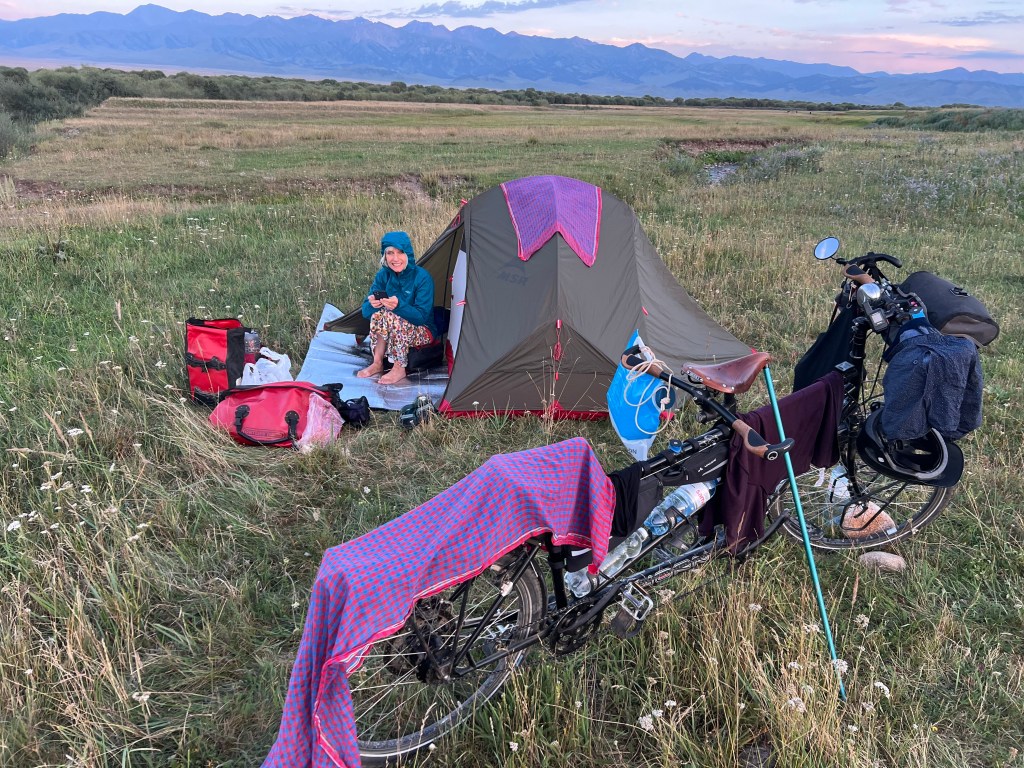

The riverside camp set in a lush meadow adorned with wild flowers and back dropped with the mighty Tian Shan range had quite an Alpine feel. We washed in the icy meltwater river that flowed swiftly past on its journey to the Charyn Canyon and then beyond through desiccated mountain ranges and cutting into the parched steppe, eventually petering out and never reaching the sea. In just three days we have experienced all the river’s passage will see, harsh sparse landscapes in soaring heat, craggy mountains and sculptured canyon. The ambitious severe engineering of the irrigation canal from the Soviet era mellowed the landscape of our first day, turning the land into a green productive fruit farm. The mighty slabs of concrete running for hundreds of miles, along with various dilapidated bleak structures and failed farms, were a monument to a dubious bygone regime, yet their waters, often leaking as a result of disrepair, still brought life to land.

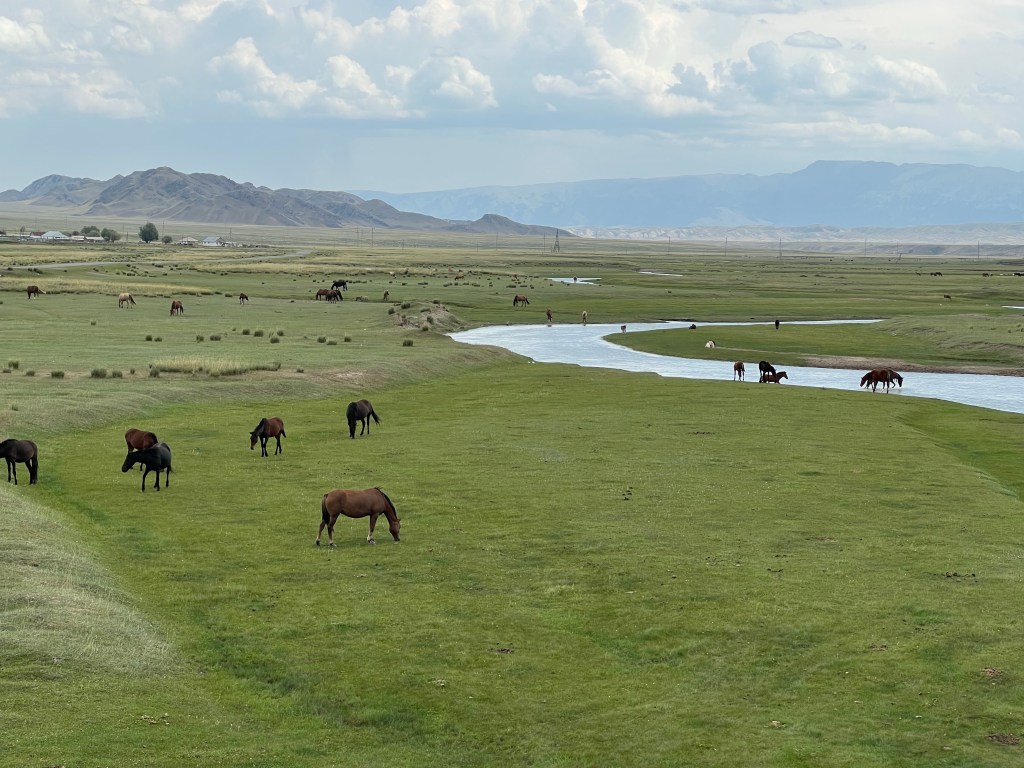
We woke to rain, heavy cloud hung over the Tian Shan, the day before we had been in 35 deg C, sweating our way across the mountains and steppe, now we were cold. We cooked breakfast, noodles, eggs and a tin of sweetcorn, in full waterproofs and huddled in the tent. It was a slow start and we pushed on to the Kyrgyzstan border. The rain became torrential and the road deteriorated after the frontier. We climbed and climbed rough rocky tracks to the Kizil Kiya pass. Thankfully the rain eased and stopped which was a blessing as we pushed the bike up steep rock strewn hills to the top. The views opened out as the cloud hung onto the higher peaks. Vivid green valleys with herds of exquisite elegant horses roaming the panorama. The occasional simple farmstead, old cans and milk churns upturned on posts around little courtyards, shelter provided by a few rusty old sheets of corrugated iron. Smiles and waves from farmers with rugged wrinkled faces. Sweet children come running out and want to just say hi and shake hands in a very polite way. The green mountains rounded slightly, by the harsh ice and snow of the winter, form a rolling vista, set against the towering peaks of the Tian Shan.


We descend into the cultivated flat valley that leads to Karakol. The wild small scale horse and livestock farming higher up has given way to orderly organised arable farming. We look to the distance on our right, the mountain range that we have crossed from Almaty, our first geographical boundary conquered on our journey to India. To our left the more formidable range that is our next challenge. Much higher passes and many days of self sufficiency needed to get through them.
Only four days in, and feeling disappointingly haggard we are having a day off to take on supplies and plan the next section, crossing the Tosor Pass(3900m)
Karakol is a pleasant town with wide tree lined avenues laid out in a Russian grid like pattern. There is a spectacular timber church with shiny gold domes. There is a mosque that resembles a Buddhist temple, not so surprising as the Dungan Muslims of this area originally migrated from China.



We decided to add in a side trip up a valley in the Tian Shan to try and improve our fitness and acclimatisation in preparation for the formidable Tosor Pass in a few days time.
An early start took us through the sleepy Karakol streets, the day hard got started and the roads were nice and quiet. We picked up the Djety Oguz valley and were soon within the Tian Shan. The road started off good, the mountains towered around us, the track became rough as we got further up the valley. The river thundered past us grey with silt from the glacier higher up, but also white that caught the sun as the turbulent water crashed over the boulders. The narrowing valley echoed with the roar of thunderous water. The rough track became steep and strewn with rock forcing us to push the bike at times.
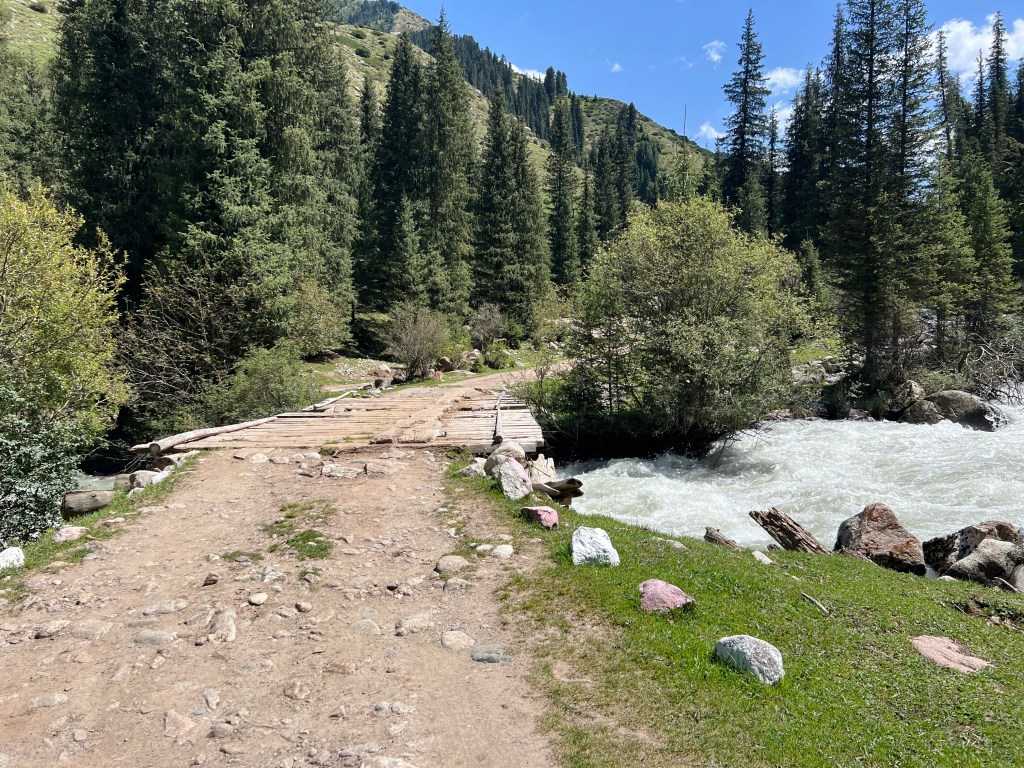
The gigantic scenery was dramatic. We crossed one more rickety bridge made from tree trunks and the rocky road seemed to end. Ahead was a muddy green pasture covered in boulders of all sizes with the river now narrower, rushing its way through it. Our map showed a track, but it was almost impossible to see. The vivid green pasture must be completely engulfed by the river at times. We pushed our bike across the undefinable route through muddy ruts and over big rocks, with the hope that things would improve. Souring snow capped rugged mountains were ahead of us. The vista was stunning as the river rumbled through the chaotic mass of rock. Horses roamed the rocky grassland. We pushed on sometimes unloading the bike to get it across streams and over boulders. It was hard work and took all our strength.
As we came round the next corner feeling shattered, the huge snow covered mountain, ‘The Borris Yeltsin Peak’ was majestically ahead of us, set stark against the rocky lower peaks and all contrasting with the dark green tree lined mountains of the foreground and set off by the vibrant pastures with grazing genteel horses and bulky cows.


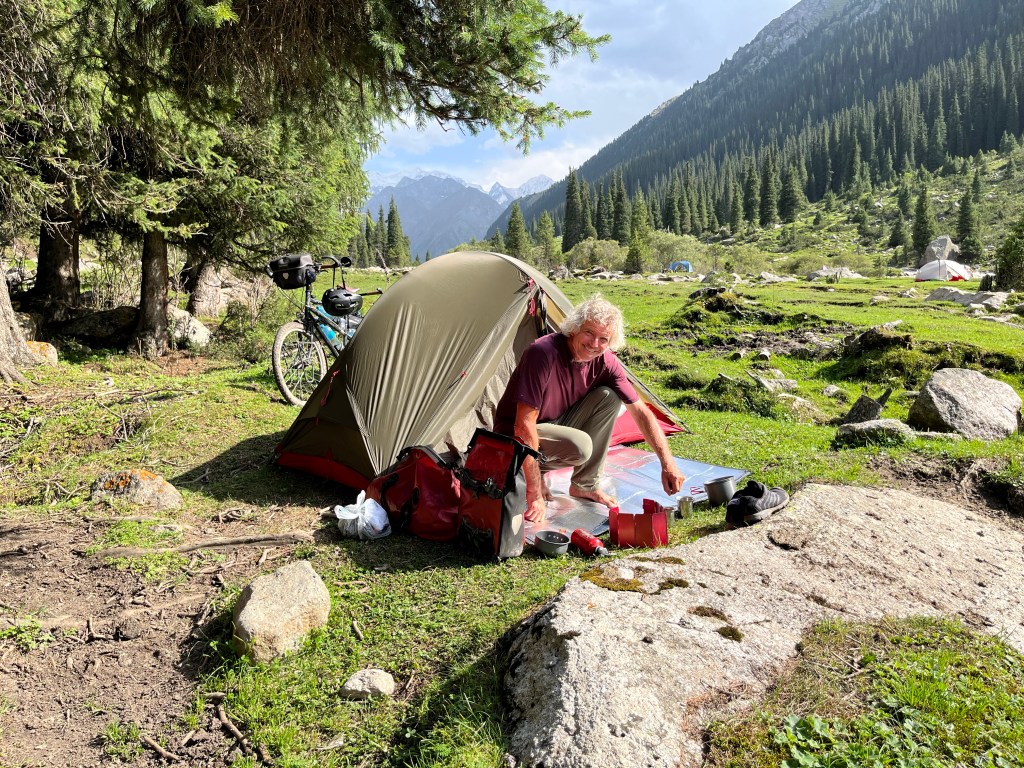

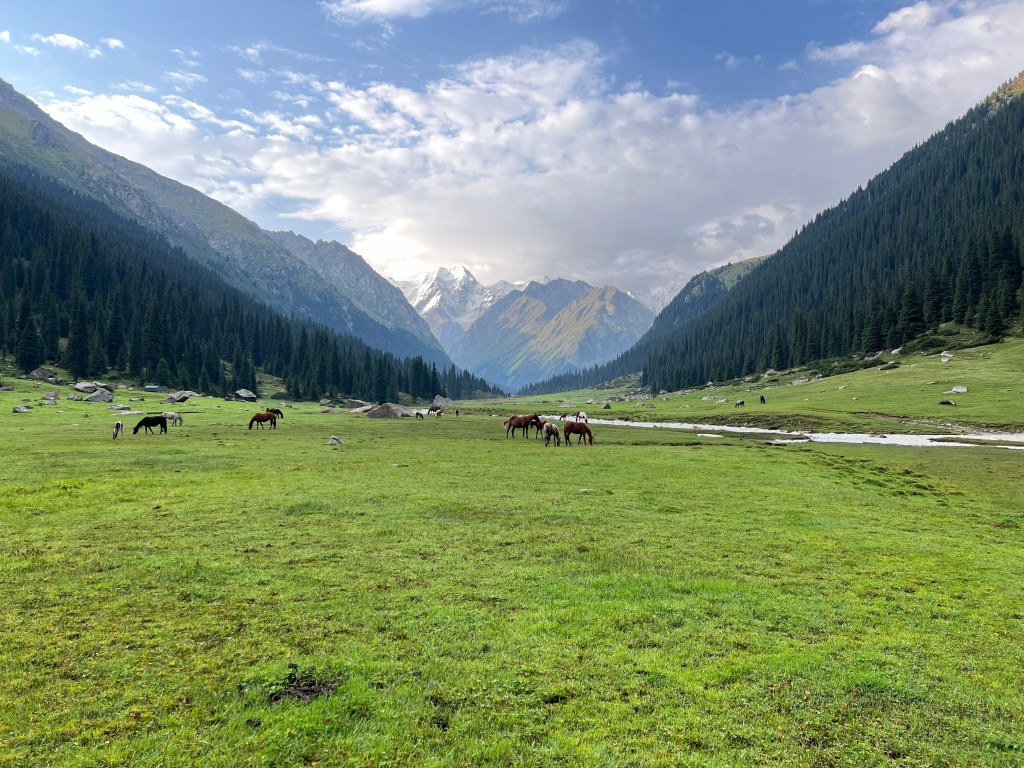


A group of Russian trekkers were just pitching their tents close to the river in glorious sunshine. They had just come off the higher mountains from an eight day trek visiting glacial lakes and crossing high passes. They were an organised group of ten guests and two guides from Moscow and St Petersburg. A lovely friendly bunch and we had great chats with them. The two guides who were also Russian were carrying 35 kg at the beginning of the trek! We marvelled at how to carry all the food for eight days.
We pitched our tent close to some trees where we could hang our water bladder and filter kit. I improvised a slightly less freezing shower using the water bladder and mixed a billy can of boiling water with the icy glacial melt water from the river. It was pretty good and took the edge off the bitterly cold water. The river roared loudly. Horses galloped through the camp, herded back to the farmstead by young boys on horseback.
It was a magical wild place.
On the We meet two elderly slight Singaporean people, 75 and 73, boldly heading up the track to the high mountains on a multi day expedition, led by a muscular local guide.
The next morning we headed back down the valley and on the way met a gorgeous elderly Singaporean couple, 75 and 73 years of age, boldly heading up the valley on a multi day expedition, lead by a muscular guide with a beaming smile carrying a huge pack. Their slight kindly demeanour contrasted with their guides strong bulk. It’s inspirational when you meet these adventurous people that are a lot older than us.
A little way down the valley we stayed in a Yurt camp. It was the weekend and many locals come out to these valleys to stay in the yurts and enjoy the mountains. It was a different world to higher up the valley but fun to see everyone enjoying themselves. There was horse riding, archery, shooting and playing on makeshift swings. A charming group of Russian families from Moscow were staying at our Yurt camp as part of a summer holiday tour to Kyrgyzstan. They were so nice and invited us to join them. We had a wonderful time chatting and walking with them to a waterfall.
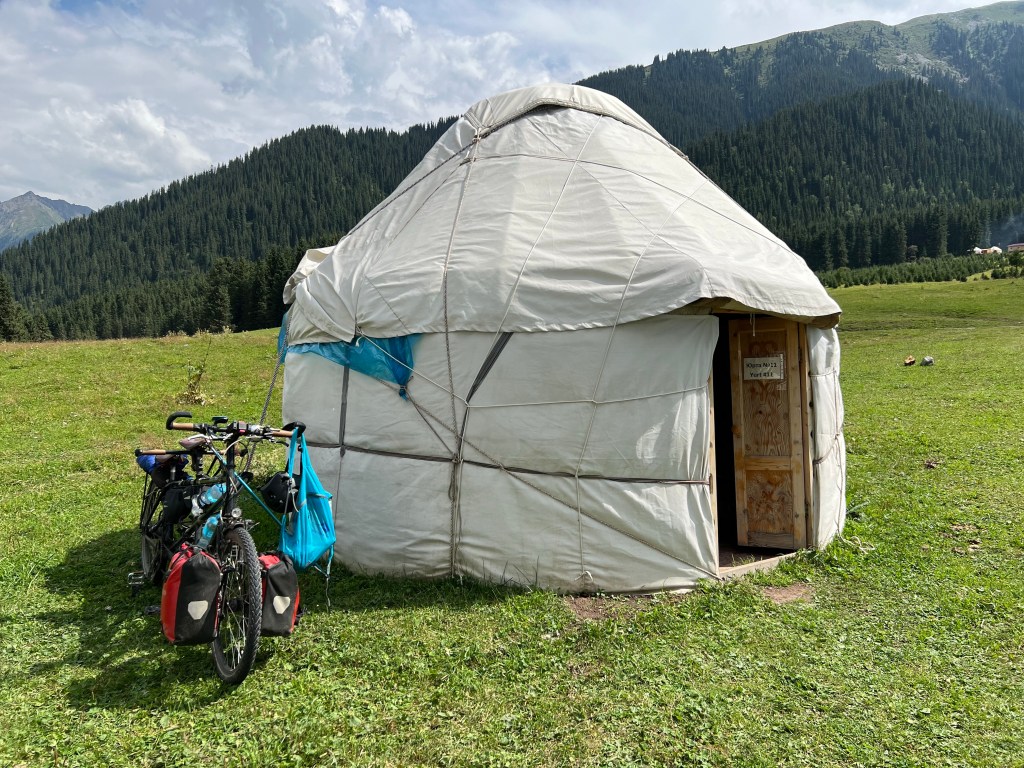


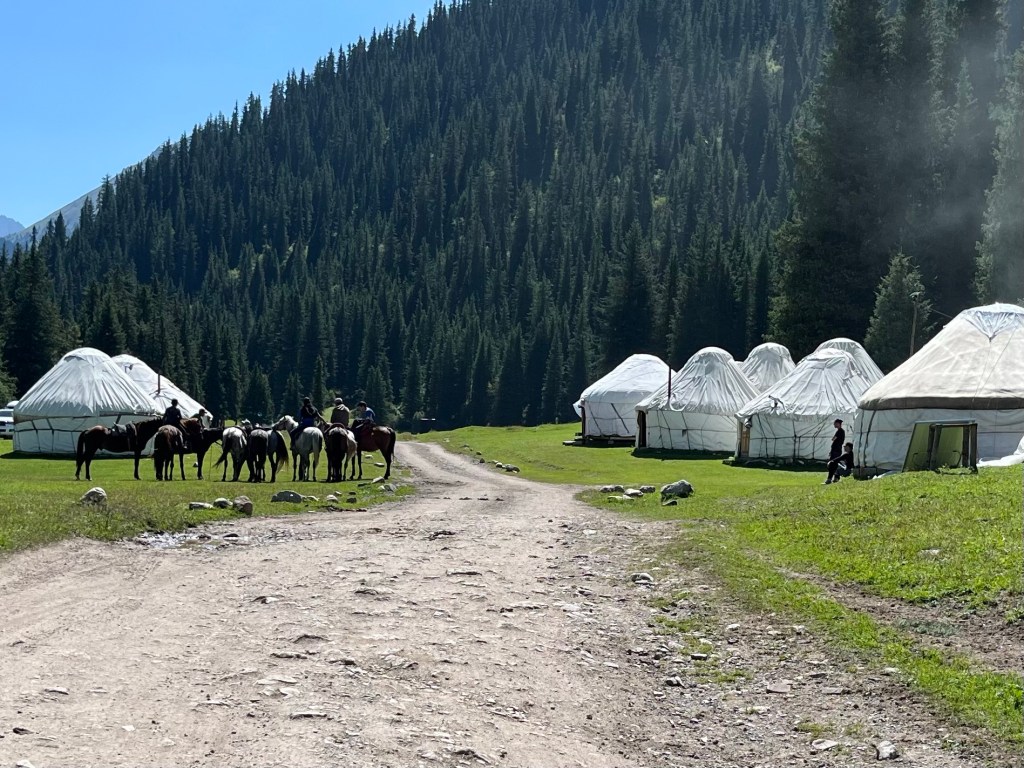
Two very different groups of Russians that we had the pleasure to spend time with. It’s always so nice when you meet like minded people and hear all about their travels and adventures in the wild and remote parts of Russia.
We return to the shores of Lake Issyk Kul to plan for our crossing of the high mountains to Naryn on our way to China. These routes over high passes have been used for centuries as part of the Silk routes to China and the Orient.
We left the huge expanse of Issykl Kul lake, with the sun rising behind us, giving the rippled water a yellow tinge, and set off to start our climb following the Tosor river towards the formidable Tosor Pass.
This part of the Tian Shan was our next barrier that needed to be crossed as we edged closer to China, following in the footsteps of the merchants of the silk route.
For us it was a daunting challenge ahead. We had not tackled rough tracks at altitude on our previous journeys and we were unsure how our bodies would cope. The rough remote terrain we are familiar with, but the work at altitude to peddle our bike loaded with four days of supplies and weighing 70kg was a concern. We felt apprehensive and flitted with plans of which pass to take over the high mountains, the Arabel or the Tosor. Both had different merits but after going from one plan to another we chose the Tosor. A harsher ascent but a more defined peak meant that camping at the top was very unlikely. We could cycle the track to say 3200 metres camp and then get over the top to a similar altitude camp on the other side. The Arabel has a very broad summit and a camp at nearly 4000m would be necessary which we were worried about.
The day had arrived to go for the pass. We felt confident our time in Karakol and our training trip up the Djety Oguz valley had put us in the best state to tackle the Tosor with the best success.

Soon we were engulfed in a small rocky gorge with a narrow track climbing and clinging to the steep cliffs, twisting and turning we followed the river that was tumbling over the rocks. More of a mountain river babbling over the boulders and the clear waters quite different from the thunderous grey torrents from the previous valley that were flowing directly from the glaciers high up in the Tian Shan.
The gorge soon opened out into a large vivid green wide valley with grazing horses and cows and a few little farmsteads made from corrugated iron and mud bricks. The common sight of dried dung ‘cakes’ were in neat stacks along by a simple fence. This is useful fuel for cooking and heating as there are very few trees in this region. Small streams snaked down the rocky mountains higher up and meandered through the verdant life giving productive valley.
The track left this fertile oasis and started climbing through rolling green mountains on a vast scale. The less verdant short grass that covered the landscape was scattered with rocks and gave way to harsher craggy relief higher up. Snow capped peaks sat against the clear blue sky towering high up in the distance. The weather was perfect, calm and sunny.

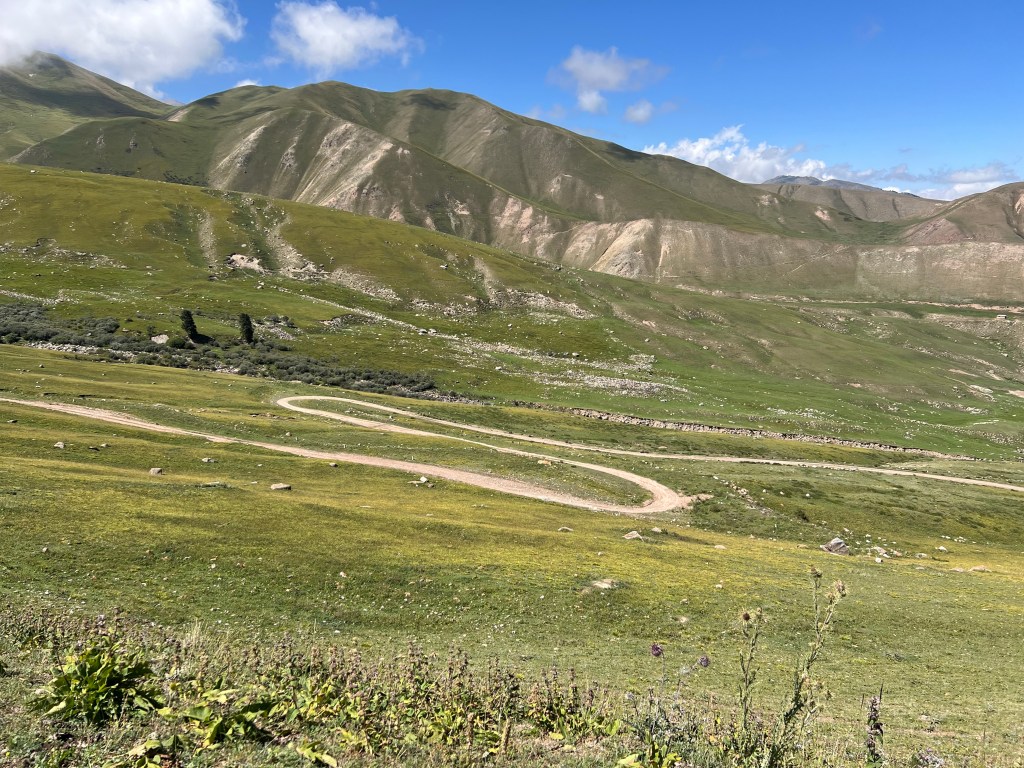


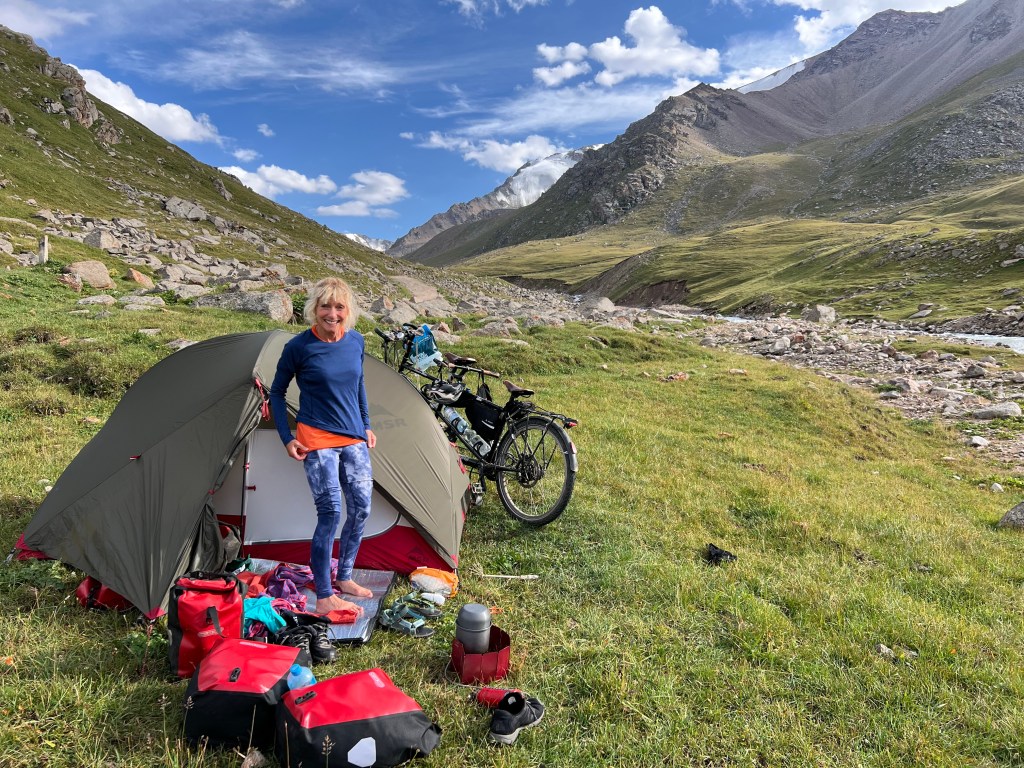
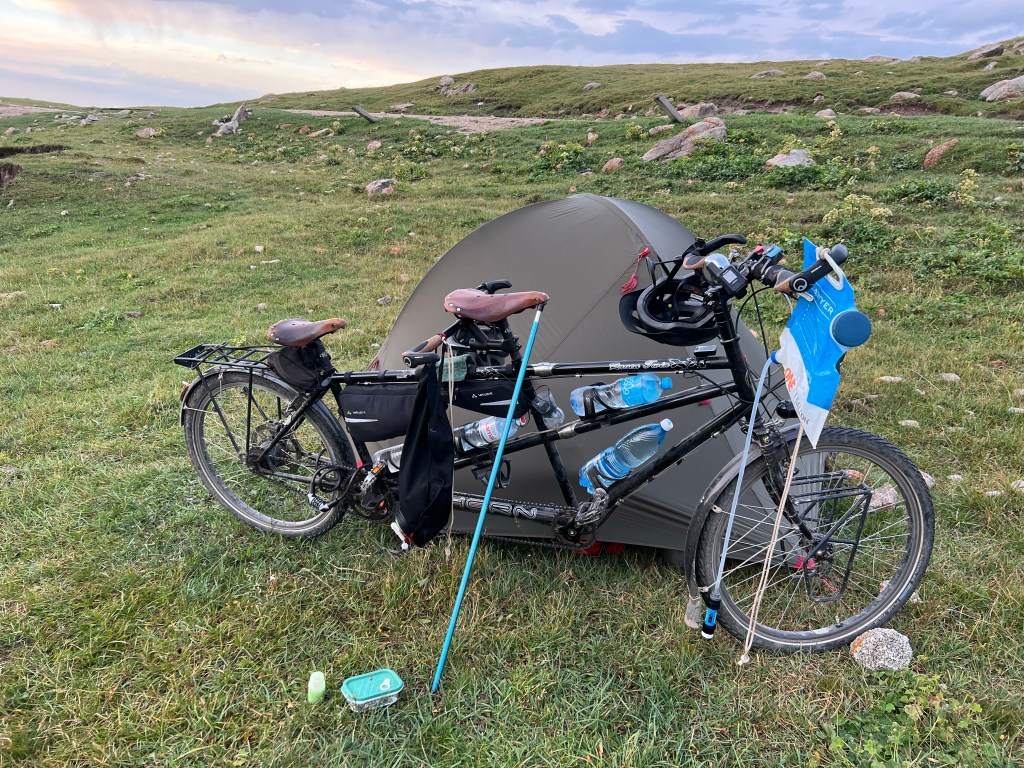
Our rocky way climbed and climbed. The route twisted turned, and zigzagged its way up and up gaining altitude all the time.
We pushed on slowly, needing more rests as we got higher. We were aiming for ‘the last shelter before the pass’. We didn’t know what this was but it appeared on our map. It’s strange how obscure places like this become the all consuming focus of a day! Our progress was better than expected, 1300m climb in six hours and we were able to push on higher than this place that turned out to be an animal shelter. We were feeling strong but sensibly started to look for some fairly level ground to camp near a river at 3200m elevation.
Just then a group of four mountain bikers were ahead coming down from the pass. We had a lovely chat with them in broken English. They had all the gear and lycra but like us were on a challenging multi day expedition. They were young Russians and we feel for them when we ask the inevitable question “where are you from?” Sheepishly they reply “Russkiy” as there eyes don’t quite meet ours in a slightly uneasy stance. We respond with warmth and positivity and and the mood is changed to meeting like minded adventurers. Time and time again we come across this, but we are all the same and it is our regimes that are the problem.
We set to setting up camp, collecting water, filtering for drinking water, washing ourselves before it got too cold and cooked supper before falling asleep as darkness fell and the nearby river cascading filled the air with a roaring burble.
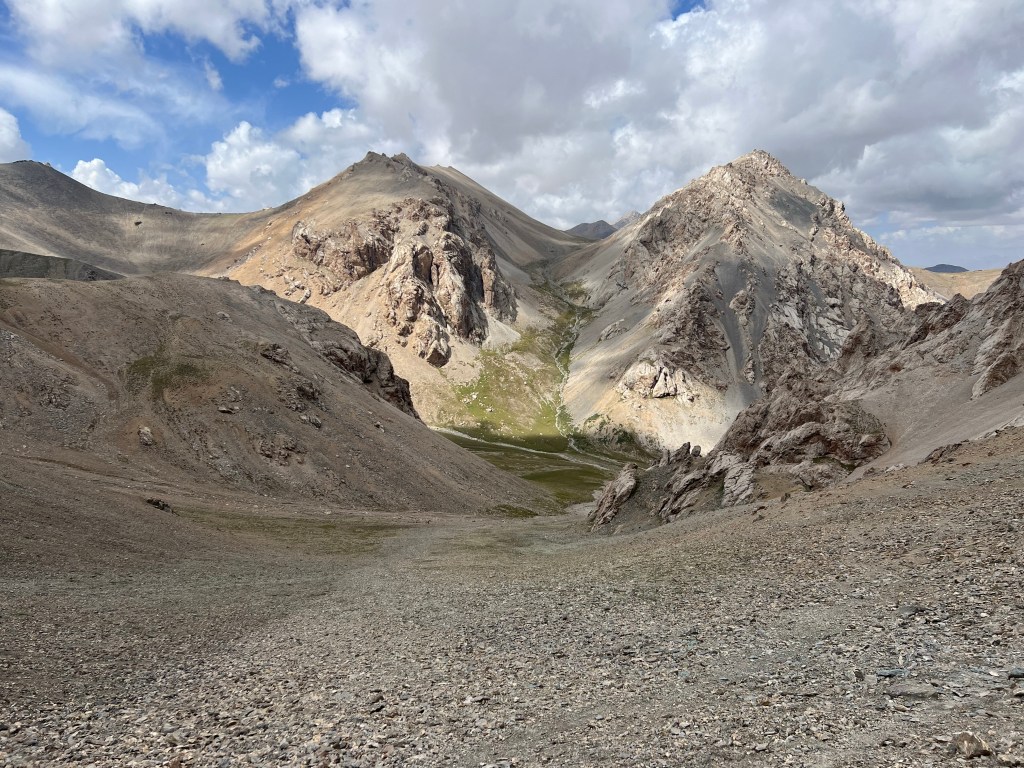
An early start had us back on the rugged route towards the pass. 700m still to climb and soon the rocky olive coloured slopes were replaced with angular hues of grey rock. White ice hung onto the crevices of the northern sides of ridges and peaks. Piles of rock debris formed screes that heaped up against mountain sides. The route was often unrideable. We pushed the bike for lengthy spells, needing to stop regularly to get our breath back. It was brutal. We meandered our way through the harsh terrain between huge mounds of rock debris. The setting was like an amphitheatre made of surrounding high mountains and ridges with threatening masses of fissured ice hanging onto the sides high up. We were centre stage, tiny, and diminutive, finding our way through this stark remote ominous scape. Eerily the ice groaned and creaked and as the sun got higher and warmed the glacier, rocks were released and tumbled down the mountain side making an unnerving reverberating sound that echoed around the theatre. There was a turquoise lake set deep in the geology fed by meltwater and surrounded by craggy boulders and scree.
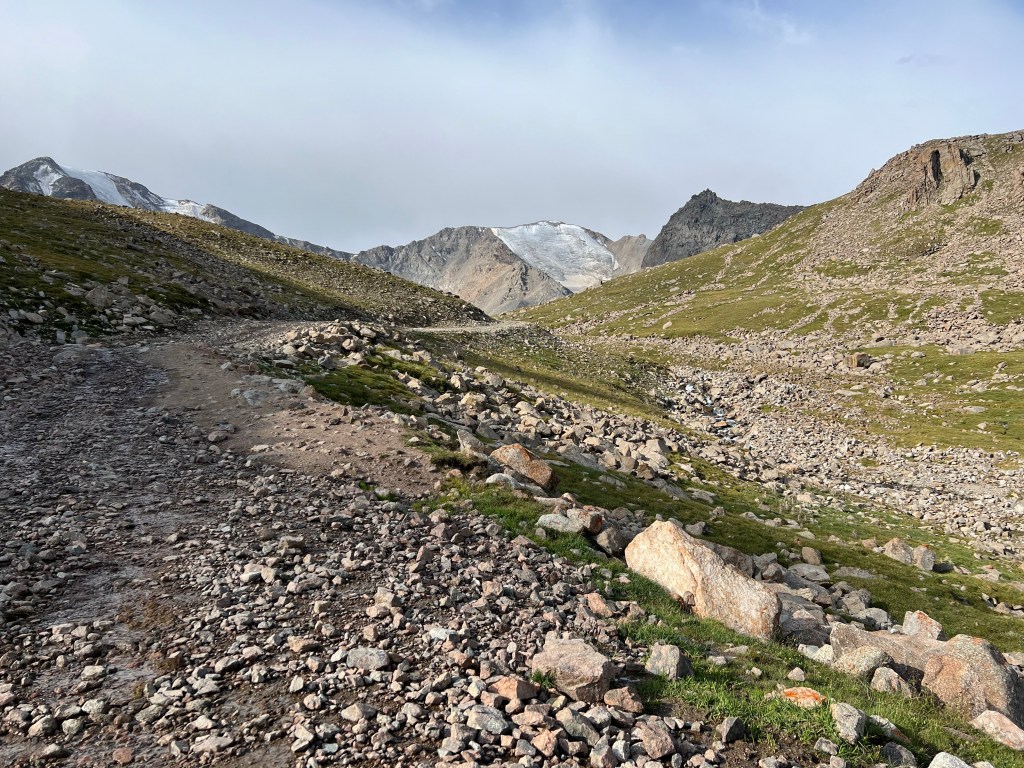
We pushed on higher and higher, gasping for air at times. The scenery was stunning and awe-inspiring. Eventually before us, the dip in the ridge line revealed the pass and the breathtaking view of the next valley flanked by further mountain ranges made a panorama that led into the far distance.


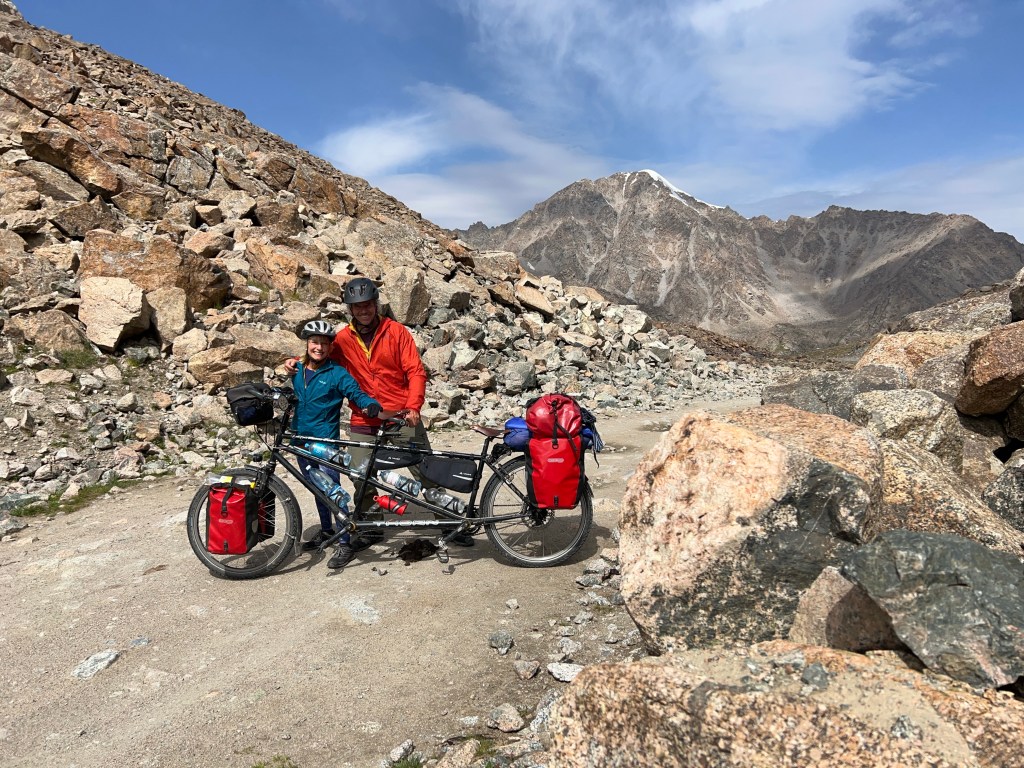
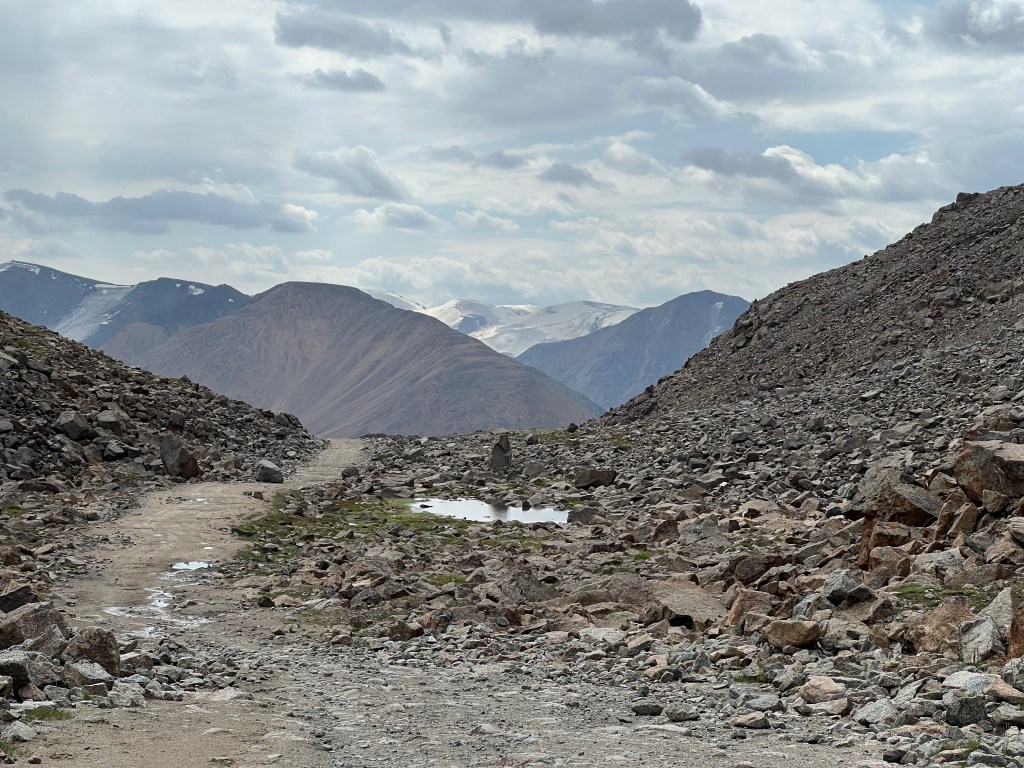
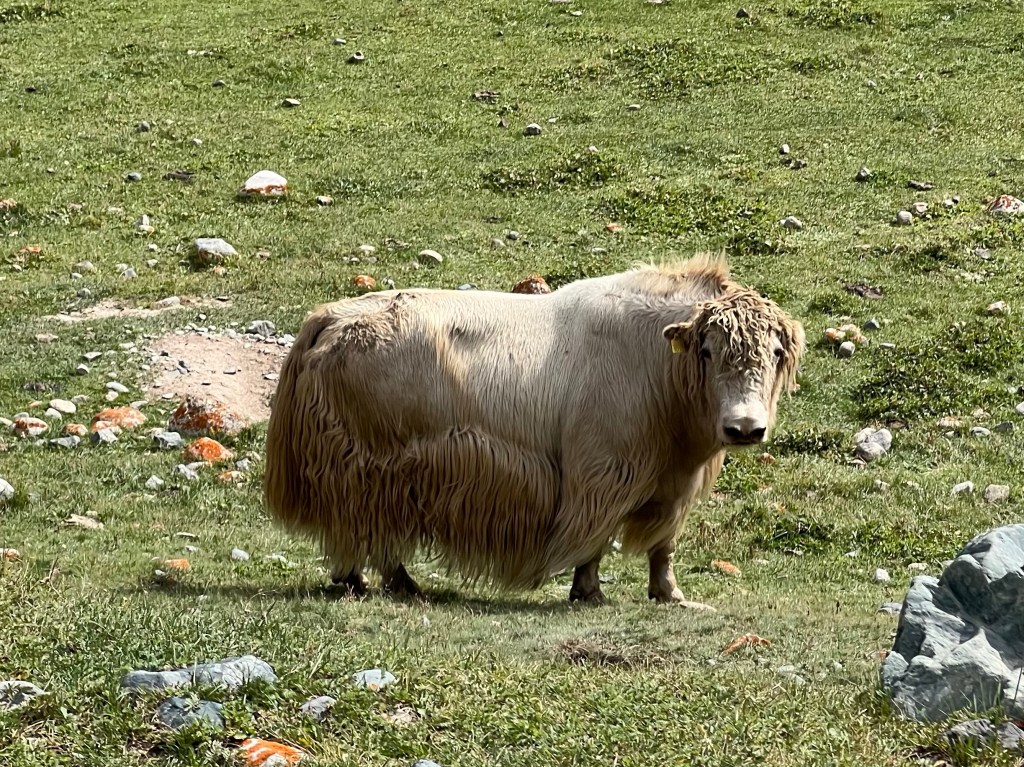
Finally we coasted down hill on the bumpy track. The trail was less steep and we followed the now green again valley systems with the river not far away and accompanied by occasional herds of horses, cows and yaks. Grand horseman herders rode by. Bundled in warm clothing, wearing waistcoats and always with their binoculars in leather cases at their side, they looked the picture of the Kyrgyz nomad herder or perhaps a Mongolian eagle hunter. We wondered whether the treasured binoculars in their worn and battered cases had been handed down through the generations. They rode their horses so confidently and elegantly, it was as if the horse was joined to them, man and horse in perfect harmony. Pristine white and felt yurts positioned on vantage points overlooking the river and hilly valley contrasted with the green land.
We waded through shallow stoney rivers and crossed a rather challenging landslide which involved quite a torrent of a river. Guided by an elegant friendly horseman we picked our way through the boulders and streams until we got to the main flow. This was when having a horse to cross a torrent was a distinct advantage. We had to head down stream until the river widened sufficiently and split into several manageable water flows.

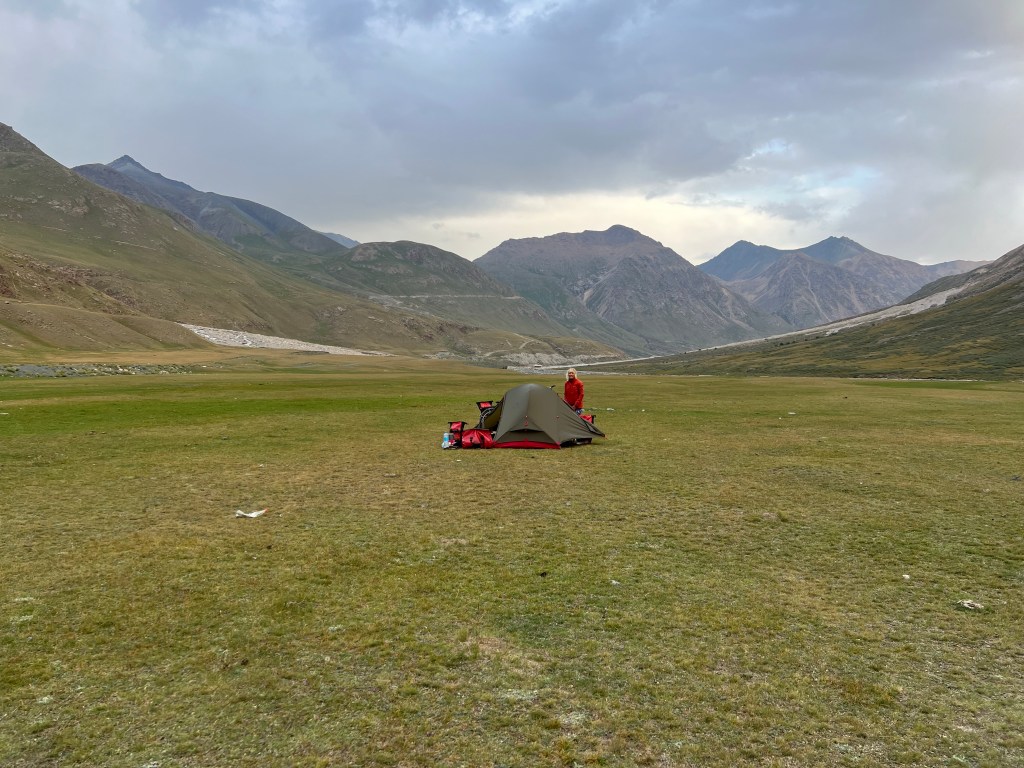


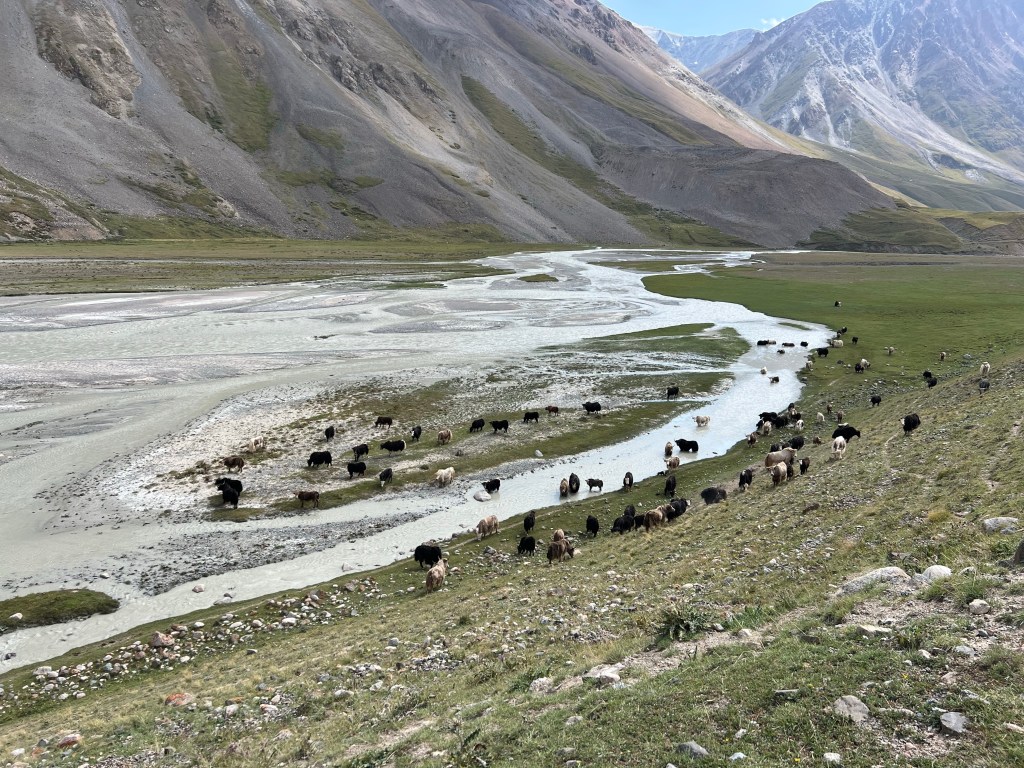

We camped in complete isolation on a wide green expanse. Our little home was diminutive surrounded by colossal scale rugged empty landscape all around.
We followed rivers and gorges all the way to Naryn. Before the gorge we came across our first civilisation, a very small well stocked shop run by a lovely characterful elderly couple. Azzamat, their son had returned home to help with harvesting the families wheat. He spoke amazing English and was incredibly knowledgeable on History of the region. It was fascinating and we could have spent all day listening to him. He was so well informed on every aspect of the colonial and Soviet past, and the interference of the superpowers in the region. We understood so much more after our brief encounter with him. It was particularly interesting knowing about the struggle of the herders during the Soviet agricultural collectivisation times. So many fled to China and Afghanistan. Also interesting was what happened at the end of the collective farming at the time of independence. People didn’t know what to do. The farms weren’t viable and people swapped sheep for vodka and alcoholism became a major problem.
We passed many large derelict Soviet farms, concrete walls and collapsed roofs in ruins. A sad monument to a harsh system based on an ideology.

From Naryn we continue through the mountains on ancient routes to China used by the silk route traders, but we also learn now these were the routes Kyrgyz herders fled to China fleeing from the Soviet Collectivisation and forced labour on engineering prospects. Kazakhstan, Kyrgyzstan, Tajikistan and what was Kashgari were once all the same land before Russian colonisation and like so many parts of the world we travel, the superpowers selfishly divided the land.
The road to China is a good tarmac road. It winds its way climbing out of Naryn, well engineered the ascent to the pass is pretty easy. Chinese lorries bringing Kia cars and containers full of cheap goods come from the Torugart Pass. Empty lorries hurtle back in the opposite direction, indicating the dependence on China for goods. The drivers wave and smile, and give us loads of room as they pass which is so unusual. Over the pass the view opens out to yet another range of rugged snow capped mountains. This is the last range that separates us from China. Eagles with their vast wing span majestically soar about high above us gliding on the mountain air streams.
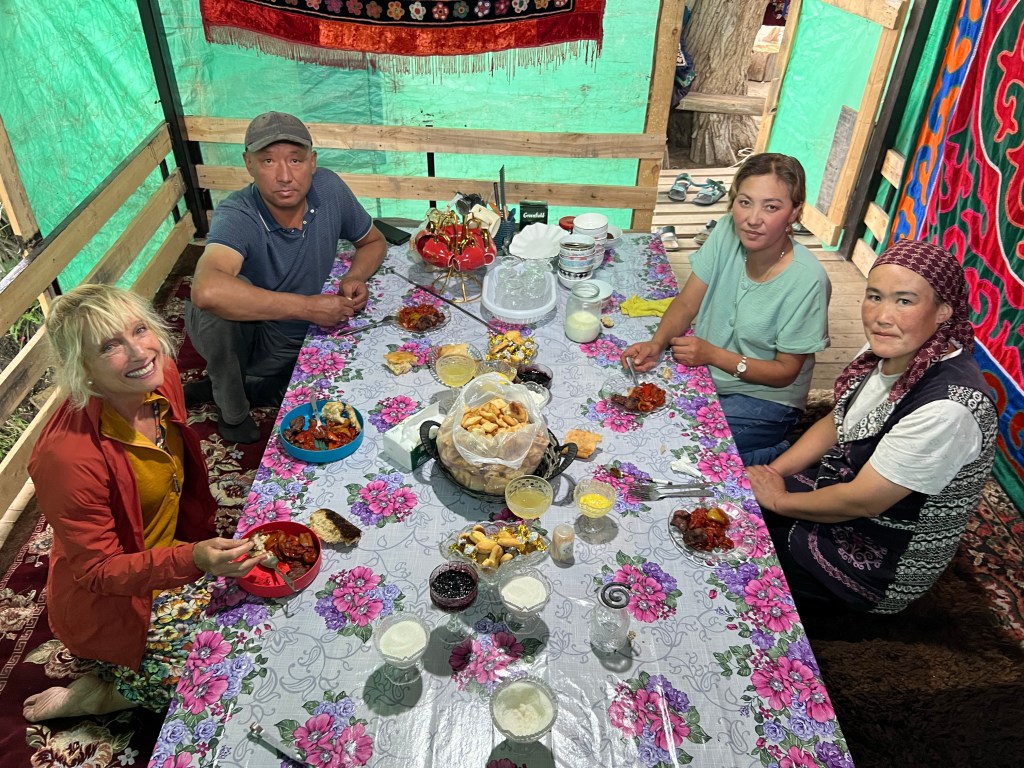
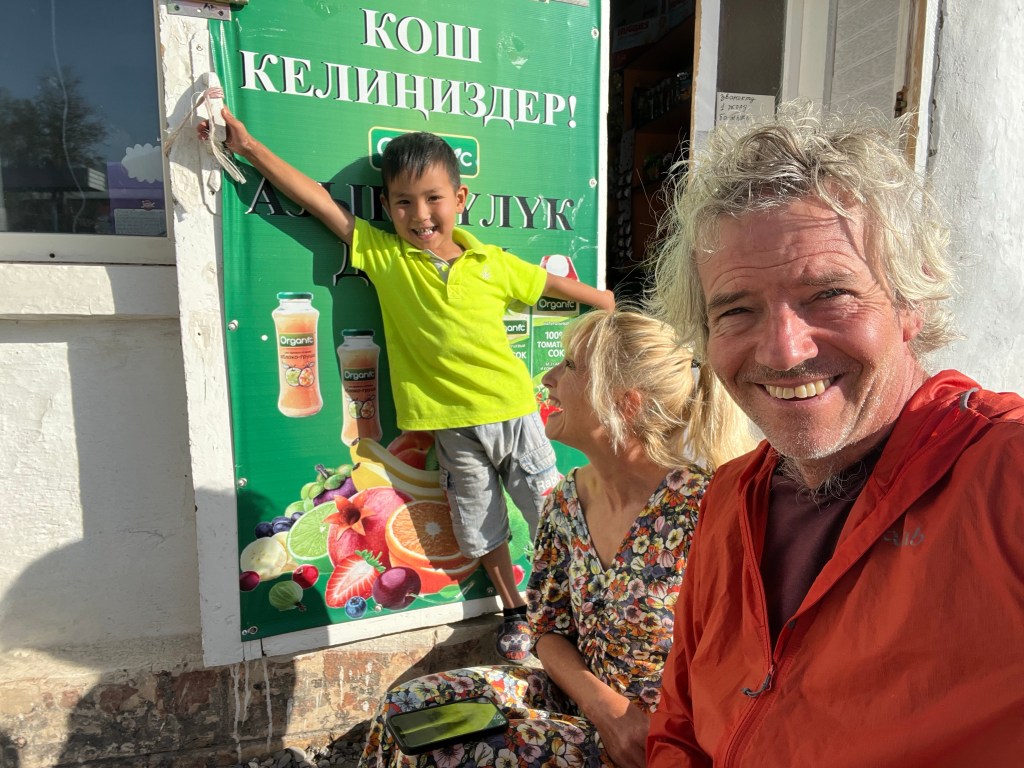
People are so kind. Staying at a homestay we are made so welcome and become incorporated into their family for the evening, sharing tea from an intricate urn, homemade bread and mutton kebabs with us. When we leave in the morning we are presented with a gift of two China bowls. We are so touched with the generosity but have to apologetically decline the offer as carrying them on the bike might be a problem. We stop at a shop to buy a drink which we drink sitting on the concrete step. A smiling young child, the son of the shopkeeper, presses a Milky Way bar in each of our hands.
Bread is such an important part of Kyrgyz life. It comes in different sizes, round and thick at the edges with a thin intricately decorated central part. Much pride surrounds the bread and there are customs associated with it like it must always be placed the correct way up and never upside down. Also it mustn’t be wasted or thrown away. I like the sacred status of bread.
We leave the tarmac road and head on the old route to China following a spectacular green valley, punctuated with huge rocky outcrops. We are heading to a 15 century Caravanserai at Tash Rabat where we are going to camp the night.
The caravanserai is an impressive stone structure built into the hill side and the Silk Road merchants who stop here on there way to Kashgar and beyond. A huge dome makes up the central part which was for religious worship. A labyrinth of corridors and small domed chambers lead of the central corridor and place of worship, providing shelter for the travellers.


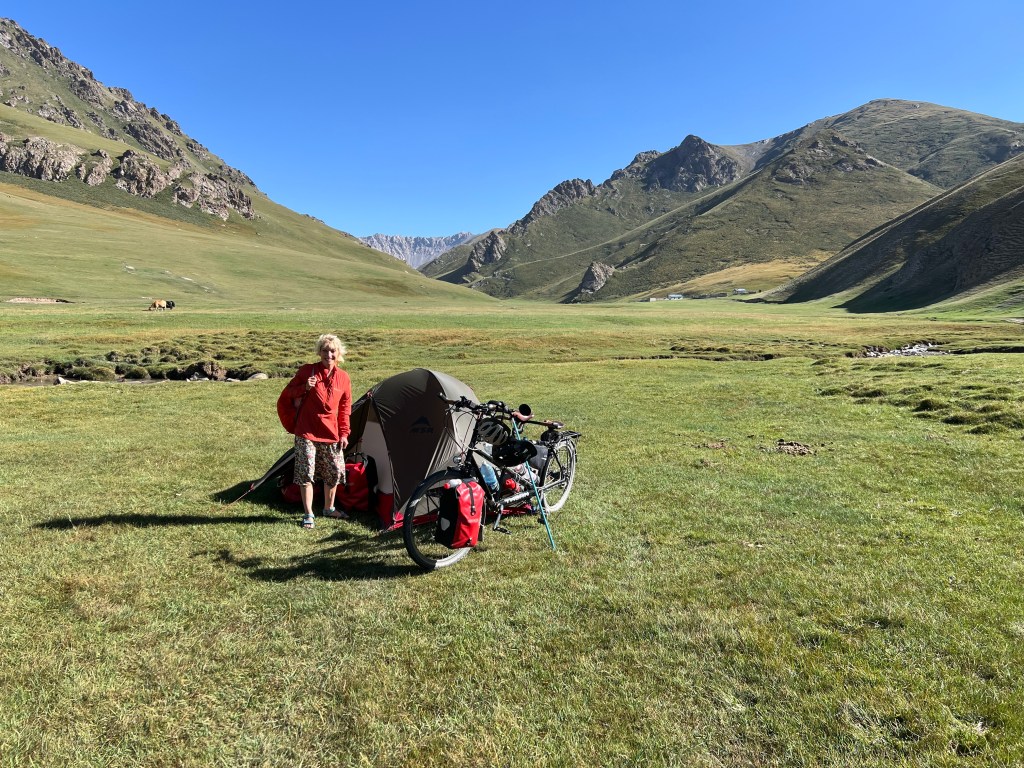
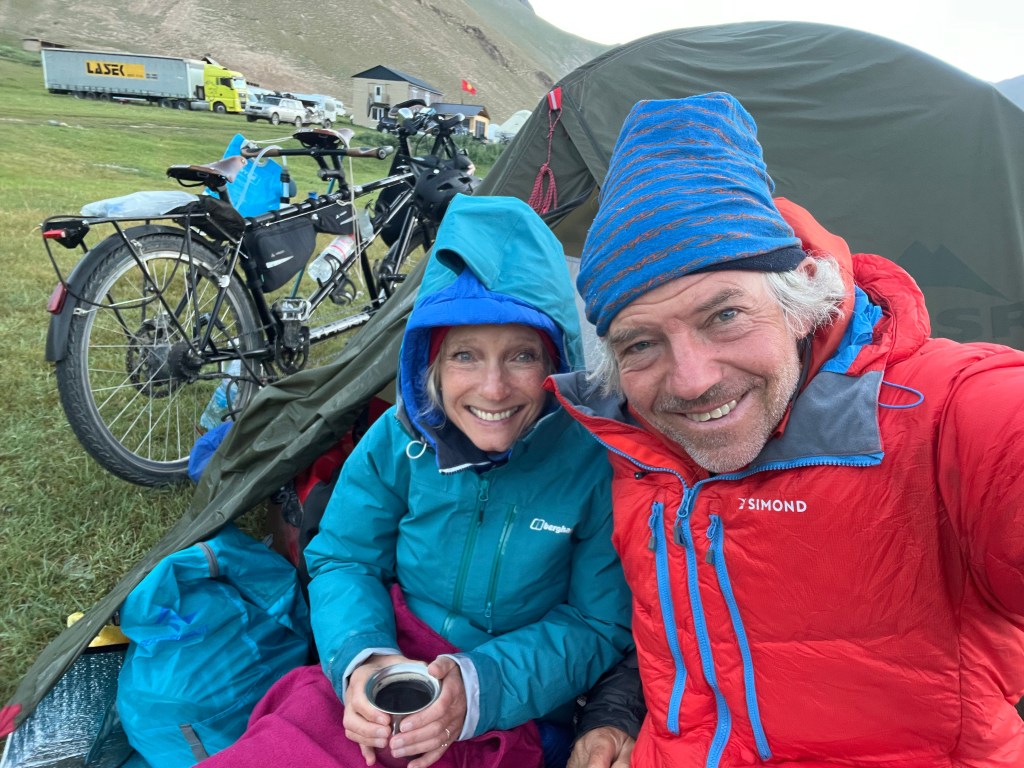
We left the bike and our tent at the caravanserai and continued on this old route to the Tash Rabat Pass. The green rocky valley with grazing yaks and cheeky marmots darting about and calling out with a birdsong type of shriek to warn others of our approach, eventually gave way to oppressive huge rocky scenery all around us. We walked slower as the altitude took our breath away and we thought of the people with their horse and merchandise travelling this way hundreds of years ago on their way to Kashgar a Silk Road hub.
We eventually reached the Pass after a long climb up a narrow trail over a long grey scree bank. Ahead of us in the distance on the other side of the huge expanse of Chatyr Kul lake was the Torugart Pass and the border with China.


Sadly this is as far as we go on the bike or on foot as the area upto the border is a restricted area and we have had to arrange transport from the caravanserai to the China border gate at the Torugart Pass where we will be transferred to a Chinese vehicle and driven to Kashgar where we are allowed to continue cycling towards Pakistan.
After a couple of hours wait at the pass in no man’s land just before the Chinese gate, it was something of a relief when our Chinese arrangement turned up and we could carry the dismantled bike and our kit over the border to the waiting vehicle.
Formalities were stringent. Over the next hundred kilometres of horrendously broken potholed road with queues of lorries sliding around the sometimes awash track there must have been six controls for passport checks, questioning, and searches. Cameras watched our every move from all angles. Even our minivan had a large internal camera installed by the bureau of tourism! to check that our driver was taking the necessary rests we were told. We had one of our maps of India taken from us due to discrepancies of border positions between India and China, making it forbidden material. I was asked to drink water from our water bottles to prove I guess it was water! The road chaos surprised us but this was due to a major road building project through tough terrain. An impressive new high speed expressway was being constructed through this wild valley, on flyovers and tunnels it carved its way plainly through, conquering the challenging relief, miraculously the project shouted out to you the determination of Chinese engineering. This will connect Kashgar and Kyrgyzstan more closely, cementing the Chinese Kyrgyz economic ties, and for sure their dependence on China. When the final layer of smooth tarmac was triumphantly laid the machines and roadside were decorated with numerous red flags saying “Xinjiang One Road, One Belt Project”. Our guide says it is propaganda. The slogan describes the massive investment that has been going on. The ‘Belt’ is the economic powerhouse that has been invested in this part of the country to feed into all the neighbouring countries of Central Asia. The ‘Road’ are the links to the port near Karachi in Pakistan that the Chinese are building and have a 40 year lease on, and the high speed road and railway that are being built through Kyrgyzstan and Uzbekistan to eventually link to Europe. They call this the new Silk Road!
Since the Uyghur uprising of 2009 and the crushing of an independence movement Beijing has invested hugely producing an economic zone in the far west of Xinjiang that will dominate Central Asia.
Our guide is disparaging of the neighbouring countries saying they are poor, they produce nothing and they are reliant on China. China is great he says and when talking about engineering projects round the world he says now it is China’s turn. He is a Uyghur man
It’s been a long day and we are exhausted. We are plunged into a very different world from Kyrgyzstan. The mountains aren’t so green, construction on a scale you haven’t seen before, vast areas of Industry, a lone yurt on an island of carved up landscape, fenced and gated villages with rows of identical houses in grid like straight lines for nomadic people, and eventually wide dual carriageway highways as we approach Kashgar. We arrive downtown. Chinese and Uyghur writing everywhere, not a sign in English, it felt very foreign, intimidating and oppressive particularly experiencing the level of control and checks on the way. There were lots of people everywhere, darting about on electric scooters, traffic, brightly coloured commerce, noise, and pungent smells of spice and the air was full of the aroma of exotic food and incense. A bustling Chinese city on a vast scale. Large neon signs in Chinese characters dominated the street scene, but the enterprise below them was diverse and Asian, a complete array of shops and eating places selling everything from spice, dried fruit, colourful fruit and vegetables, pungent meat cooked on smoky charcoal to all kinds of functional shops like pharmacies, opticians and supermarkets. Interesting all the signage has the Uygur language first!

Where was the romantic Silk Road meeting place where the merchants had travelled from so far to reach and trade in exotic goods from distant lands. This was such a contrast to sleepy green Kyrgyzstan with its snowy mountain peaks, and semi nomadic herders with their yurts. Everything was hard to achieve with the language barrier and no access to the internet, but thank goodness for translation apps! In our tired state, just getting some cash and finding some food was like going through treacle. But as always happens some lovely patient person helps us through a few simple tasks and everything seems much brighter. We checked into our pre booked hotel with its large neon sign and grand entrance hall with marble floor. The gold elevator took us to our suite on the tenth floor.
We slept badly in our agitated state, feeling trapped in a difficult country and the day had left us rather annoyed.
 tandemtravelcouk
Fascinating although I have had difficulty in reading all of it!
LikeLiked by 1 person
wow!! 5Xinjiang, A Mixed Bag……Bike Ride to India
LikeLike